After overturned conviction, Queens man faces jury again for 1993 killing
/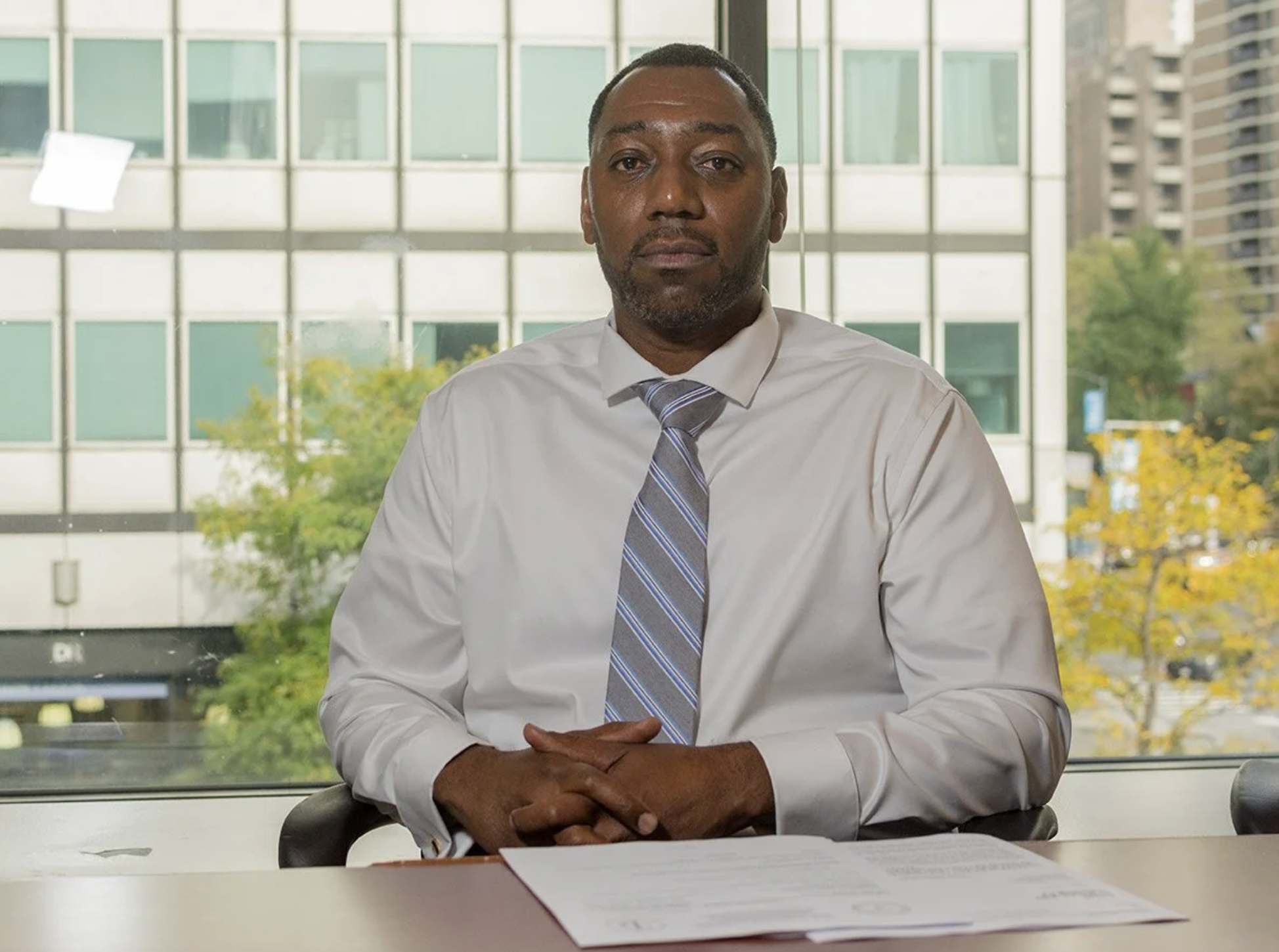
For the second time in his life, Michael Robinson faced a jury who had been told that he murdered his estranged wife in a Bayside home in 1993. Photo via The Legal Aid Society
By Jacob Kaye
After serving 26 years in prison for a murder he says he didn’t commit, Michael Robinson was back in a Queens courtroom Thursday, facing a retrial around half a decade after new DNA evidence unraveled his original conviction.
For the second time in his life, Robinson faced a Queens jury tasked with deciding whether or not he killed Gwendolyn Samuels, his estranged wife, by stabbing her to death inside a Bayside home in January 1993.
The Queens district attorney’s office decided to retry Robinson in 2023, several months after a group of appeals judges overturned the Queens man’s 1994 murder conviction, ruling that had newly discovered DNA evidence found beneath the victim’s fingernails that didn’t belong to Robinson been shared with the jury, the outcome of the original trial may have been different.
It’s taken nearly three years since Queens District Attorney Melinda Katz decided to continue prosecuting Robinson for the case to actually make it to trial.
Beyond the extensive work needed to prepare to litigate a more than 30-year-old murder, Robinson’s attorneys with the Legal Aid Society and prosecutors in the DA’s office spent years sparring over pre-trial motions and managing scheduling conflicts.
Delays haunted the case until the eve of the trial.
The night before the trial was scheduled to begin, a juror told Queens Supreme Court Administrative Judge Michelle Johnson, who has overseen the case for the past several years, that the case was weighing on them. The thought of participating in the trial had left the juror nauseous and unable to sleep. Johnson dismissed the juror and was forced to delay the trial by an additional day.
The judge almost appeared surprised on Thursday when both the DA’s office and Robinson’s defense attorneys said they were ready to begin.
“We are actually ready to start,” Johnson said with a slight laugh. “I think we can call the jury in. Let’s call the jury in.”
While the major details of the case have not changed, there will be several significant differences between the trial currently unfolding in Queens Criminal Court and the one that took place in the same building around three decades earlier, which ended with a guilty verdict and a lengthy prison sentence, which Robinson has long since completed.
To start, nearly all of the witnesses who testified during the first trial have since died, including the sole eyewitness to the killing, a then-88-year-old legally blind woman named Elvina Marchon who employed Samuels as an aide and whose house served as the scene of the crime.
As such, much of the prosecution’s witness testimony will be read from transcripts from the 1994 trial, spoken aloud by a member of the DA’s office.
While the jury is aware the murder has been litigated before, they are unaware to what extent. Johnson instructed both prosecutors and the defense only to refer to a prior “court proceeding” when talking about the first trial. Both sides are also barred from mentioning the fact that Robinson’s original conviction was overturned.
There’s also new DNA evidence that will be presented by Robinson’s defense attorneys that wasn’t available at the time of his first trial.
Robinson discovered the evidence around a decade ago after submitting a government records request while still serving his sentence. Though it took several years to physically track down the box of evidence – the DA’s office appeared to have misplaced it – and another year to test it, the evidence eventually revealed that a small amount of DNA found on clippings of Samuels’ fingernails did not belong to Robinson. The DNA also didn’t belong to Jermaine Robinson, a man not related to Robinson, who Samuels was dating at the time and who was expecting a baby with the victim before she was slain. While Robinson claimed at his first trial that it was in fact Jermaine Robinson who had committed the killing, prosecutors said Robinson stabbed Samuels after learning she was pregnant.
The trial will also likely feature new evidence about Marchon’s eyesight.
During the original trial, Marchon admitted that she’d had some difficulty with her vision – by the time of the trial, she was legally blind – but said that her eyesight was good enough at the time of the murder to identify the killer, she claimed. It was the same man who used to come to pick up her employee at the end of the work day and who once painted her house.
But new evidence uncovered in 2024 showed that doctors documented Marchon’s “long history of double vision” five months before the murder.
Marchon’s previously documented issues with her eyesight were never presented at trial, despite the fact that they allegedly contradicted the testimony she gave from the witness stand.
But much about the two trials will also be similar.
Prosecutors still believe that Robinson went over to Marchon’s two-story, two-bedroom home on a cold January Monday in 1993. Once he arrived, he allegedly sat briefly with Marchon before joining Samuels on a trip to the grocery store. When the pair returned, prosecutors claim that Robinson followed Samuels upstairs and stabbed her multiple times in the back and then slit her throat before turning the knife on Marchon and fleeing the house.
“He was the only person with the means, motive and opportunity,” Assistant District Attorney Nicole Rella said on Thursday.
And Robinson’s claim that he’s innocent is unchanged.
It’s a case of mistaken identity, Robinson’s attorneys said. With the only thing tying him to the scene being the testimony of a visually impaired elderly woman, Robinson has claimed Marchon mistook him for the killer.
“This is not just a case of a tragic death, it's also a story about an innocent man who is being accused of a crime he didn’t commit,” one of Robinson’s attorneys said on Thursday.
Also unchanged is the weight and gruesome nature of the murder.
Several members of Samuels’ family grew visibly emotional this week as prosecutors described in detail Samuels’ stab wounds.
When Rella told the jury that the final cut came when the killer dragged the knife across Samuels’ neck, one of the victim’s family members got up and left the courtroom in tears.
What remains to be seen is whether or not the jury’s verdict differs from the one rendered by a Queens jury 33 years ago.
Regardless of the verdict, Robinson faces no prison time, having already completed his sentence.
Robinson’s trial is expected to continue through mid-June.