Sentencing reform bill backed by top judge begins to advance through Senate
/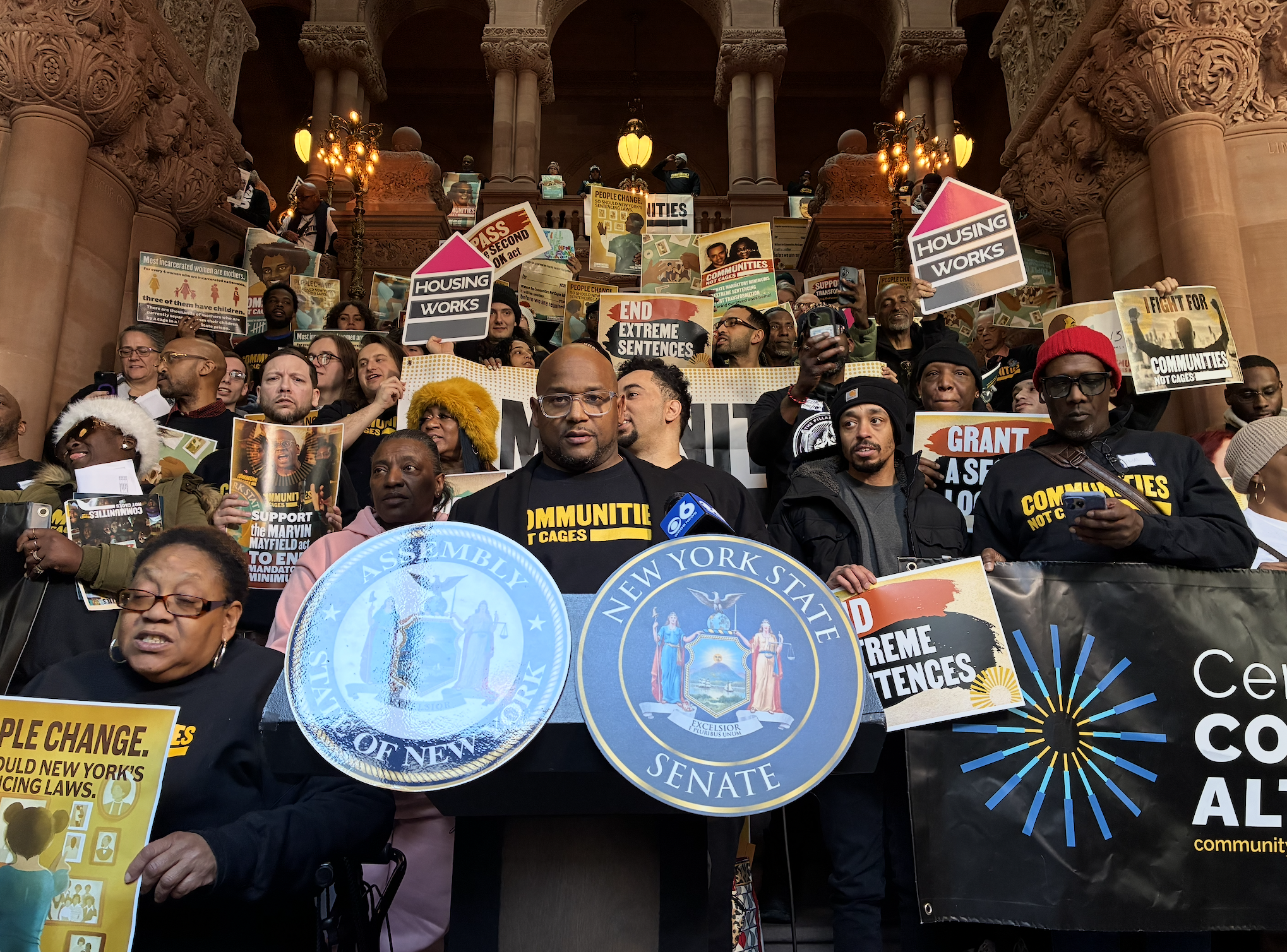
The Second Look Act was passed out of the Senate Codes Committee on Monday, the furthest the bill has ever gone following years of advocacy. Photo courtesy of the Center for Community Alternatives
By Noah Powelson
A bill that would create a formal process for long-time incarcerated individuals to get a judge to reconsider their sentence was passed by a key Senate committee last month, creating the first real opportunity in years for the bill to become law.
The Second Look Act was recently passed by the Senate Codes Committee, the farthest the bill has ever gone since first being introduced in 2022. The bill would allow incarcerated people who have been imprisoned for a decade or more to request a judge consider reducing their sentence. If it eventually makes its way into law, the bill would offer a lifeline to those who were incarcerated when the state required massive minimum sentences for nonviolent offenses and have sat behind bars for decades since, according to its supporters.
Among them is Chief Judge Rowan Wilson, who has called for the bill’s passage a number of times in recent years and dedicated his entire 2025 State of the Judiciary speech to showing the state’s judges why he thought the bill was necessary.
The bill now goes to the Senate Crime Victims, Crime and Correction Committee, which the bill’s primary sponsor, Queens Senator Julia Salazar, chairs.
"I'm thrilled to see the Second Look Act advance forward, because too many New Yorkers are unnecessarily languishing behind bars for decades on end. This is despite the fact that we know keeping people in prison for so long does nothing to reduce or deter crime,” Salazar said in a statement to the Eagle. “By passing the Second Look Act, we’d be allowing judges to reassess excessively harsh or unfair sentences given to incarcerated individuals. It’s not a guarantee of release, it’s a second look at what are often unjust circumstances."
The vote drew praise from prison advocacy groups, including the Center for Community Alternatives, who said the bill would create a fair and careful process for incarcerated people who have made the effort to reform themselves in prison.
“Today’s vote is a powerful step toward justice, safety, and second chances in New York,” Thomas Gant, community organizer for CCA, said in a statement. “By passing the Second Look Act out of the Senate Codes Committee, lawmakers affirmed what families, advocates, judges, and directly impacted people know to be true: people can and do change.”
Salazar’s office did not say when the bill might be brought forward for another committee vote.
The Second Look Act was first introduced in 2022, and has seen a steady increase in momentum each year since. While the bill saw more co-sponsors sign on each legislative session, it was never able to get out of the Codes Committee until now.
Currently, the bill has 61 Assembly co-sponsors and 30 Senate co-sponsors, including Queens State Senators Leroy Comrie, Michael Gianaris, John Liu, Jessica Ramos, James Sanders Jr., Toby Ann Stavisky and Kristen Gonzalez.
"The Second Look Act recognizes that people are more than the worst thing they’ve ever done,” Gonzalez told the Eagle in a statement. “Our criminal legal system is historically racist, and we must recenter it on accountability and rehabilitation. This bill would give thousands of New Yorkers the opportunity to have their excessive sentences reconsidered. To build a dignified New York, we must pass legislation that puts people first.”
Liu, who first signed on as a co-sponsor in 2025, said the bill moving forward was a “significant step” to addressing the state’s criminal justice issues.
“Allowing courts to take a careful, individualized look at convictions with lengthy prison sentences will help determine whether continued incarceration truly serves the interests of justice and public safety,” Liu said in a statement.
Comrie also applauded the committee’s decision to move the bill forward.
“The measure of justice is not how long we punish, but whether we leave room for redemption and rehabilitation,” Comrie said in a statement. “These bills recognize that people can change and that a stronger New York is built through accountability, opportunity and second chances."
The bill gained an especially influential supporter in Wilson when he took the helm as the state’s leading judge in 2023. Since his appointment, Wilson has actively called on legislators to pass the Second Look Act, going so far as to say the state’s criminal justice system “just isn’t working.”
The chief judge devoted the entirety of his 2025 State of the Judiciary Address to the Second Look Act, bringing in currently incarcerated people serving upwards of 65-year sentences to tell their stories. He has also encouraged lower court judges to steer away from lengthy sentencing practices, especially for those dealing with defendants facing mental health or substance abuse issues.
Wilson even went so far as to call the state’s sentencing laws “stupid,” and told New Yorkers at a public symposium that they can support Wilson and the Second Look Act by not voting for judges who have had their sentences overturned for being overly lengthy.
“This has mattered to me in some form or another since the 10th grade,” Wilson said in a public symposium in December 2025. “Everybody here can do something and needs to do something.”
Wilson’s advocacy for the piece of legislation is unorthodox for a judge, especially for the leader of the Court of Appeals, and has earned him the scrutiny of lawmakers who said he’d gone too far.
Last March, a group of Republican state lawmakers filed a formal ethics complaint with the Commission on Judicial Conduct against Wilson for the comments he made about the Second Look Act. The coalition, headed by the ranking member of the Senate Judiciary Committee, Anthony Palumbo, said Wilson crossed an ethical line in his advocacy.
“[Judges] must project that image of neutrality and not suggest that they lean one way or another, whether for a particular party or not, because that is the nature of the beast,” Palumbo said at the time. “And if you can't do that, you should be a legislator and not a judge.”
Al Baker, a spokesperson for the Office of Court Administration, defended Wilson’s comments at the time, and said that the chief judge acted well within his bounds as the state’s court leader.
“It is also appropriate for him to speak publicly about proper judicial temperament and values, and to encourage New Yorkers to stay informed about the conduct of the judges serving their communities and to participate in the processes by which those judges are elected or appointed,” Baker said in March.
The commission does not comment on whether complaints are elevated to full investigations unless the investigation results in a finding.
In response to the bill moving forward, Baker affirmed the Second Look Act continues to have the support of UCS leadership.
“The UCS firmly supports the passage of second look legislation, which would allow those serving long prison sentences to prove to a court through evidence, in an adversarial proceeding, that their continued incarceration is no longer justified,” Baker said in a statement. “Second look legislation does not seek to erase or ignore the criminal actions of incarcerated individuals or the harm they did to victims, but allows them to be reevaluated, after a sufficiently long period of incarceration and based on the actions that they have taken since their sentence, to determine whether society has a continuing interest in keeping them in prison.”