Court-appointed manager to take over troubled Rikers misconduct investigations
/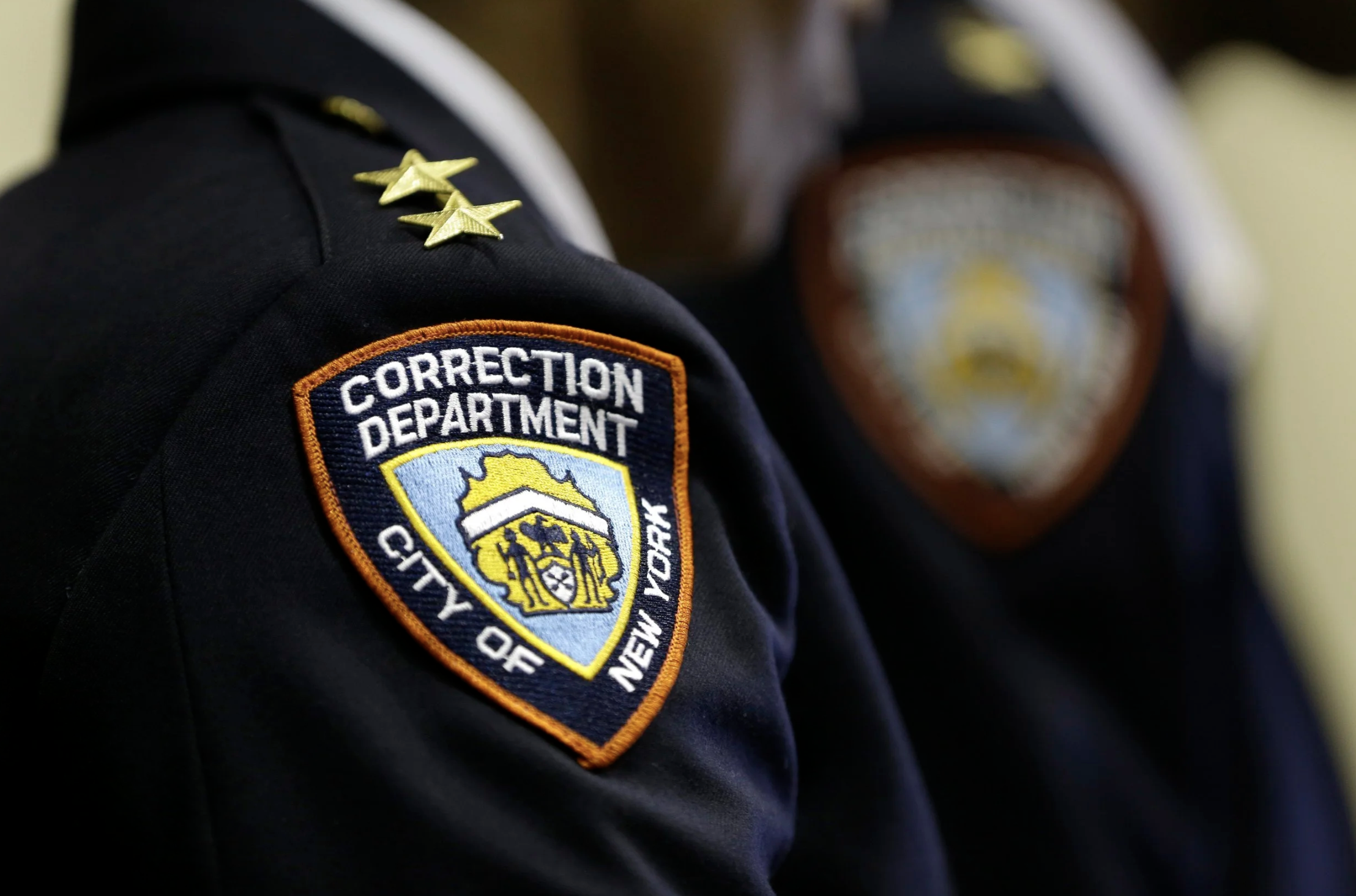
Correctional officers on Rikers Island who commit alleged abuses will now be investigated by a new unit that falls under the direct authority of the remediation manager, Nicholas Deml. AP file photo by Seth Wenig
By Jacob Kaye
Investigations into alleged abuses by Rikers Island officers will no longer be handled by the Department of Correction, according to a new organizational structure that puts a court-appointed remediation manager in charge of probing misconduct inside the jails.
According to a new court filing first reported by the Eagle, Nicholas Deml, the remediation manager who was granted sweeping authority over the jail system by a federal judge earlier this year, will have final say over a new investigations division on Rikers Island. The new unit will inherit the largest use of force investigation caseload in the country.
The unit will probe both alleged staff abuse and gang activity in the jails, and will recommend whether officers or detainees should face discipline. Final disciplinary decisions, however, will be made jointly by Deml and DOC Commissioner Stanley Richards, who has characterized his work with the remediation manager as a “partnership.”
Indeed, the collaborative relationship between the two officials was detailed in a new organizational chart Deml sent to federal Judge Laura Swain last week, the first publicly documented communication between the remediation manager and the judge since Deml officially took office in February. Deml and Richards are listed atop the chart, on equal footing, despite the fact that Deml only has to answer to the judge.
The new investigation unit, which will be led by a yet-to-be-appointed senior deputy commissioner, is the biggest change from the current structure of the DOC detailed in the organizational chart.
The new approach to staff accountability is an attempt to address the abuses at the heart of the civil rights case known as Nunez v. the City of New York.
In 2024, Swain ruled that the city was in violation of 18 provisions of a decade-old consent judgment in the case, including several related to the DOC’s inconsistent use of force investigations and its inability to hold staff accountable.
While the DOC has at times come into partial compliance with staff investigations and accountability provisions, it has often quickly reverted to non-compliance after periods of improvement.
Swain said in her 2024 ruling that the DOC’s Investigation Division “still cannot consistently identify misconduct when it occurs” and that “consequently, some DOC staff are not held accountable for misconduct, and corrective action is not always applied.”
The new investigative unit will absorb a number of existing DOC units, including its Special Investigations Unit, which leads staff investigations; the Correctional Intelligence Bureau, which investigates detainee gang activity; Adjudications, which determines discipline for detainees; Trials and Litigation, which conducts staff accountability; and Command Discipline, which conducts informal staff discipline.
The DOC commissioner will have no authority over the unit, according to the organizational chart.
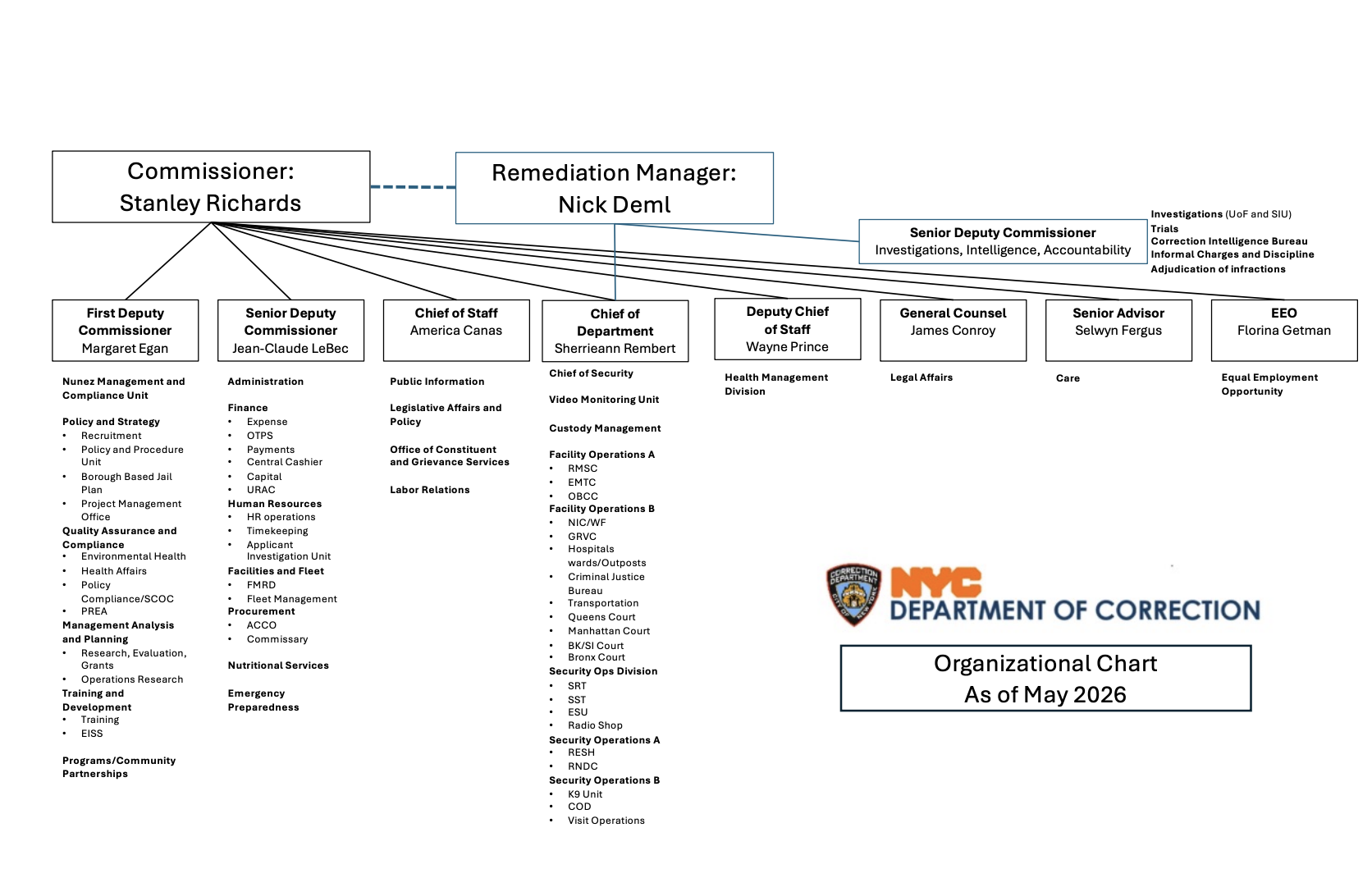
Chart via Court filing
The quality of the DOC’s investigations into staff appeared to take a nose dive following former Mayor Eric Adams’ appointment of former Commissioner Louis Molina, according to Steve J. Martin, the federal monitor appointed by Swain to track conditions in the jails.
Martin said in an April 2023 report that a “disturbing trend” in the investigations unit began to show itself half a year after Molina took office.
“Beginning in summer 2022, a discernible deterioration in the quality of investigations conducted by ID was identified and there was evidence that ID was not consistently addressing or analyzing the available evidence and their conclusions did not appear to be objective,” the monitor said at the time.
According to Martin, a greater number of investigations were being closed without action, a significantly smaller number of cases were being referred for further investigation, and misconduct was being identified much less frequently than in the past.
He also said that staff at the unit “had been influenced or prompted, either overtly or implicitly, to adopt a more lenient approach when assessing cases and to change their practice in ways that compromised the quality of the investigations.”
While the DOC began to address the issues within the investigations unit, it still has not been able to come into full compliance with the consent judgment.
In the monitor’s most recent compliance report, which was issued in January, Martin said that while the investigation division had “emerged from the state of turmoil that began in 2022 and ended in spring 2024…addressing the damage from ID’s mismanagement will take time.”
According to the monitor, the DOC’s inability to consistently conduct rigorous investigations has contributed to its troubles with reining in use of force incidents and other claims of misconduct by staff.
Though the rate of use of force incidents has declined by 6 percent over the last year, it remains higher than it did before the pandemic, according to DOC data.
The monitor described a number of disturbing use of force incidents in his January report. Among them was an incident that unfolded in December 2025 when a group of correctional officers were walking a detainee back to his housing area on Rikers Island.
With the detainee’s hands cuffed behind his back and his feet in shackles, he fell to the floor and began convulsing. Thinking he was faking the episode, six officers told the man to get up, while a seventh officer walked into a janitor’s closet, away from the cameras in the hall.
Inside the closet, the officer covered the bottom of his boot in pepper spray, and then walked out and put his boot directly in front of the detainee’s face. When the man began to convulse again, an officer turned him on his side and moved him closer to the closet, putting his face directly next to an orange bootprint. After the man began to complain about the pepper spray on the floor, the officer bent the detainee’s wrists, causing him to scream in pain.
“Don’t resist, sir,” the officer said.
The incident was under investigation by the Investigation Division at the time of the report.
Benny Boscio, the president of the Correctional Officers Benevolent Association, said in a statement that the union “will have a strong voice advocating to protect the rights of our members…[r]egardless of how the new DOC organizational chart is structured.”
“It’s imperative that decision makers at all levels tap into our institutional knowledge, which can be harnessed to maximize our common goal of enhanced safety and security for everyone in our facilities,” he added.
The new investigation unit was not the only change to the DOC’s structure created in the new organizational chart.
The chief of department, the highest-ranking uniformed DOC officer, will now begin to report to both Deml and Richards – the commissioner will provide daily operational leadership to the chief of department, while the remediation manager will oversee officer deployment, the creation and implementation of operational reform efforts, and changes to operational policy.
Top deputies in the commissioner’s office will continue to report directly to Richards, who, alongside Deml, will have dual authority over the DOC’s finances, facilities, procurement practices, labor relations, legal matters and more.