Judge rejects attempt to dismiss case against Queens man shot by cop during mental health crisis
/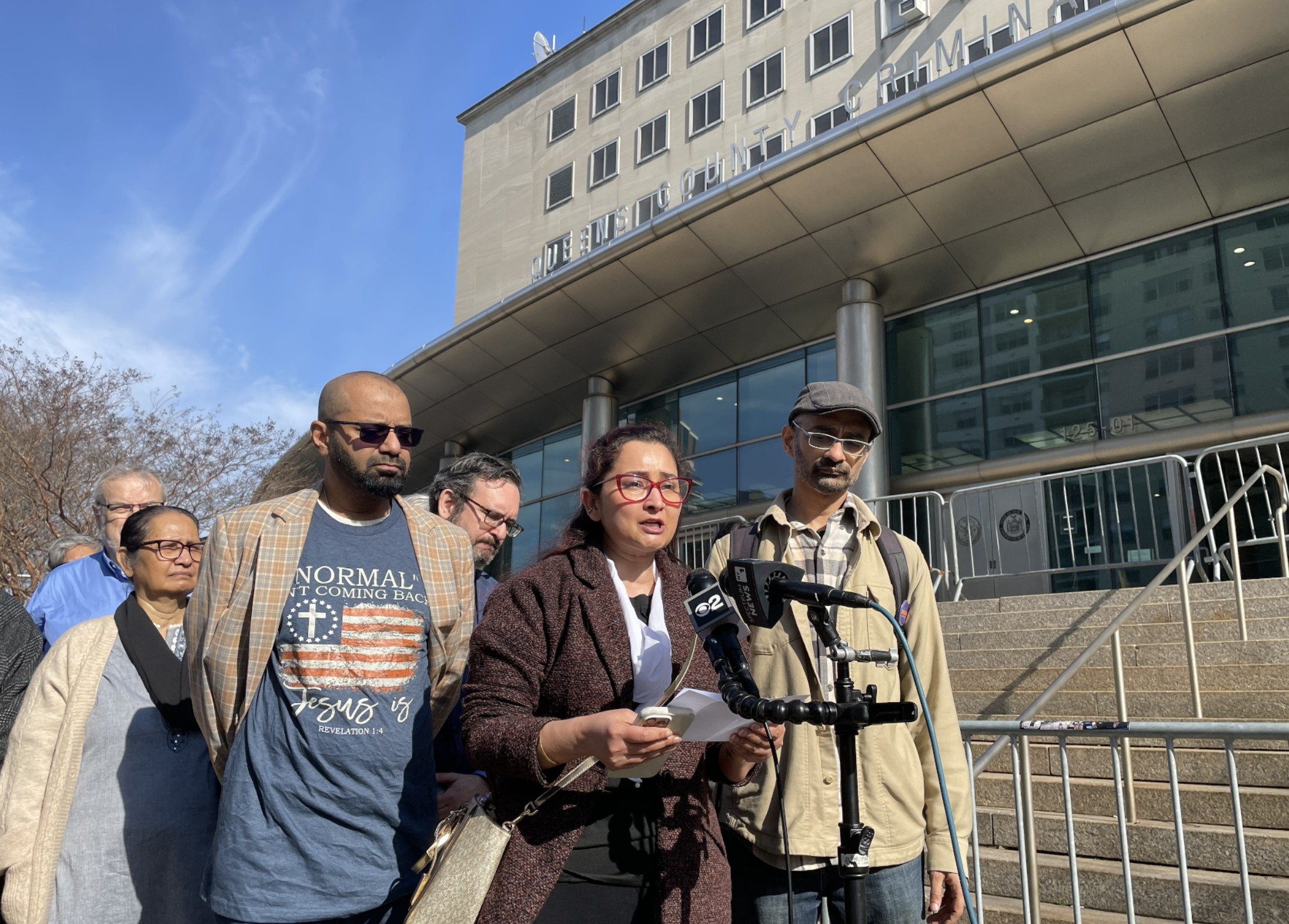
Jabez Chakraborty’s family outside of Queens Criminal Court. The case against the 23-year-old Briarwood man will continue after a judge rejected a motion to dismiss the charges on Wednesday, April 1. Eagle file photo by Jacob Kaye
By Jacob Kaye
A Queens judge this week refused to throw out charges against Jabez Chakraborty, a 23-year-old shot by police while in the throes of a mental health crisis in January, ruling that prosecutors did not violate his rights by indicting him while he was shackled to a hospital bed recovering from his gunshot wounds.
Queens Supreme Court Justice Leigh Cheng on Wednesday rejected a motion to dismiss the case from Chakraborty’s defense attorneys, who argued that prosecutors failed both to arraign Chakraborty quickly and to “advise any of the attorneys who reached out on his behalf about the grand jury presentation.”
With the motion quashed, the Queens district attorney’s controversial prosecution of Chakraborty, who remains hospitalized more than two months after the shooting, will continue.
The ruling was a disappointment to Chakraborty’s family and supporters, who filled nearly half of the Queens courtroom where the case was heard on Wednesday.
“Why is the Queens DA choosing to continue to pursue a case against my son while he is healing mentally and physically?” Chakraborty’s mother, Juli Chakraborty, said outside Queens Criminal Court. “Why do we have to be here when I could be there with my son recovering?”
In a statement, the Legal Aid Society, which is representing Chakraborty, said they “disagree with the ruling but remain committed to providing Mr. Chakraborty with a zealous and unwavering defense.”
A spokesperson for Queens District Attorney Melinda Katz referred the Eagle to a February statement from the DA when asked for comment on Wednesday’s ruling.
“As prosecutors, we are duty-bound to follow the facts, evidence and circumstances where they lead us, including in cases that have a mental health component,” Katz said after indicting Chakraborty. “These decisions, however, must be thoughtful, deliberative and based on the expertise of mental health professionals. Dispositions can take vastly different forms, and I will use the resources of my office to address the unique needs in this case while upholding my responsibility to keep this borough safe.”
Chakraborty’s case has drawn citywide attention since it began in late January.
The Briarwood family called 911 hoping medics would come to their home and involuntarily transport the 23-year-old to a hospital on Jan. 25. The family told a 911 operator that Chakraborty, who was diagnosed with schizophrenia three years ago, was throwing glasses against a wall.
Instead, two police officers showed up to the home, including officer Tyree White, who was the first to walk through the door and into the living room.
Almost immediately, Chakraborty, who was standing in the kitchen, grabbed a knife and began to move toward White, body-worn camera footage of the incident shows.
White demanded the 23-year-old drop the knife but was ignored. The officer shot Chakraborty four times.
The family, who said they had struggled to connect Chakraborty with mental health treatment in the weeks leading up to the shooting, claim they were taken to the local precinct and kept for hours without being told whether or not Chakraborty was alive.
Chakraborty was shackled to a hospital bed for over a week as he was treated for his gunshot wounds.
His case brought renewed attention to the city’s mental health crisis, and Mayor Zohran Mamdani’s pledge to largely take the police out of the city’s response to those in the throes of an episode.
Though Mamdani called on Katz not to bring charges against the Briarwood man, the DA charged Chakraborty with attempted assault and criminal possession of a weapon on Feb. 13, nearly three weeks after the incident.
Chakraborty, who appeared at his arraignment virtually from Jamaica Hospital, cried multiple times throughout the proceeding as his lawyers entered a not guilty plea.
Queens Supreme Court Justice Jessica Earle-Gargan, who presides over the Queens Mental Health Court and who was the first to hear the case, said the case was an “extremely difficult” one given Chakraborty’s mental health struggles.
“The mental health system in this state has failed many,” the judge said at the February arraignment.
Chakraborty’s family said on Wednesday that he had recently begun to receive mental health treatment at Jamaica Hospital, but that the hospital doesn’t offer as robust a treatment plan as is needed.
More than 9 weeks after being shot, Chakraborty is still in need of another major surgery. Doctors will likely leave one bullet inside his body because it sits too close to his heart, the family said.
Chakraborty will next appear in court on May 13.