
Rikers Island still mired in violence as receivership looms
/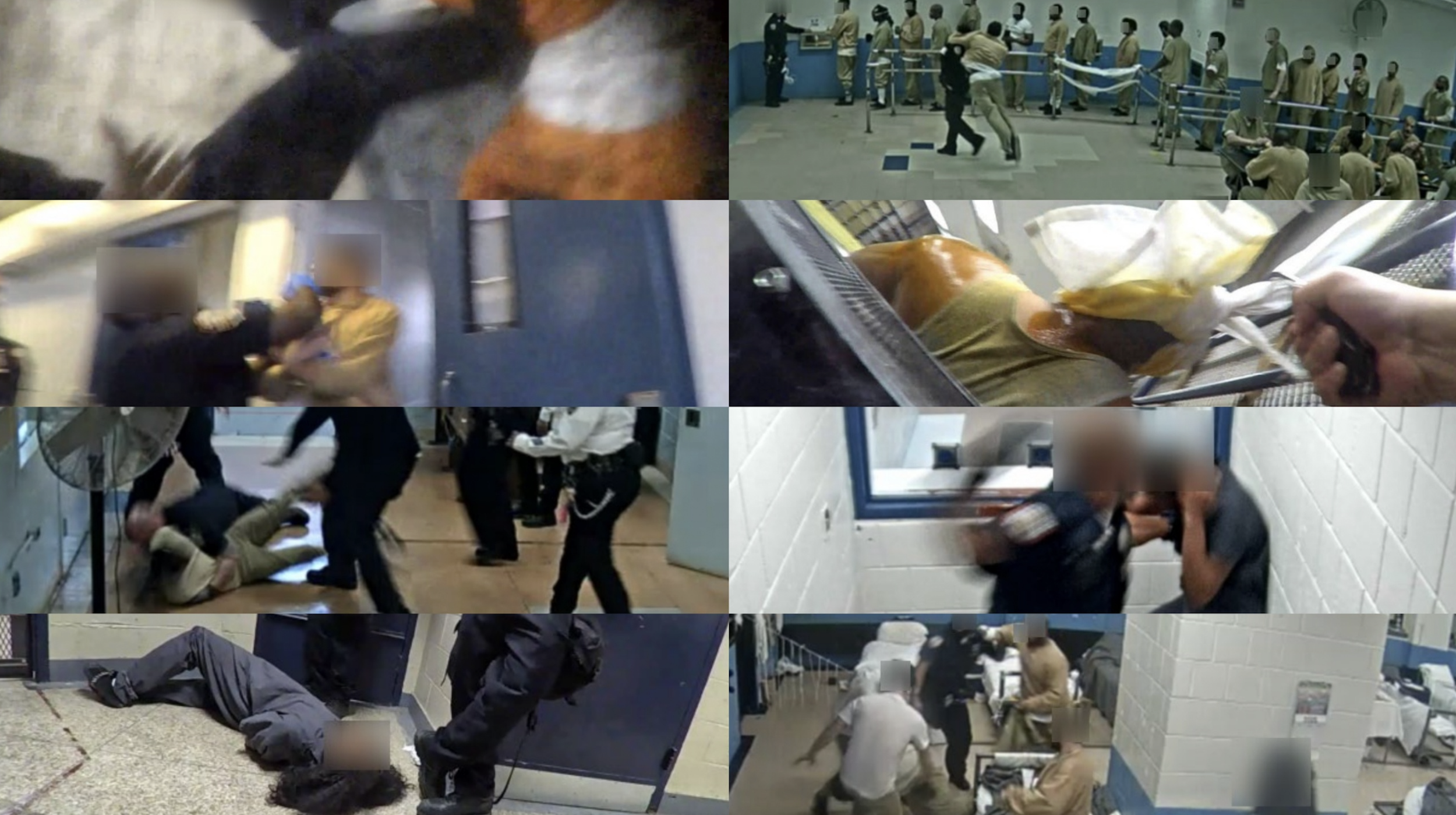
Incidents of violence on Rikers Island remained high during the first half of 2025, according to a new report from the federal monitor. Screenshots via nunez monitor report
By Jacob Kaye
Last month, a group of correctional officers were walking a detainee back to his housing area on Rikers Island when, with his hands cuffed behind his back and his feet in shackles, he fell to the floor and began convulsing.
Thinking he was faking the episode, six officers told the man to get up, while a seventh officer walked into a janitor’s closet, away from the cameras in the hall.
Inside the closet, the officer covered the bottom of his boot in pepper spray, and then walked out and put his boot directly in front of the detainee’s face. When the man began to convulse again, an officer turned him on his side and moved him closer to the closet, putting his face directly next to an orange bootprint.
When the man began to complain about the pepper spray on the floor, the officer bent the detainee’s wrists, causing him to scream in pain.
“Don’t resist, sir,” the officer said.
The December 2025 incident, which is currently under investigation, was one of over a dozen troubling scenes documented in the latest report from the federal monitor, who is tasked by a judge to track conditions on Rikers Island.
The long-anticipated report, which was filed in court on Tuesday evening, claims that even though the Department of Correction has made some improvements to the way it manages the jail complex on Rikers in the past year, deeply rooted dysfunction and a penchant for fighting reform have left the city’s jails as dangerous and deadly as they were a decade ago, when the monitor first began their work.
“The reform effort continues to progress at a glacial pace,” the monitor, Steve J. Martin, wrote in the report, which primarily covers conditions in the jails during the first half of 2025. “Internal and external obstacles, pervasive poor practices, and an entrenched culture that opposes and/or resists reform continue to hobble the Department’s ability to materially improve the jails’ conditions with the necessary level of urgency.”
The rate at which officers use force against detainees – the issue at the heart of the ongoing civil rights case known as Nunez v. the City of New York – remained higher in the first half of 2025 than it was when the consent judgment in the case was first settled in 2016, as did the rate of slashings and stabbings.
And deaths reached a three-year high last year when 15 people died while in DOC custody, the most since 2022, when 19 people died. According to the monitor, “poor operational and security practices were identified, including [detainee] access to illicit substances, inadequate supervision, and lapses in security and the provision of medical care” in at least a dozen of the 15 deaths.
The report comes at an extremely uncertain time for the city’s jails.
Federal Judge Laura Swain, to whom the monitor reports, has for months been considering applicants to serve as Rikers’ “remedial manager,” a third-party authority who will be given the power to assume significant control over the jails once they are appointed, supplanting the power of both the Department of Correction commissioner and mayor in many cases.
It’s also an uncertain time for the DOC.
Mayor Zohran Mamdani, who took office at the start of January, has yet to name a commissioner to run the agency.
Lynelle Maginley-Liddie, who was appointed to serve as DOC commissioner by former Mayor Eric Adams in December 2023, has remained in charge but in an interim capacity.

DOC Interim Commissioner Lynelle Maginley-LIddie. Photo via DOC/X
And while both Swain and the monitor have praised Maginley-Liddie in the past for her alleged commitment to reform, that support appears to be waning.
As conditions have worsened and efforts to reform the jails have stalled, the monitor said the commissioner and her top deputies have revived a “disturbing pattern” by attempting to “limit transparency and candor” with the monitoring team, the report said.
In an incident during the summer, DOC leadership reportedly got frustrated that agency staffers were speaking anonymously with the monitor, as they are allowed to do. In response, top officials interviewed staff to ask if they had spoken with the monitoring team and searched staff emails to identify the person who shared the information that it appeared the DOC “did not want the monitoring team to have.”
The mayor’s office did not respond to a request for comment regarding the summer incident detailed in the report, nor did it respond to a request for a comment on the general findings of the report.
‘Turn the f–k around’
Much of the violence on Rikers can be traced back to the DOC’s inability to improve security practices in the jails, the monitor said.
Cell doors are regularly left open, and officers frequently abandon their posts and keep incomplete logbooks. What’s left are the conditions for a chaotic environment, which officers often respond to with unnecessary force, according to the report.
“The monitoring team has reported on the deficiencies in basic security practices for years,” the report read. “Unfortunately, little to no progress has been made in improving security practices within the department.”
The monitor said that often “staff engage in hyper-confrontational, argumentative behavior and have an overall demeanor that often escalates situations rather than using appropriate de-escalation tactics to diffuse the situation.”
In some cases, officers threaten detainees or use profanity or racial epithets when attempting to control them.
The monitor said that in June 2025, officers went into a cell where a man had tied one end of a shirt around a cell window and the other around his neck. When an officer opened the door, the man untied the shirt and threw it at the officer.
The officer immediately punched the detainee, who turned his back to the guard in a defensive position. Several other officers then joined in the beating. Multiple staff members told the detainee to “turn the f–k around,” according to body-worn camera footage of the incident.
A supervisor who was present throughout the incident, repeatedly told officers to avoid hitting the man in the face, but did not comment on any other ways in which they were using their force.
The man suffered injuries to his torso, ribs, arms and scalp. Medical staff on Rikers noted in their records that he was not immediately taken to the medic after the incident. No staff injuries were reported.
The supervisor and all officers involved in the beating were suspended.
A similar incident unfolded in May 2025 when a man in the George R. Vierno Center prepared to hang himself in clear view of multiple officers.
The man tied a sheet around his neck, climbed onto a TV mount in an open housing area and tied the sheet to a railing “while staff failed to intervene with any sense of urgency.”
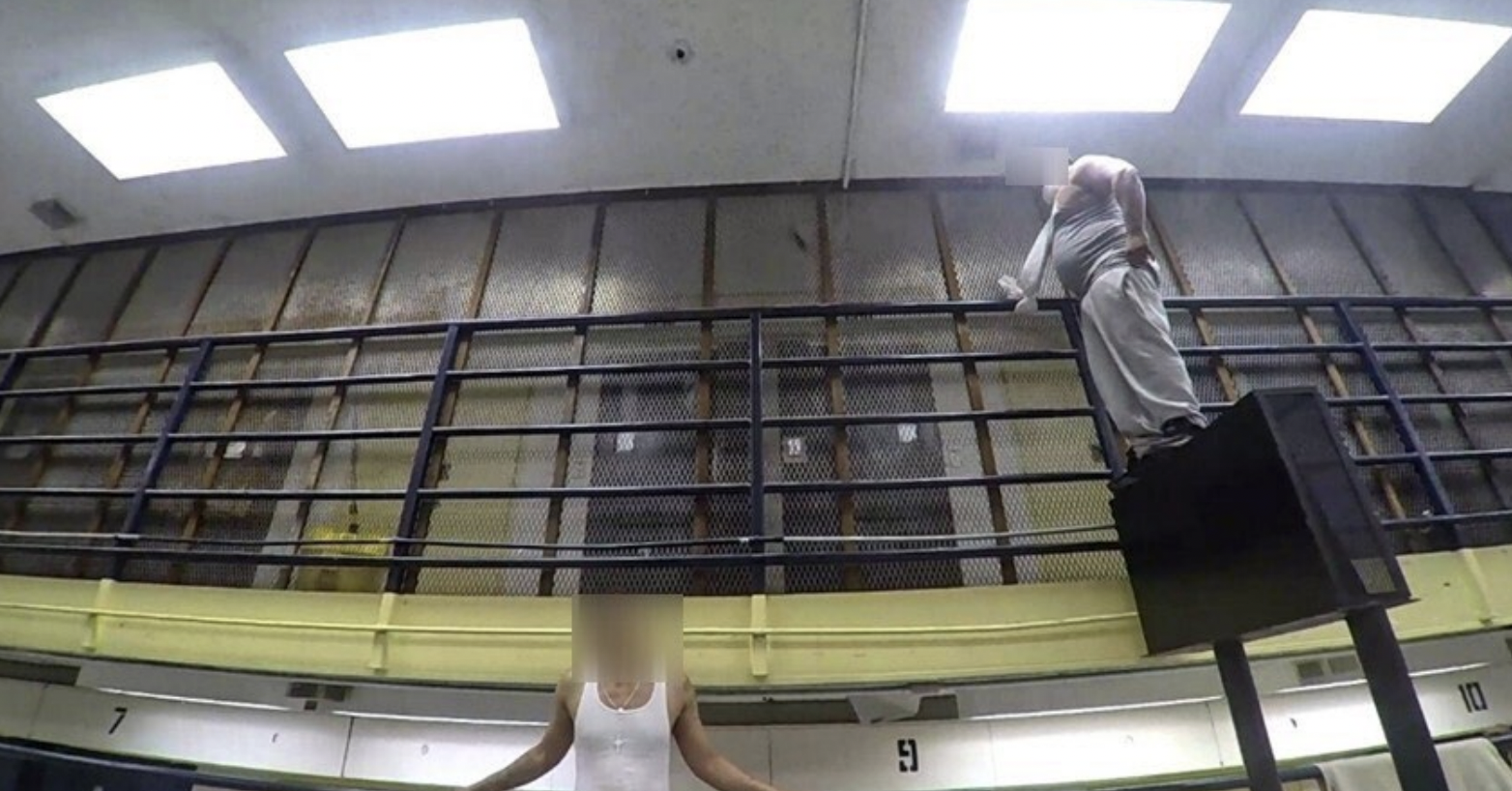
Officers failed to act with any sense of urgency when a detainee tied a sheet around his neck and prepared to hang himself from a TV mount on Rikers Island in May 2025. Photo via Nunez monitor
Rather than immediately cutting the sheet, an officer sprayed the man with pepper spray as he was hanging from the TV mount.
After eventually being cut down, the man fell to the ground and began convulsing, the report said.
That’s when a captain was caught on a body-worn camera yelling at another officer to “bring that dumbass outside.”
When the man began coughing because of the pepper spray, the captain instructed others not to get him any water.
As a result of the incident, the officer was ordered to go to counseling.
A receiver on the horizon
Tuesday’s report is likely to be the last from the monitor before Swain officially appoints a remediation manager to take over control of Rikers Island.
The judge has been interviewing a short list of candidates from the nearly 30 who applied to the position over the summer.
In December, she issued a ruling detailing the sweeping powers the remediation manager will have once they are appointed.
The remediation manager, who will work full time either from Rikers Island or within DOC headquarters, will have administrative, financial, contracting, legal, operational and other powers over the city’s jail system.
They’ll have the power to hire, train, promote, demote, transfer, investigate, evaluate and fire anyone currently working for the DOC except the commissioner. The receiver will also be granted “the authority to enact or change DOC policies, procedures, protocols, systems, and practices.”
Swain will also give the receiver “unlimited access to all records and files maintained by the DOC” and “unlimited access to all DOC facilities, persons in custody, and DOC staff.” They will also be allowed to confidentially interview staff and detainees.
The judge first began seriously considering ordering a receiver in November 2024, when she found the city in contempt of 18 provisions of the consent judgment in the Nunez case.
The Legal Aid Society and Emery Celli Brinckerhoff Abady Ward & Maazel LLP, which together represent detainees in the class action case, had called for the appointment of a receiver twice before, arguing that the DOC had continuously shown that it was unable to stem the violent conditions on Rikers.
Swain eventually agreed, and ordered the creation of a receiver in May 2025.
In a statement on Wednesday, the Legal Aid Society said the monitor’s latest report shows that their demands for the “prompt appointment of the remediation manager” were justified.
“Today’s report again confirms that the status quo at Rikers Island has failed,” the public defender firm said in a statement. “Despite multiple court orders, commissioners, city administrations, and reform plans, conditions in the city’s jails remain dangerous, and the city has not demonstrated an ability to deliver the basic safety and care to which people in custody are entitled.”
“This moment demands more than incremental change or recycled promises,” they added. “Extraordinary reform is required to finally bring accountability, stability, and meaningful improvement inside our jails.”