
Detainee’s death after allergic reaction pushes Rikers toll to 15 this year
/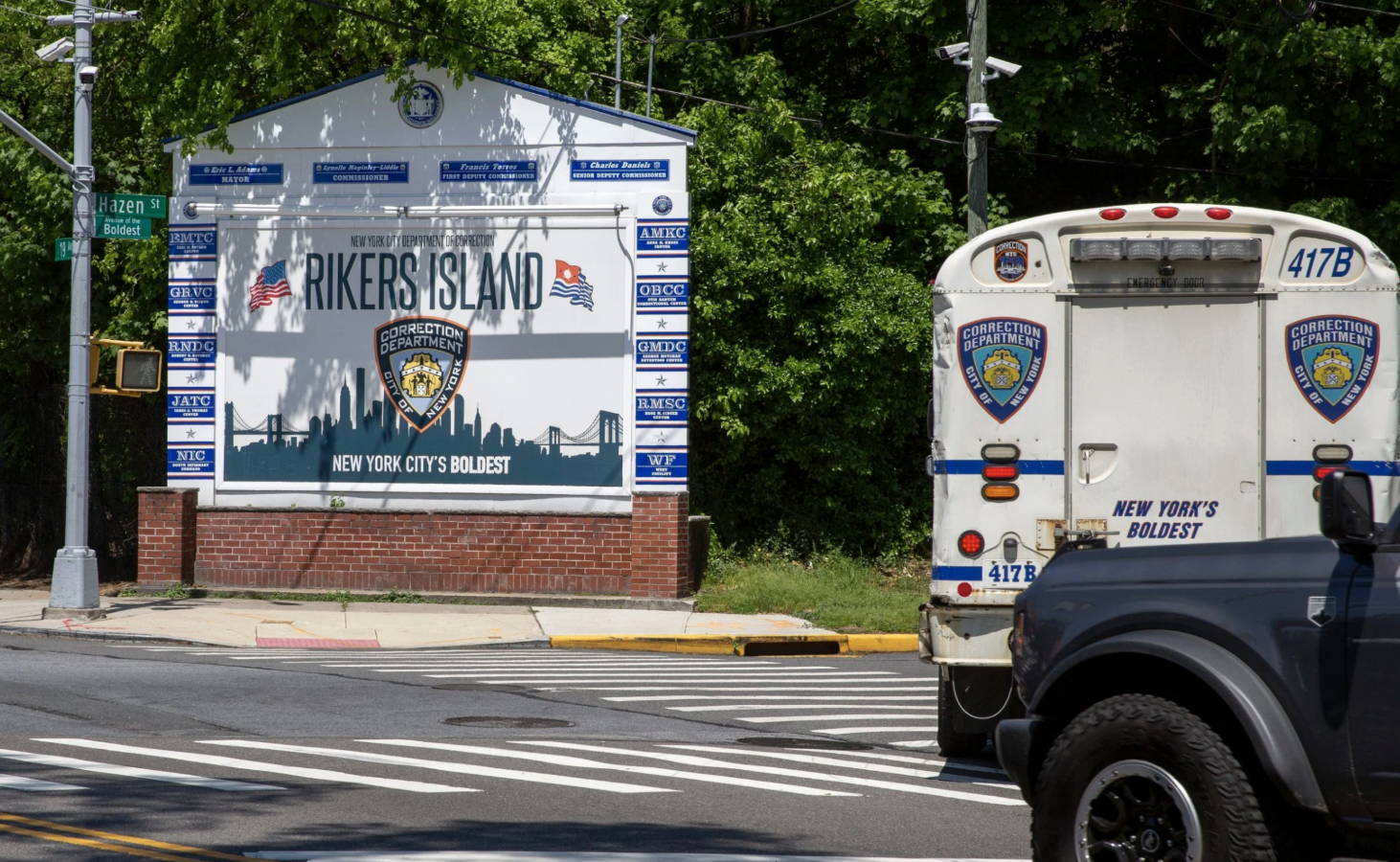
Kyron Randall became the 15th person to die in DOC custody in 2025 when he experienced an allergic reaction on Rikers Island on Sunday, according to the DOC. AP file photo by Ted Shaffrey
By Jacob Kaye
The death toll on Rikers Island continued to rise to its second-highest point in the past four years on Monday, when a 33-year-old detainee died after allegedly having an allergic reaction in the city’s jail complex.
Kyron Randall was pronounced dead at Elmhurst Hospital around 1 a.m. Monday morning, approximately 12 hours after he first began experiencing an allergic reaction at Rikers Islands’ George R. Vierno Center on Sunday, according to the Department of Correction.
The exact cause of his death has yet to be determined.
Randall is the 15th person to die in Department of Correction custody this year, the highest death toll seen in the city’s troubled jails since 2022, when 19 people died.
Randall was the second Rikers detainee to die in December, and the third to die in the last month. He is also the 48th person to die in DOC custody since Mayor Eric Adams first took office.
The 33-year-old had been held on Rikers Island for nearly a year and a half, having first been sent there in July 2024. He was facing murder charges after prosecutors in the Bronx alleged that he killed his 56-year-old neighbor after an argument broke out between the two. Randall had pleaded not guilty to the charges.
Randall’s attorney, Brian Sullivan, declined to comment on his client’s death.
A spokesperson for the Department of Correction said the agency reported Randall’s death to a number of agencies and watchdog groups for further investigation, including the Board of Correction, the state attorney general’s office, the city’s Department of Investigation, the State Commission of Correction, local district attorneys and the Office of the Chief Medical Examiner.
The agency also reported the death to Steve J. Martin, the longtime federal monitor tasked by United States District Court for the Southern District of New York Chief Judge Laura Swain to track conditions in the city’s notoriously dangerous jails.
“As we investigate this incident, we keep Mr. Randall’s loved ones in our prayers,” DOC Commissioner Lynelle Maginley-Liddie said in a statement. “This matter will be thoroughly investigated.”
The uptick in deaths comes at a pivotal moment for the city.
Days before Randall’s death, Swain issued a long-anticipated decision, outlining the expansive powers of the incoming “remediation manager,” a third-party official who will soon assume day-to-day control over much of the city’s jail system.
The order outlines a powerful position that would effectively displace the authority of both the mayor and the Department of Correction commissioner over the jails for the better part of the next decade.
The remediation manager, who will work full time either from Rikers Island or within DOC headquarters, will have administrative, financial, contracting, legal, operational and other powers over the city’s jail system. They’ll have the power to hire, train, promote, demote, transfer, investigate, evaluate and fire anyone currently working for the DOC except the commissioner. The receiver will also be granted “the authority to enact or change DOC policies, procedures, protocols, systems, and practices.”
Swain also gave the receiver “unlimited access to all records and files maintained by the DOC” and “unlimited access to all DOC facilities, persons in custody, and DOC staff.”
The Adams administration has been attempting to convince Swain for years that the appointment of a receiver was unnecessary, claiming that it had the ability to reduce violence in the jails on its own.
But the Legal Aid Society, which represents Rikers Island’s detainees in the ongoing civil rights case known as Nunez v. the City of New York, said the increase in deaths suggests otherwise.
“As deaths rise and conditions at Rikers continue to worsen, the city needs to use every alternative to incarceration and fully support real change in our broken jail system,” the public defense organization said in a statement on social media.
The rising death toll also comes as Mayor Eric Adams, who has fought against receivership and Rikers Island’s closure, is preparing to leave office.
Advocates have long been critical of Adams’ handling of Rikers, which was in a state of acute crisis when he first took office in 2022.
Deaths rose to a decade high during Adams’ first year in office as the population in the jails also began to rise to levels not seen in years. The mayor also took little action to advance the city toward the August 2027 deadline to close Rikers Island, which experts now say is an impossibility.
Darren Mack, the co-director of Freedom Agenda, said that Randall’s death on Monday was a result of Adams’ management of the jails.
“As we head into the holidays, another family is grieving, and thousands more are worried sick about their loved ones who are suffering at Rikers instead of celebrating with them,” Mack said. “But that is Mayor Adams' legacy – he took a place that was already creating such immense harm in our communities, and managed to make it even worse.”
“We know very clearly what we need from our incoming mayor – urgent action to stop sending people to this death camp, invest in real community safety, and finally get Rikers closed,” Mack added.
Mayor-elect Zohran Mamdani, who has expressed his general support for receivership, told the Eagle in February that he would make it his “mission” to “comply with the law, to close Rikers and to decarcerate our jail population.”
“That is something that the city has for years paid lip service to, while doing nothing to make it a reality,” Mamdani told the Eagle earlier this year. “We have not invested in alternatives to incarceration, our courts have taken that lack of investment as a cue to continue shuffling New Yorkers to Rikers, and dozens of people have died as a result.”
This story was updated at 2:43 p.m. on Monday, Dec. 22, 2025.