New Rikers leadership earns praise, but violence persists, report says
/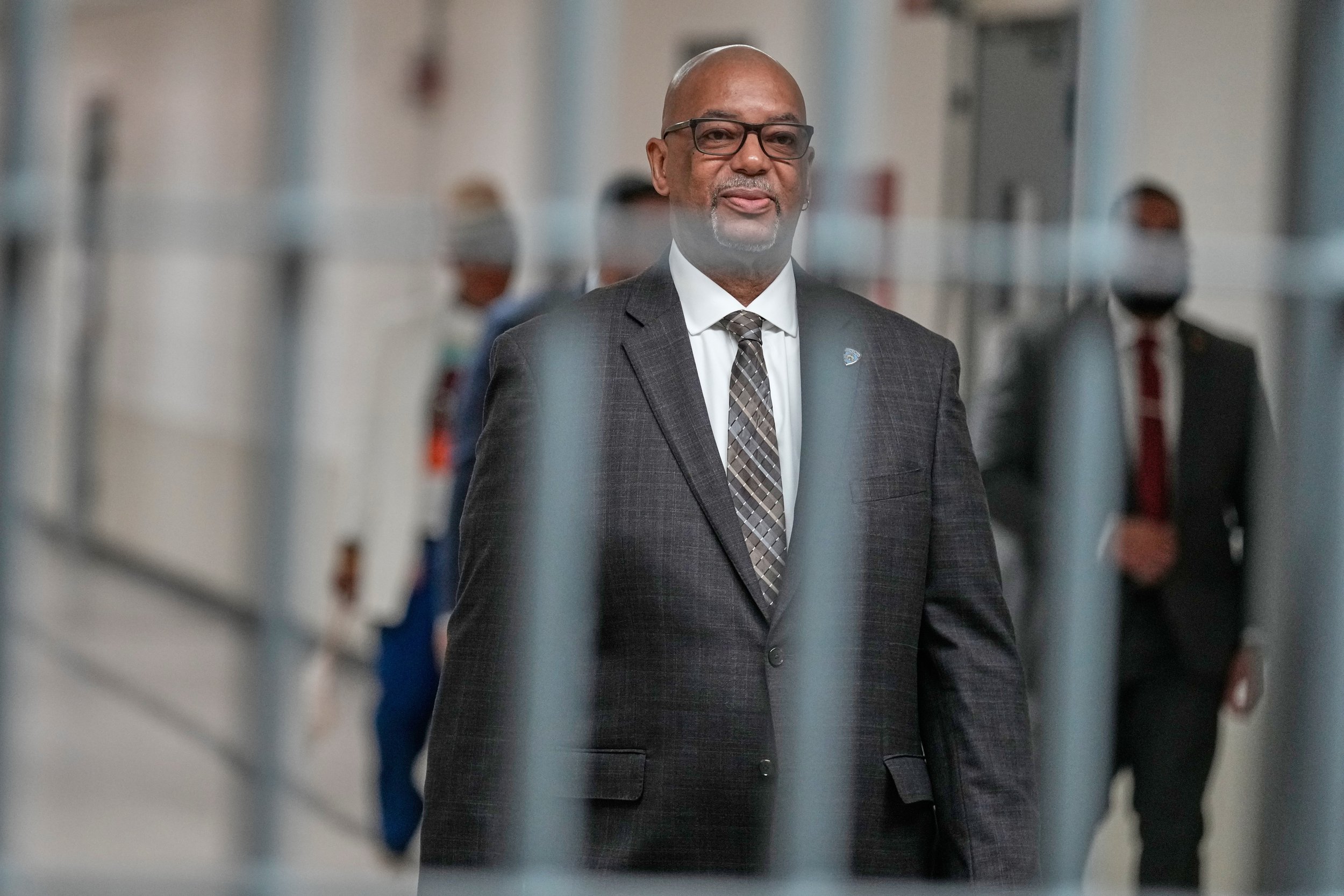
Federal monitor Steve J. Martin had early praise for Department of Correction Commissioner Stanley Richards (pictured here) but said in a new report that violence on Rikers Island remains persistent. AP file photo by Seth Wenig
By Jacob Kaye
While the federal monitor tasked with tracking conditions on Rikers Island appears optimistic about the leadership of the two new officials in charge of the city’s jails, violence in the troubled complex remains high, the monitor said in a new report.
In a biannual report filed in federal court last week, Steve J. Martin, the federal monitor in the ongoing detainee civil rights case known as Nunez v. the City of New York, praised the early work of new Department of Correction Commissioner Stanley Richards and remediation manager Nicholas Deml. But alongside Martin’s positive outlook, there was heavy concern about the continued violence that he has been documenting in the jails for over a decade.
“While the changes in the department's leadership structure are important to note, as of the filing of this report, there has been no material change in ameliorating the risk of harm in the jails and the reform effort continues to move at a glacial pace,” Martin said in the report.
“The risk of harm in the New York City jails remains unreasonably high for those incarcerated and working within the city jails,” he added.
Martin’s report, which details the city’s compliance with the dozens of court orders included in a 2015 consent judgment in the case, is the first issued since Deml and Richards assumed control over the jails. Richards, the first formerly incarcerated person to hold the commissioner’s position, was appointed to the job by Mayor Zohran Mamdani, while Deml was chosen for the new remediation manager job by federal Judge Laura Swain, who granted Deml significant power over the day-to-day operations of the DOC and its jails. Both took office in February.
While Martin’s report primarily focused on conditions in Rikers’ jails during the final six months of the Adams administration in 2025, it also included early observations about Richards and Deml.
Deml, who reports only to the judge and whose work is largely shielded from public view, has been assembling his team – he’s hired a chief of staff, three lawyers, four career correctional experts, a data analyst, and an administrative and operational professional. Earlier this year, the Eagle reported that the remediation manager and his staff are expected to cost the city $10 million for the first year of their work.
Deml has “worked closely” with the monitoring team during the first few months of the new arrangement, according to Martin.
The monitor said that the initial focus of Deml’s work “has been on meeting stakeholders, obtaining the necessary background and context underpinning the decade of work already accomplished in this case, and developing a strategy for addressing the work that lies ahead.”
But while Deml’s collaboration with the monitor appeared to be a given – both report to the same judge – the commissioner’s willingness to work with the monitor and remediation manager was not.
A number of commissioners over the past decade have clashed with the monitor and have made it difficult for the monitor’s team to conduct its work, according to Martin.
While Martin and Swain praised former DOC Commissioner Lynelle Maginley-Liddie after her appointment in December 2023, the relationship between the DOC and the monitor quickly eroded.
By Maginley-Liddie’s final months in office, the monitor had grown worried about how opaque the agency had become under her watch.
“During the…monitoring period, previous DOC leadership engaged in a variety of actions and steps in what appeared to be an attempt to limit the monitoring team’s access to information,” the report read. “The monitoring team reiterates its serious concerns about the actions taken by Department leadership throughout 2025 and reiterates the importance of transparency and collaboration.”
But the agency appears to be operating differently under Richards, Martin said.
“The monitoring team has observed a positive shift in the approach to working with the monitoring team upon the appointment of the new commissioner,” the report read.
Richards, a criminal justice reformer who spent the past several years leading The Fortune Society, has pledged to the City Council, the Board of Correction, and the public that he would lead a more transparent DOC.
He’s also promised to change the culture of the agency, which has been described by the monitor as a “deeply entrenched culture of dysfunction that has persisted across decades and many administrations.”
But Richards has said on multiple occasions that implementing a culture shift is analogous to turning a cruise ship – it’s not going to happen quickly.
Martin made a similar observation in his report last week.
“Despite years of work and multiple court orders, these problem centers, regrettably, remain present with little to no change observed as of the filing of this report,” he said. “The practical reality is that ameliorating these problem centers will take time and certainly will not occur from one reporting period to the next.”
As has been detailed in previous reports, Martin said the agency continues to struggle with finding well-trained staff and deploying them throughout the jails properly. Officers regularly leave housing areas unattended, which can lead to preventable violence, according to Martin.
Fifteen detainees died in DOC custody last year, a tally larger than the previous two years combined and the highest total since 2023. In many of the deaths, detainees were left alone without officers either conducting their rounds or working in the area where the detainees were housed.
The monitor also said officers continued to use force against detainees at high rates during the latest monitoring period, which ran from July to December 2025. The number of fights between detainees and stabbings and slashings also remained high during the reporting period.