Fight continues to fund Far Rock trauma hospital
/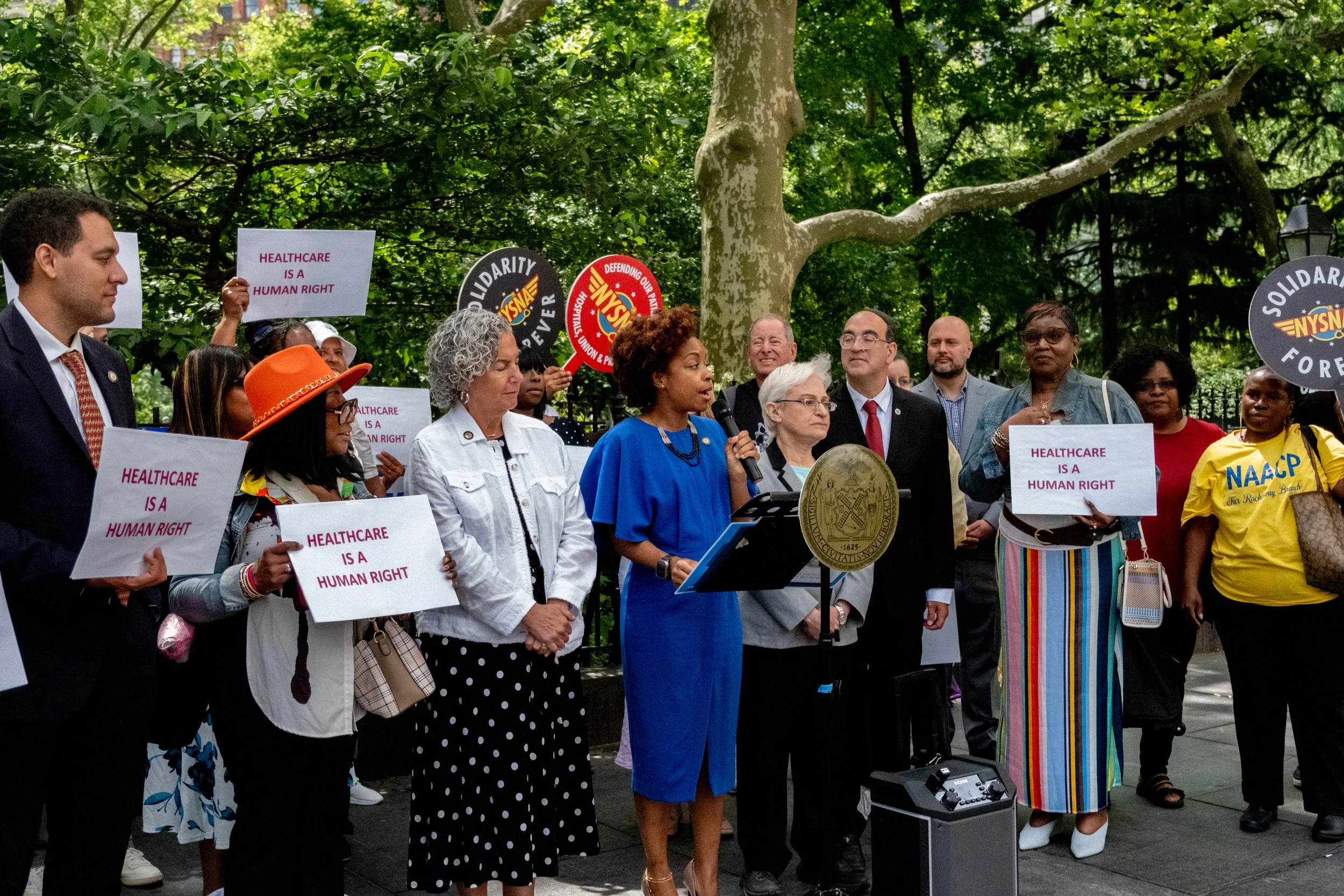
Officials called on the city to fund the construction of the Rockaway trauma center at City Hall on Wednesday. Eagle photo by Ryan Schwach
By Ryan Schwach
Queens residents rallied outside City Hall on Wednesday to demand that Mayor Zohran Mamdani work with the City Council to help fill a $150 million hole in funding to construct a much-desired trauma center on the far-flung Rockaway peninsula.
Rallygoers, led by local City Councilmember Selvena Brooks-Powers, continued their call for the city to fill the gap in Rockaway’s health infrastructure by building a hospital to treat shooting, drowning and other trauma victims.
The rally comes as the Council and mayor prepare to enter into the most serious portion of the budget negotiation process.
The mayor’s proposed executive budget included no funds for the healthcare center.
“The people of Far Rockaway deserve the same access to life-saving health care as every other New Yorker,” said Councilmember Selvena Brooks-Powers, flanked by local advocates and other electeds from the peninsula and beyond. “We are asking City Hall and Council leadership to continue moving this project forward.”
“Politicians often talk about how much they love the Rockaways,” she added. “They come to our beaches, they come to our boardwalk, they talk about the strength of our community. Yes, but love is an action verb. If we truly love the Rockaways, then we must invest in the Rockaways.”
Brooks-Powers told the Eagle that the goal is to fill the $150 million hole this year in order to reach the $200 million needed to begin construction on the trauma hospital, should the state approve the plan.
An initial $50 million was allocated in last year’s budget by the Adams administration.
The Queens legislator said that the full $150 million may not come to pass under the constraints of this year’s budget, but the hope is that they can chip away at that larger number.
“The previous administration put money where their commitment is, so we're looking for this administration to also put money where their commitment is,” she told the Eagle.
City Hall did not respond to a request for comment about the rally and the call to include trauma hospital funding in the budget.
Support for the center, once thought to be a local pipe dream, has steadily increased in recent years.
On top of funding allocations under Adams, backing for the proposal has extended to other parts of Queens.
“Equitable emergency care is a right, not a privilege,” said Queens Councilmember Lynn Schulman, who chairs the Council’s Health Committee. “I'm going to continue to push this administration.”
The closest trauma center to the Rockaways, Jamaica Hospital, is in Schulman’s central Queens district.
In order to receive trauma care, Rockaway residents need to trek more than 40 minutes through the often congested Van Wyck Expressway. Pediatric cases are often sent to Cohen Children's Medical Center in Glen Oaks, which could take an hour to get to from parts of the peninsula.
“This is not about politics, this is not about bureaucracy, this is about whether a child, a parent, a first responder, or a visitor to our community has a fighting chance when the worst day of their life hits,” said Brooks-Powers.
Michael Greco, the president of Local 2507, the union that represents EMS workers, said that Rockaway’s isolation often creates a domino effect that leads to a shortage of ambulances throughout the region.
An ambulance could be put out of commission for several hours after taking a patient to Jamaica from Rockaway, he said.
“When one gets taken to a trauma center in Jamaica, that is an extra hour plus without services, so we all know in healthcare seconds matter, and right now it's taking hours,” he said at the rally. He added that sometimes the ambulances don’t even make it back to the Rockaways because they are called for another job.
Rockaway’s lack of trauma care has gone on for more than a decade, dating back to the closure of Peninsula Hospital in 2013.
The issue was highlighted in March 2024 when Police Officer Jonathan Diller, who was shot on-duty in Far Rockaway, had to be brought to Jamaica Hospital to receive treatment.
That was despite being shot just a few blocks away from Rockaway’s only hospital, St. John’s Episcopal, which does not have trauma treatment capabilities.
“We have to be treated fairly and equitably,” said State Assemblymember Khaleel Anderson. “[Rockaway] understands how important it is not just for us to get this trauma center, for us to no longer be kicked or treated at New as New York City's stepchild.”