Threat of strike looms as public defender unions call for more funding
/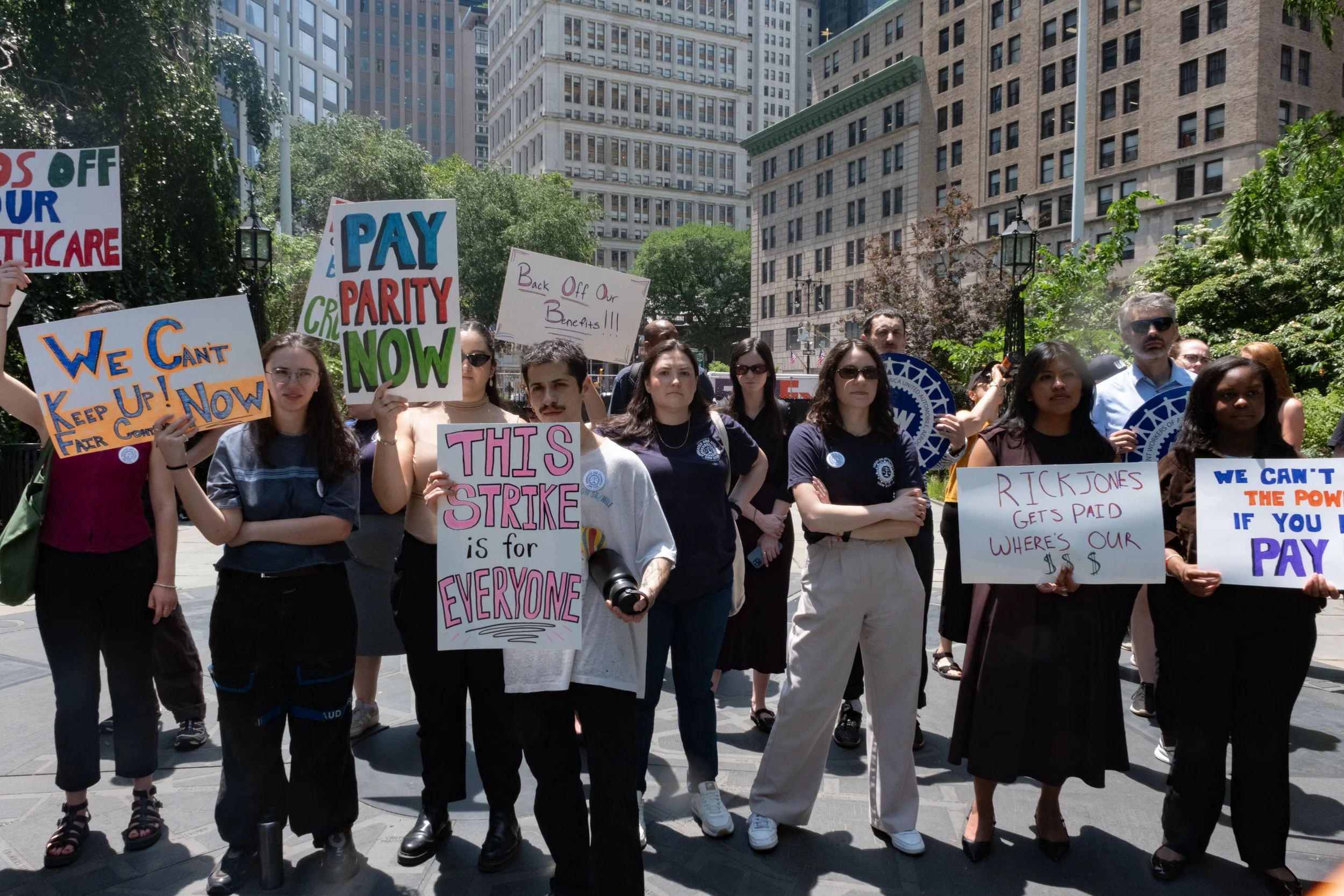
Union members of five city public defender organizations rally outside City Hall, calling on the city to invest in public defense. Eagle photo by Ryan Schwach
By Noah Powelson
Over 1,000 attorneys could go on strike as early as July 1 unless the city makes considerable investment into their public defender organizations, union leaders warned on Wednesday.
Attorneys and staffers at some of the city’s largest legal aid organizations rallied in front of City Hall on Wednesday, demanding the city’s final budget include significant investment into their public defender organizations ahead of tense labor negotiations. Five different organizations and their respective unions will see their labor contracts expire on June 30, raising a very real possibility of a mass public defender strike that could cause significant delays in city courthouses.
The five public defender organizations are currently bargaining with their respective unions, which are backed by the Association of Legal Advocates and Attorneys, UAW Local 2325.
In all, over 2,000 attorneys and legal aid staffers are negotiating new salaries this month. That includes 1,000 attorneys at the Legal Aid Society whose contract does not expire this year but who are able to negotiate new wages.
Management at these organizations have said delays in both the city and state budget created an uncertain financial future, making it difficult for them to offer significant pay increases.
Lisa Ohta, the president of the ALAA, said that the unions are asking for pay increases for both attorney and non-attorney staff that keeps up with the cost of living in the city.
ALAA also said the rally on Wednesday was not just to make their demand for more money known to lawmakers but to put the city on notice – they are prepared to go on strike if they can’t reach an agreement with the organizations.
“We are feeling the crunch of the affordability crisis like every other working class New Yorker and too many of us are being forced out of jobs we love because love doesn’t pay the rent,” Ohta said in a statement. “By increasing funding to vital work and raising the wages of the union members who keep our courts running, the City Council can send a message that providing the best defense to New Yorkers is an investment in the safety of our communities.”
Among those who rallied on Wednesday were union members working at Brooklyn Defender Services, the second largest public defender group in the city that also employs hundreds of staff in Queens. BDS has more than 750 staff members on its books, according to the nonprofit, including around 120 employees it received after it absorbed Queens Defenders’ criminal defense contract in June 2025 after the Queens’ organization's former executive director, Lori Zeno was ousted from the company and later arrested on fraud charges.
Johnny Castellanos, an attorney at BDS and a member of the union’s bargaining committee, said that public defenders have faced increasing burden from growing caseloads and new discovery reform requirements, but have not received the funding necessary to meet those demands.
Following the 2019 discovery reform law, prosecutors faced new requirements to turnover evidence to the defense in a timely manner. The reforms have led to more work for both sides of the courtroom but Castellanos said money from the state and city to offset the increase has only flowed in one direction.
“Prosecutors continue to receive resources and funding that allows them to meet the demand of these new reforms, while also tackling attrition,” Castellanos said. “We are here to ask the Council to remember us, the people who defend New Yorkers, who give them zealous representation.”
Union shops from Neighborhood Defender Service of Harlem, Bronx Defenders, Center for Family Representation and Catholic Migration Services also rallied outside City Hall on Wednesday.
The unions were joined by Queens City Councilmember Tiffany Cabán, who said the city disproportionately prioritized funding prosecutors and police over public defenders.
Cabán – who previously served as a public defender before joining City Council – was a regular supporter of city’s legal aid union shops when they went on strike last year, and said the city and state’s lack of investment lead to overburdened attorneys, which in turn can lead to lesser quality representation for their clients.
“I still think about a number of my cases to this day that haunt me, and I think about what if I had more time, what if I was healthier, what if I got a little bit more sleep, what if I could get to the doctor, what if I had less cases and clients,” Cabán said. “It is exactly that scenario why I decided to take up the rules of the legislature.”
“[Public defenders] have an immensely high caseload and are in charge of advocating on behalf of a person and keeping them out of a cage while under the crush of devastating debt in a city that is completely unaffordable,” Cabán added.
The threat of a public defender strike mirrors the same threats the city faced last year, when roughly 750 attorney and non-attorney staff took to the picket line after labor contracts for seven legal aid organizations expired at the same time.
City legal aid unions can have contentious relationships with their managers, but in one matter they agree – the city invests far less into public defense as it does prosecutors or law enforcement.
At a March City Council budget hearing, officials with The Legal Aid Society, Brooklyn Defender Services, New York County Defender Services and the Bronx Defenders said they needed between $100 and $150 million in additional funding to hire new attorneys and retain their current numbers.
Lisa Schreibersdorf, the executive Director of Brooklyn Defender Services, previously told the Eagle they have been bargaining with their union since April, but a lack of city investment leaves BDS with little option to offer increased pay or benefits. Schreibersdorf previously said that many BDS staff have to work a second job to get by, and called on the city for enough cash to enable BDS to offer competitive salaries.
“We join our staff in calling on the city to provide a living wage for public defenders,” Schreibersdorf said in a statement to the Eagle. “Along with my colleagues in the other defender offices, we have been advocating that the City provide more legal services funding, underscoring that the current salaries for our staff are inadequate. Our interdisciplinary staff of lawyers, social workers, investigators and administrative staff work tirelessly at protecting the rights of New Yorkers.”
“They deserve to earn a competitive salary to allow them to do this work long-term and to afford to live in New York City,” she added.