Queens building workers brace for ‘rough’ contract negotiations with landlords
/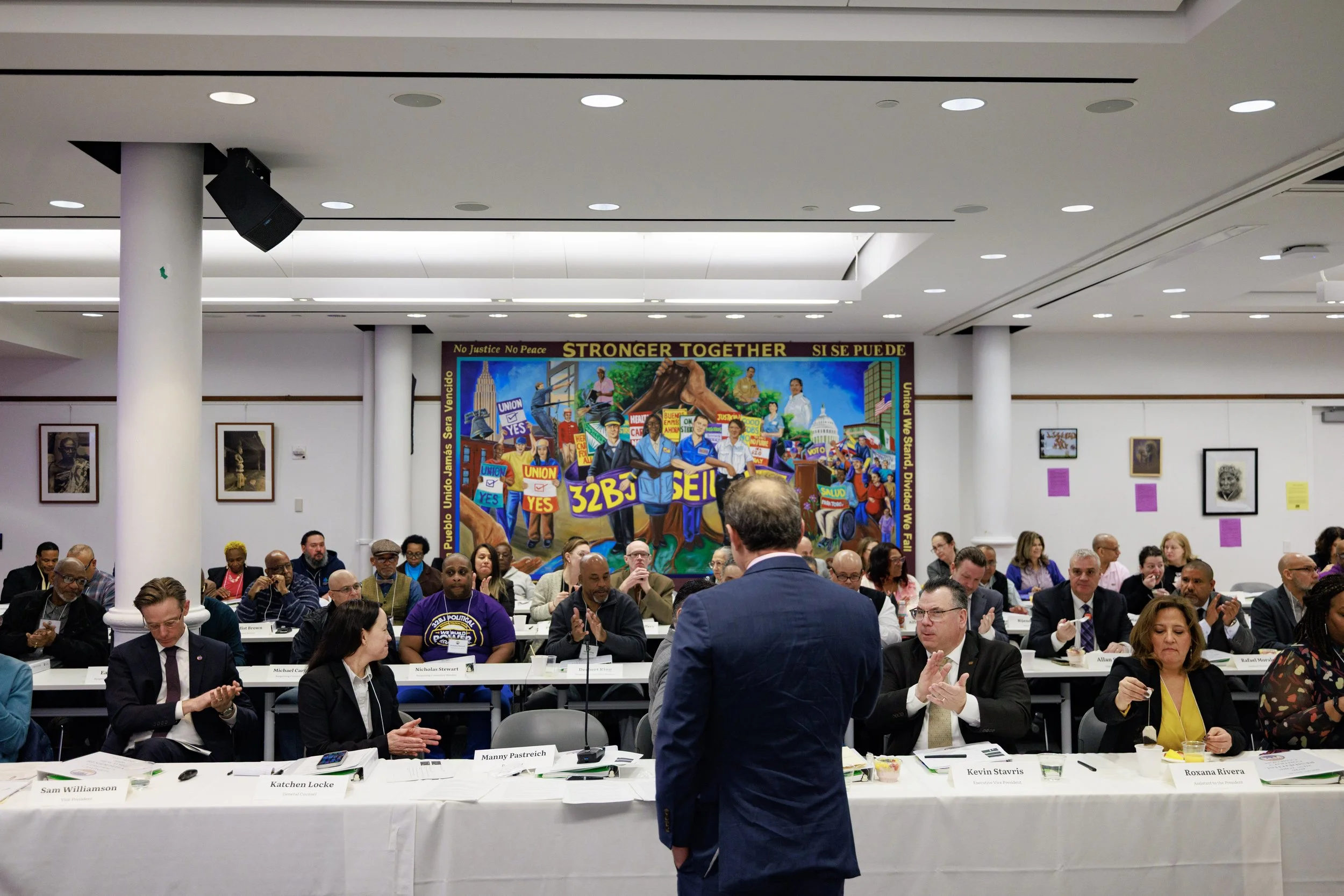
Members of 32BJ SEIU’s bargaining committee kicked off contract negotiations earlier this month. Photo via 32BJ SEIU
By Jacob Kaye
Queens residential building services workers joined more than 34,000 porters, doorpersons, superintendents, handypersons and resident managers across the five boroughs as they began negotiating a new labor agreement with building owners throughout the city this month.
Around 34,000 members of 32BJ SEIU, including 3,000 who work in Queens and 7,000 who live there, began negotiating a new contract with the Realty Advisory Board on Labor Relations ahead of the April 20 expiration of their current collective bargaining agreement.
Several union members who both live and work in the World’s Borough said they expect the negotiations with the RAB, which collectively represents building owners in labor negotiations, to be tense.
The union is pushing for wage increases, but not at the expense of education programs that have helped members rise up the ladder in their buildings or of their fully employer-paid family health care plan.
“We know this is going to be a rough one,” Derbert King, a member of the bargaining committee, told the Eagle. “I say that because of what we're protecting, not what we're going for.”
The contract between the residential building workers union and building owners has been in existence for more than 90 years. It was first created following the 1934 elevator operators’ strike, which occurred less than a year after the union was first formed. The strike ended when the owners of around 400 buildings in Manhattan agreed to increase wages and workplace protections for the elevator workers, some of whom had been working over 80 hours a week for $50 a month, or around $3.75 per hour in today’s dollars.
In the near century since the strike, the union and the protections in their labor agreement have grown. The union’s members who maintain around 600,000 units across the city have paid vacation, paid sick leave and paid holidays. Their contract also includes free training courses, a 401(k), access to free civil legal services, and wage guarantees that range from $29.78 per hour to $43 per hour depending on the job.
But central to the contract is access to health insurance, which is fully paid for by the building workers’ employers, has 0 percent premium sharing and covers the workers’ entire families. Union members are concerned that the RAB will push for workers to begin paying health care premiums as part of the new agreement.
“We look forward to continued productive meetings that will result in a fair and mutually-agreeable resolution for both sides,” Howard Rothschild, the president of the RAB, said in a statement. “The RAB and 32BJ have a history of successful, collaborative collective bargaining that supports tens of thousands of middle-class jobs, and we are confident that will continue this year. Over the next few weeks, the union and industry must come together to negotiate a contract that will provide for a sustainable future of the industry.”
King said the health insurance he’s received during his 32 years on the job has allowed him to raise his three sons in New York. One of his sons recently began working as a porter in a Queens building.
“What I'm doing here with the bargaining committee is not just for myself,” he said. “This fight goes deeper for me.”
Negotiations over the collective bargaining agreement come as the cost-of-living crisis is top of mind for city residents, who overwhelmingly voted in favor of Mayor Zohran Mamdani’s affordability agenda last November. It also comes weeks after the end of a 41-day strike by nurses working at four major hospitals in New York City.
Members of the union’s bargaining committee said the workers wouldn’t shy away from a strike should their demands not be met. The last time the union workers went on strike was 1991. The labor action only lasted a few hours.
“That was a quick one, because they thought we were bluffing,” King said. “When we walked off the job, they found out that we weren't bluffing.”
The building workers play a vital role in city life. Without them, many of the large residential buildings in New York City wouldn't be able to function, said Donald McCaffrey, a porter at a Jackson Heights co-op building who also serves on the bargaining committee. Not only do they learn the faces and needs of a building’s residents, but they also are experts in ensuring the buildings, some of which are nearly a century old, continue to work.
When McCaffrey, who is 67 years old, first began working in residential buildings, he stopped a would-be robber from mugging one of his residents. He saw the trouble coming from a mile away because he was so attuned to the comings and goings of the building, he said.
“We are the eyes and ears of the building,” he said.
The second bargaining session between the union and the RAB is scheduled to take place on Tuesday, March 24.