Court of Appeals revives charges against man accused of throwing urine at prison guard
/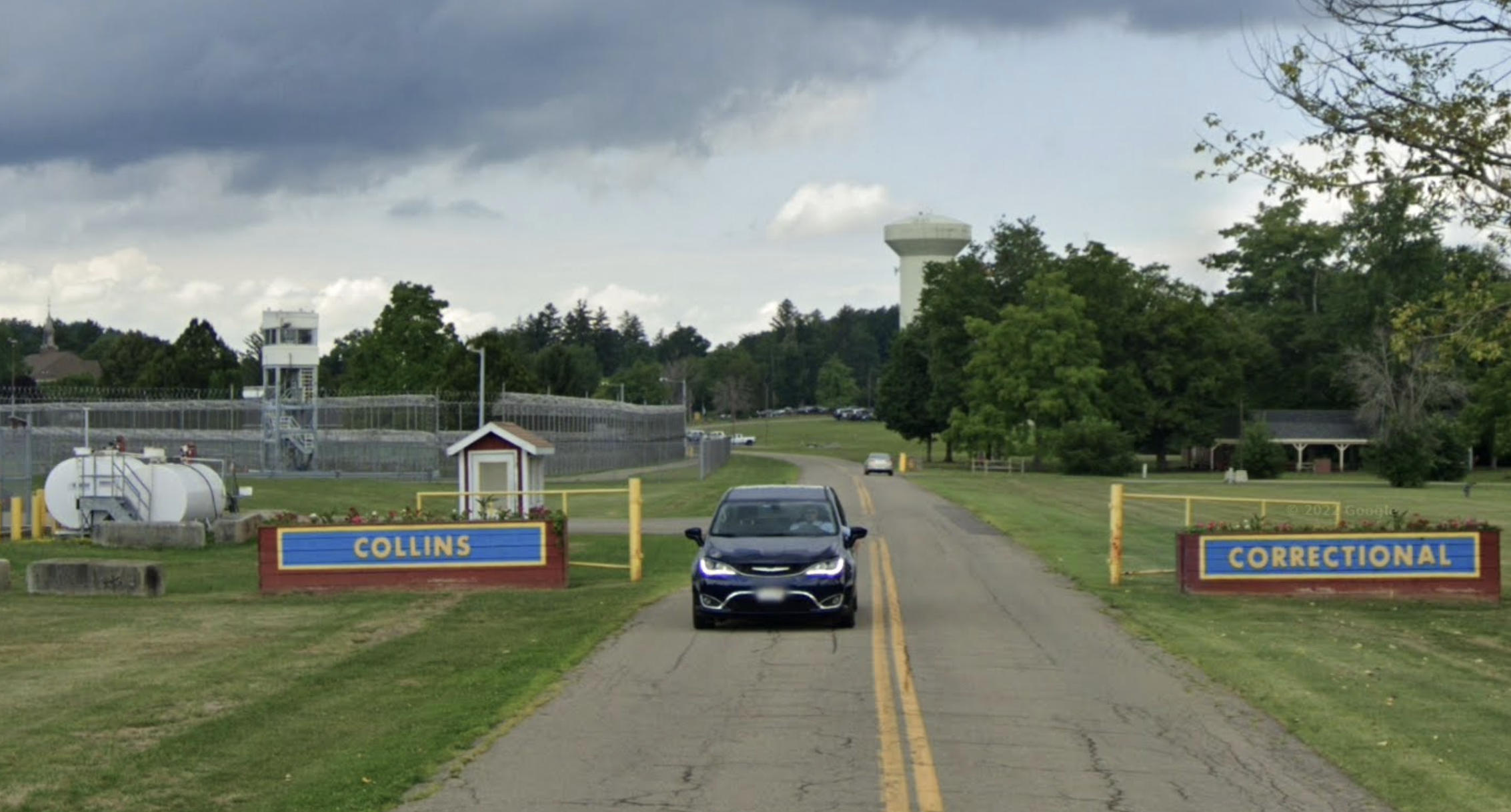
A man formerly incarcerated at Collins Correction Facility will be charged for allegedly throwing urine at a correctional officer after the Court of Appeals said two lower courts erred in dismissing his original indictment. Photo via Google Maps
By Jacob Kaye
A New York man accused of throwing urine at a prison guard will face criminal charges after the Court of Appeals said that several lower courts improperly dismissed the charges against him.
Kenneth Tyson, who was incarcerated at Collins Correctional Facility, will now face one count of aggravated harassment of an employee by an incarcerated individual, a felony, after New York’s top court said that the decision by both an Erie County Supreme Court judge and an Appellate Division judicial panel to dismiss his original indictment was wrong.
The lower courts initially ruled that prosecutors waited too long to bring charges against Tyson, who allegedly threw the human waste onto an officer at Collins Correctional Facility while they were conducting a welfare check on him on Christmas Day in 2021. Tyson was placed in solitary confinement after the alleged attack and was held there for seven months until his release from prison in July 2022.
Later that month, the Department of Corrections and Community Supervision referred the case to the state police. A month later, the state police sent the case to the local district attorney’s office for prosecution. But charges weren’t brought against Tyson until February 2023, a year and two months after the alleged crime.
In the time between his release and the February 2023 indictment, Tyson had moved to New York City, complied with the rules of his probation, participated in counseling, and got a job as a home health care aide.
Tyson’s attorneys successfully argued that the case should be dismissed because the pre-indictment delay violated his constitutional speedy trial and due process rights. Even though the case was relatively straightforward and did not lack evidence, it still took the state 14 months to bring charges against him, they argued. Tyson also argued that he served his time for the crime, spending over a half a year in solitary confinement.
The indictment was dismissed by a state Supreme Court judge, whose ruling was upheld in the Appellate Division, Fourth Department.
But the Court of Appeals on Tuesday said in a 5-2 decision that while there was no real explanation for much of the delay in bringing the charges, there is “a large body of precedent denying speedy trial claims based on similar periods of pre-indictment delay.”
“We conclude that the defendant was not deprived of his constitutional right to a speedy trial,” the court said in its decision.
The opinion was written by Judge Anthony Cannataro. Judges Michael Garcia, Madeline Singas and Caitlin Halligan, as well as Chief Judge Rowan Wilson, concurred.
Judges Jenny Rivera and Shirley Troutman dissented, arguing that the majority’s argument that there is precedent for similar delays is flawed.
“Whether the length of the delay supports a defendant’s due process challenge depends on the facts of their case, and not merely on whether another court ultimately concluded that a similar delay was constitutionally permissible, based on that court’s holistic analysis of the unique circumstances of the case before it,” Rivera wrote in her dissent. “While a 14-month delay may seem reasonable in cases involving an uncooperative victim, multiple unidentified witnesses, tainted or no physical evidence, and open questions of law impacting potential theories of the prosecution and defense, a similar delay in a case lacking all or some of these circumstances may violate a defendant’s due process right to speedy prosecution.”
“The latter situation is present here, as this case is notable for its lack of complexity and its straightforward application of the controlling law to the officer’s factual account and the forensic evidence,” she added.
Tyson’s case was sent back to Erie County Supreme Court for prosecution following the Court of Appeals’ ruling.