City sets 2032 deadline in new Rikers closure plan
/
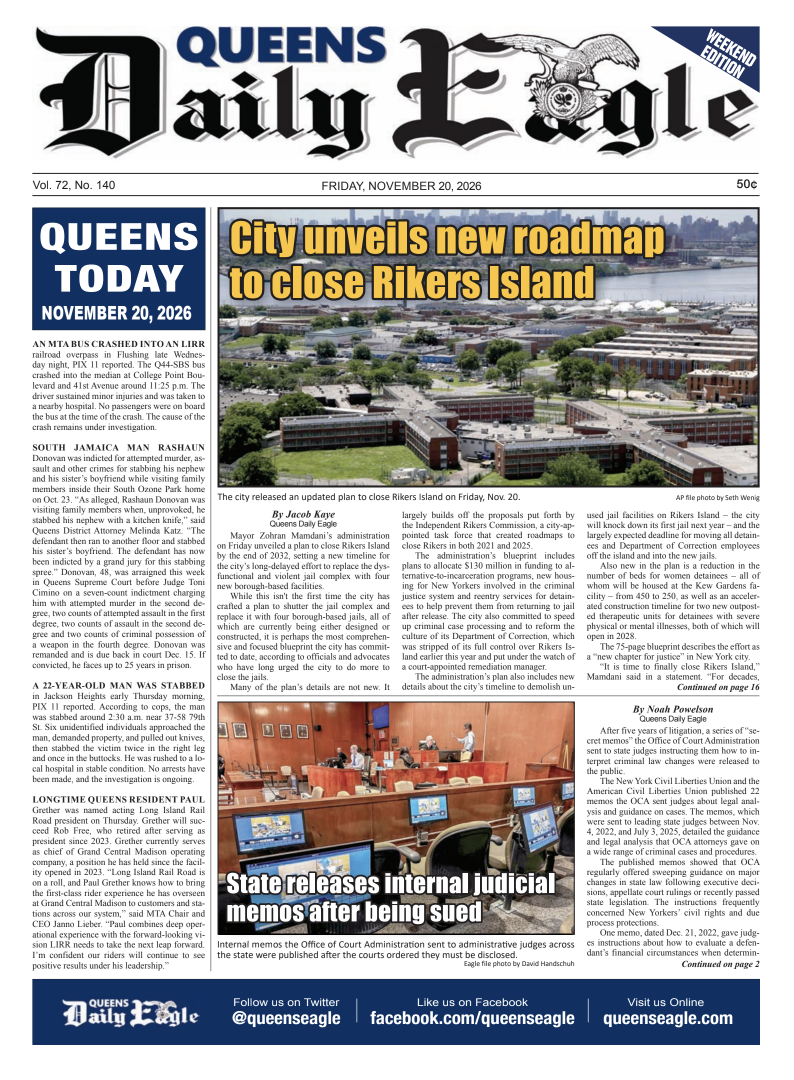
The city released an updated plan to close Rikers Island on Friday, Nov. 20. AP file photo by Seth Wenig
By Jacob Kaye
Mayor Zohran Mamdani’s administration on Friday unveiled a plan to close Rikers Island by the end of 2032, setting a new timeline for the city’s long-delayed effort to replace the dysfunctional and violent jail complex with four new borough-based facilities.
While this isn't the first time the city has crafted a plan to shutter the jail complex and replace it with four borough-based jails, all of which are currently being either designed or constructed, it is perhaps the most comprehensive and focused blueprint the city has committed to date, according to officials and advocates who have long urged the city to do more to close the jails.
Many of the plan’s details are not new. Its core is the same as the plan first introduced nearly a decade ago – replace the crumbling facilities of Rikers Island, an effective penal colony where 100 people have died in the past decade, with modern facilities located close to the city’s courthouses.
The plan largely builds off the proposals put forth by the Independent Rikers Commission, a city-appointed task force that created roadmaps to close Rikers in both 2021 and 2025.
The administration’s blueprint includes plans to allocate $146 million in funding to alternative-to-incarceration programs, new housing for New Yorkers involved in the criminal justice system and reentry services for detainees to help prevent them from returning to jail after release. The city also committed to speed up criminal case processing and to reform the culture of its Department of Correction, which was stripped of its full control over Rikers Island earlier this year and put under the authority of a court-appointed remediation manager.
The administration’s plan also includes new details about the city’s timeline to demolish unused jail facilities on Rikers Island – the city will knock down its first jail next year – and the largely expected deadline for moving all detainees and Department of Correction employees off the island and into the new jails.
Also new in the plan is a reduction in the number of beds for women detainees – all of whom will be housed at the Kew Gardens facility – from 450 to 250, as well as an accelerated construction timeline for two new outposted therapeutic units for detainees with severe physical or mental illnesses, both of which will open in 2028.
The 75-page blueprint describes the effort as a “new chapter for justice” in New York City.
“It is time to finally close Rikers Island,” Mamdani said in a statement. “For decades, New Yorkers have demanded a correctional system that is safe and humane. This plan puts us on a path to deliver just that: closing Rikers, reducing pretrial detention, tackling the case delays that deprives people of their right to a speedy trial and investing $146 million in the evidence-based supports that help break the cycles of incarceration.”
We have a legal and moral obligation to close Rikers,” he added. “Working alongside the City Council, Courts and nonprofit partners, we will meet it — for the people in our custody, the staff who serve them, victims of crime, and every New Yorker.”

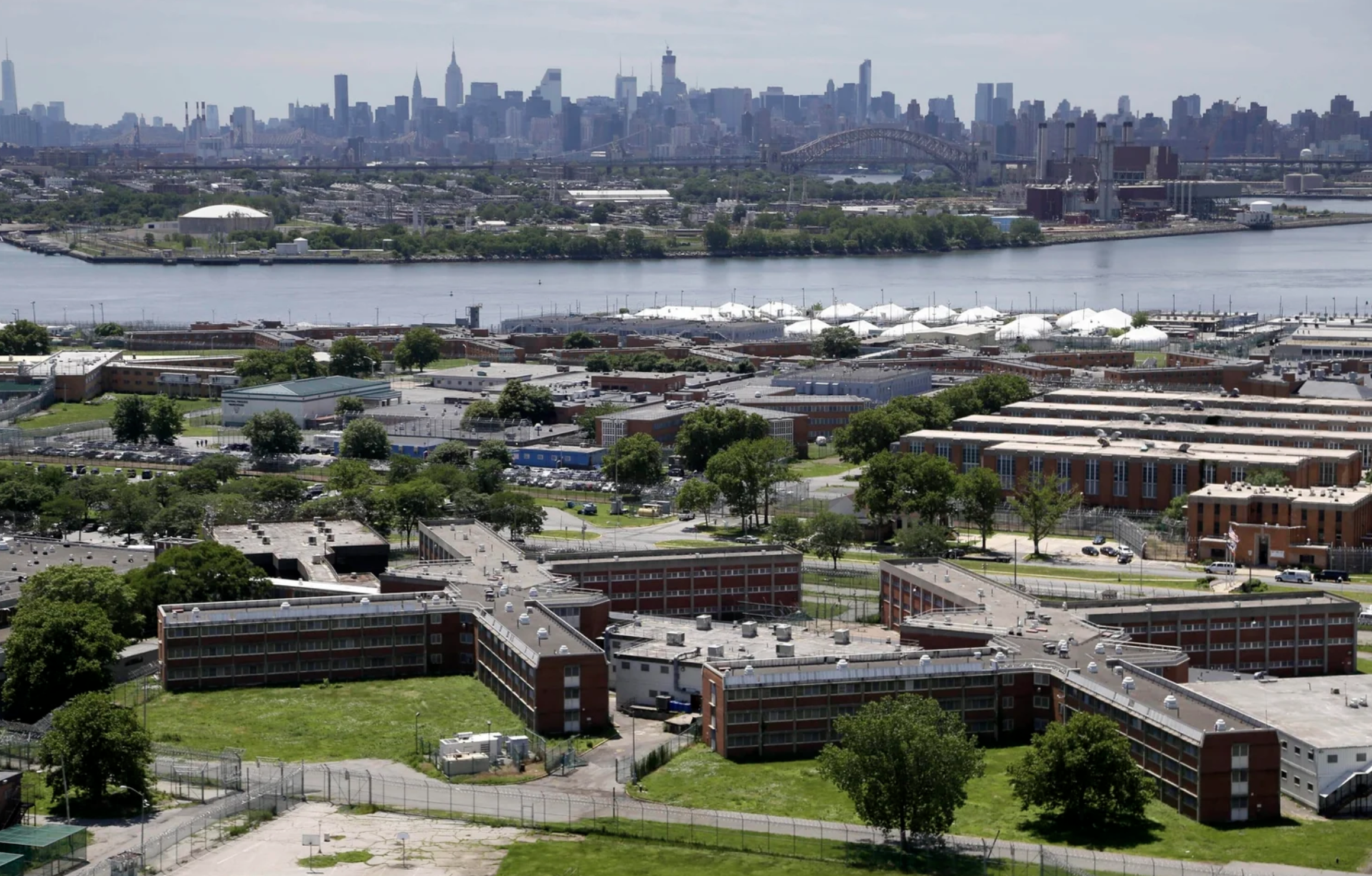
Mayor Zohran Mamdani’s administration said in a new report that it plans to shutter Rikers Island by 2032. AP file photo by Seth Wenig
The blueprint comes less than a year before the city’s original legally-mandated deadline to close Rikers, which will likely be changed by the City Council in the coming months, according to Council sources.
Officials have long acknowledged that the August 2027 deadline became unachievable after COVID-related construction slowdowns and a general lack of enthusiasm for the plan by former Mayor Eric Adams led to major delays in the transition to the borough-based jails.
The first of the new jails – the Brooklyn facility – isn’t expected to be completed until 2029. The Bronx and Queens facilities won’t be completed until 2031, and the Manhattan facility, whose construction is the subject of an ongoing lawsuit, won’t be finished until 2032 at the earliest.
The plan released on Friday marks the first time the Mamdani administration formally committed to a new deadline to close Rikers – Dec. 31, 2032.
While any change to the deadline would require a new Council law, legislators appeared on board with the administration's plan on Thursday.
“The administration cannot meet the Council deadline, the last administration couldn’t meet the Council deadline, so, something needs to give,” Speaker Julie Menin said. “The Council is committed to extending that deadline.”
“Those conversations are ongoing,” she added.
Brooklyn City Councilmember Sandy Nurse, who is expected to be the lead sponsor on the bill that would alter the closure deadline, told the Eagle on Thursday that the legislation likely won’t set a final deadline, but instead establish a series of conditional benchmarks. She largely applauded the administration’s proposal, noting the increased funding for reentry services and housing, but also said she wanted to see more funds committed to helping speed up the evidence-sharing process between police, prosecutors and defense attorneys and ensuring detainees are given medical care in the jails.
“There's a lot of things that I think aren't necessarily captured in the plan, but I do think this plan is getting us back on track from the four years of detour that Eric Adams had us on,” Nurse said. “We are 95 percent aligned on this plan, and there's like 5 percent of things that we may need to haggle about over the next two months.”
Queens City Councilmember Selvena Brooks-Powers, who chairs the Committee on Criminal Justice, called the plan a “good start” but said she would have hoped to see more solid goals and timelines.
“I am still looking to see more benchmarks so that we’re ensuring that whatever timeline we’re putting forward is something that is attainable,” Brooks-Powers told the Eagle.
There are two major hurdles preventing the city from closing Rikers – the construction of the four new jails and Rikers’ population.
Though the new borough facilities are being built to house a total of 4,500 people, around 6,600 people are currently behind bars on the jail island, around 5,600 of whom are awaiting the outcome of their criminal case.
The administration said in its blueprint that it expects to be able to lower Rikers’ population to 4,100 people after the implementation of its population reduction strategy, which includes increasing alternatives-to-detention programs, providing more pretrial release plans, speeding up case processing and reducing recidivism.
According to the plan, the biggest reduction in the population would come through reducing case delays.
Last year, it took around 431 days on average for criminal cases to reach their conclusion in New York City, 115 days longer than the rest of New York State.
The blueprint calls for the Office of Court Administration, judges, prosecutors and defense attorneys to work together to move cases off the docket.
The court system has already begun taking steps to move cases along, including by identifying detainees who have been languishing in the jails for two years or more and pushing prosecutors, defense attorneys and judges to work to resolve their case.
But more needs to be done, the report said.
City Hall said it would use its own authority to alter NYPD practices so that its forensic investigations, discovery and record production units work more quickly. It also said it would reform triage and prioritization practices within the Office of the Medical Examiner to accelerate testing in cases where delays are most likely to keep people in custody longer.
The report also calls for the creation of a new task force made up of city officials, OCA, district attorneys, the defense bar and other criminal justice groups charged with cutting back on case delays.
The plan also calls on the city’s district attorneys to utilize diversion and alternative-to-incarceration programs.
“We owe every person in custody dignity and humane conditions, and every correction officer and staff member a functional and safe place to work,” Bronx District Attorney Darcel Clark, Brooklyn District Attorney Eric Gonzalez, Manhattan District Attorney Alvin Bragg and Queens District Attorney Melinda Katz said in a joint statement. “The plan to replace Rikers with borough-based jails will help achieve that, but we have a long way to go and many obstacles to overcome to do it correctly and preserve the tremendous progress in public safety our city is experiencing.”
In order to keep track of the plan’s progress, City Hall will release a report every quarter detailing the steps it has taken toward closing Rikers.
“The era of a justice system that is ‘out of sight, out of mind’ is coming to a long-overdue end,” DOC Commissioner Stanley Richards said in a statement. “This plan is a roadmap toward a safer city that lifts up the dignity of the people who live and work in our jails. The Department is proud to support this work in order to reach a future off of Rikers Island.”