
Construction of new Brooklyn jail hits milestone as Rikers closure moves forward
/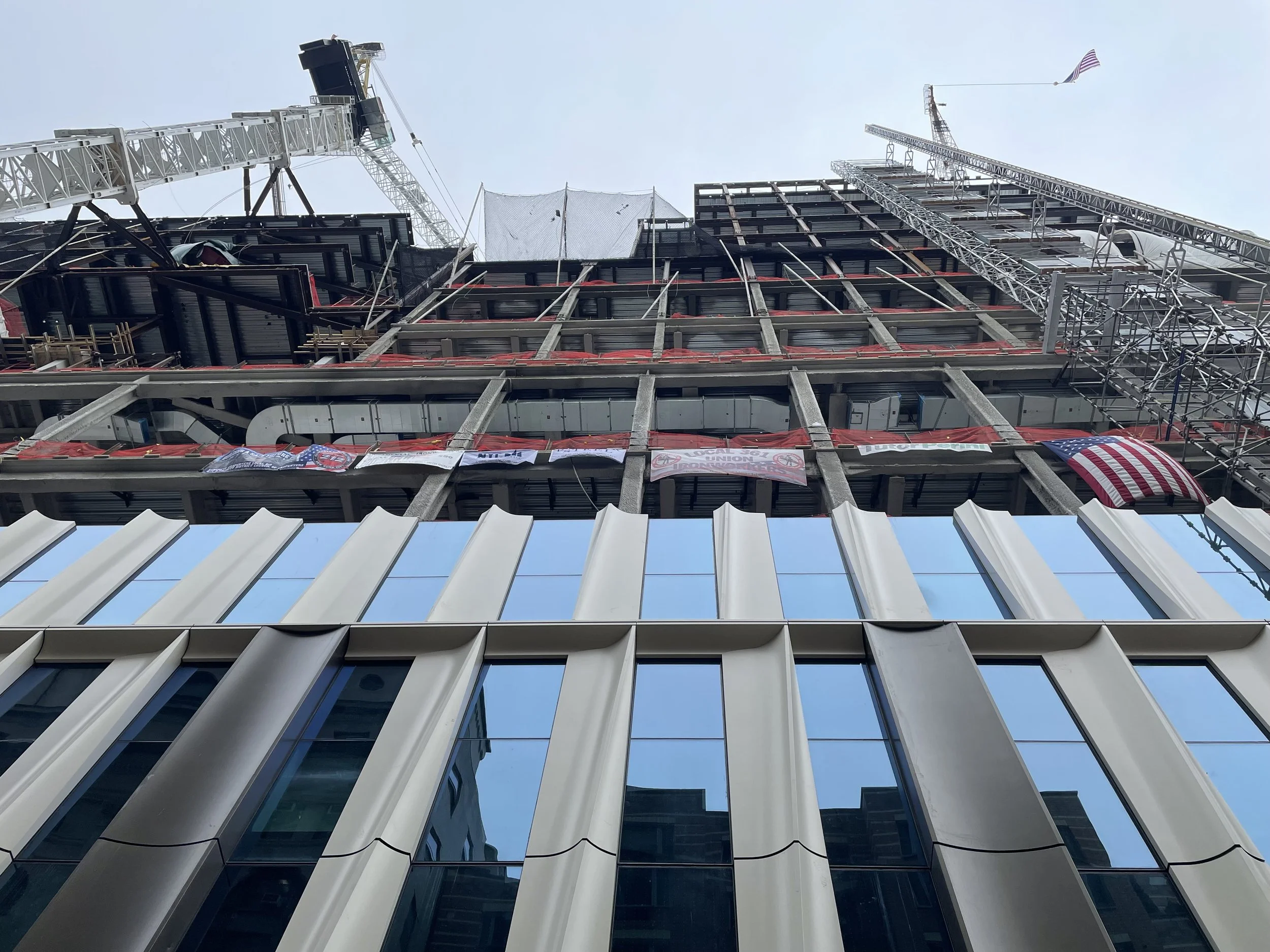
The final beam of the Brooklyn borough-based jail was installed on Wednesday, April 22, 2026. Eagle photo by Jacob Kaye
By Jacob Kaye
The final beam was placed Wednesday atop the $3 billion Brooklyn borough-based jail, which will one day be the first facility to be completed as part of New York City’s long-delayed plan to close Rikers Island.
City officials and hundreds of construction workers gathered to watch the beam be placed at the top of the now-finalized frame of the Brooklyn jail, which is expected to be completed in 2029.
When completed, the facility will be the first to house detainees as part of the city’s plan to shutter the dangerous jail complex on Rikers, which first opened as a de facto penal colony nearly a century ago.
But the plan to close Rikers is running years behind schedule and city officials have admitted the legally-mandated 2027 deadline, which largely went ignored over the past four years by former Mayor Eric Adams, is no longer feasible. While an alternate timeline has yet to be proposed, Mayor Zohran Mamdani’s administration and the City Council are currently discussing how to chart out a new path toward Rikers’ closure, according to multiple officials.
Even without a new plan, officials celebrated the completion of the Brooklyn jail’s frame on Wednesday.
“What we're focused on is our commitment to make sure that we're doing everything in our power to close Rikers,” Department of Correction Commissioner Stanley Richards said. “We have begun to demonstrate to New Yorkers and our partners that we are serious about closing Rikers…Today is another milestone.”
A more fleshed out plan for shuttering Rikers may come soon. THE CITY reported on Wednesday that Mamdani appointed Dana Kaplan, a member of the Independent Rikers Commission, to serve as the city’s first-ever “Rikers czar.” Kaplan will be charged with coordinating the city’s effort to transfer to the borough-based jail system.
The Brooklyn jail and the jails planned for Queens, the Bronx and Manhattan, will be designed to be safer than the crumbling jails on Rikers, according to the city.
They’ll also be smaller than the city’s current jail complex, where over 6,700 people are currently detained. Once completed, the four new facilities will be equipped to hold 4,400 detainees at any given time, requiring the city to figure out how to lower its jailed population before Rikers closes for good.
The city also hopes that by building the jails in the four boroughs, it will be easier for detainees’ families and attorneys to visit.
Richards, who is the first formerly incarcerated person to hold the top job at the DOC, told construction workers on Wednesday that new jails are “deeply personal” for him. It once took Richards’ father an entire day to visit his son on Rikers when he was held there in the ‘80s.
The commissioner said the trip to the island and into the secured jail was so taxing that he “asked [his] father never to come back.”
When it passed its plan to close Rikers in 2019, the city initially intended to open the Brooklyn facility in 2026. But the pandemic created construction delays that put the project quickly behind schedule. Adams was also blamed by advocates for slowing down any effort to restart construction in the years that followed.
The facility, built on Atlantic Avenue on the site of the former Brooklyn Detention Complex, will be 15-stories high and take up an entire city block. Its facade, which features long windows separated by white columns, will look little like any of the jail complexes currently on Rikers once it's completed.
If the project remains on schedule, it will open two years earlier than any other new jail facility.
Both the facilities planned for the Bronx and Queens are expected to open in 2031.
Construction of the Queens facility, which will be located behind Queens Borough Hall and Queens Criminal Court, has yet to begin. The 450-bed jail, which will be the only facility to house women and gender-expansive detainees, is the most expensive of all the borough-based facilities – it’s expected to cost $4 billion.
The Manhattan jail, which will be built in Chinatown, is not expected to open until 2032. The facility, which, at 300 feet high, will one day be the tallest jail in the world, has received the most pushback from its neighbors, who have unsuccessfully sued to stop its construction several times.
In all, the four borough-based jails are expected to cost taxpayers around $16 billion, twice the original estimated cost.