
Courts pick up pace, but hurdles to shrinking Rikers population remain, judge says
/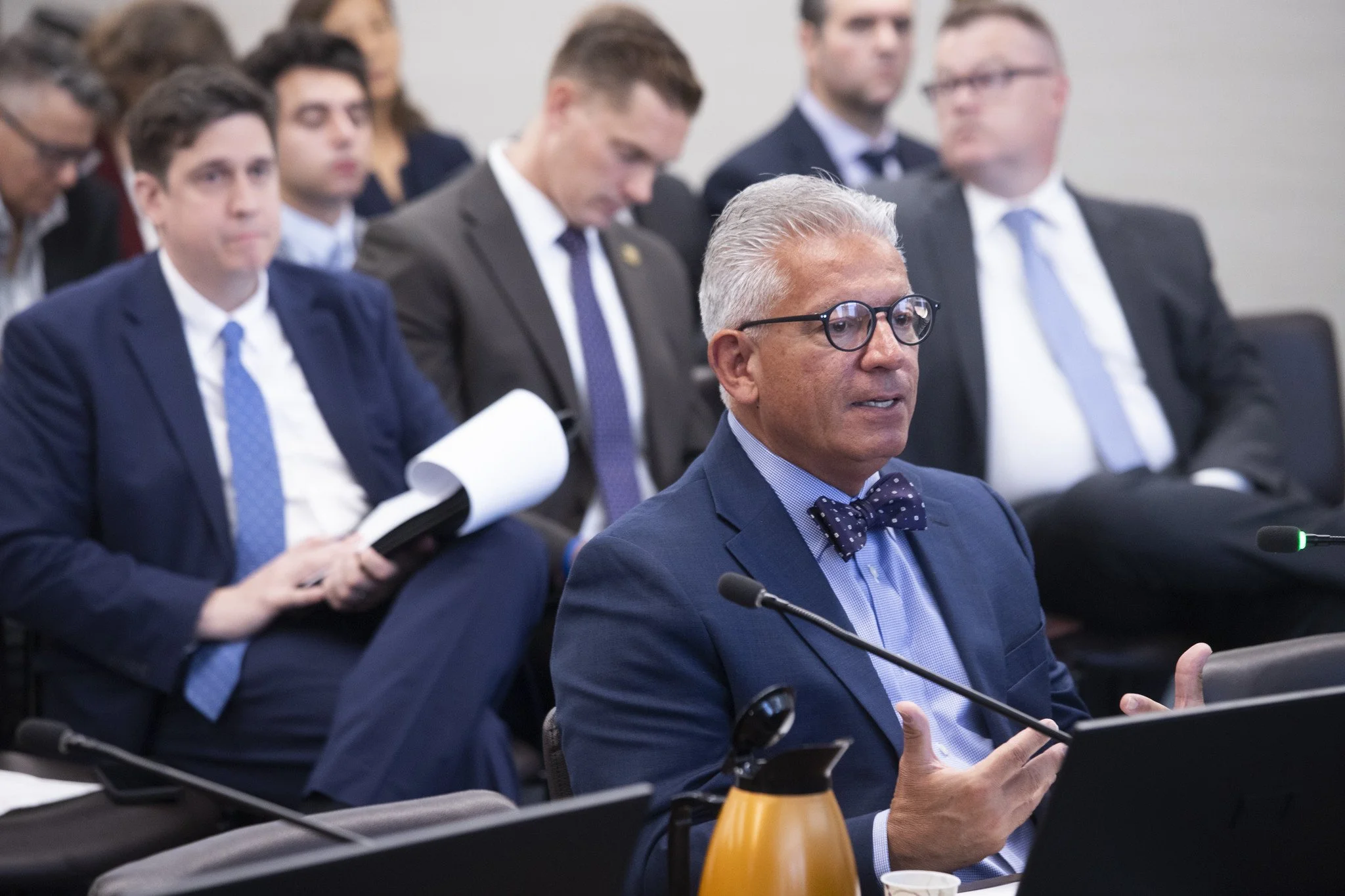
Chief Administrative Judge Joseph Zayas testifies before the City Council on Thursday, June 25, 2026. Photo by John McCarten/NYC Council Media Unit
By Jacob Kaye
New York’s courts have over the past year begun to move cases more quickly, reducing the amount of time defendants have to wait on Rikers Island for their cases’ to come to a conclusion – but a number of entrenched obstacles could make even quicker case processing difficult to achieve, the state’s top administrative judge warned last week.
During a recent City Council hearing on city and statewide efforts being made to reduce Rikers’ population ahead of its anticipated closure, Chief Administrative Judge Joseph Zayas said that a “myriad of challenges” currently stand in the way of speeding up cases to the clip necessary to significantly reduce the number of people in the dangerous jail complex.
Prosecutors’ inability to turn over evidence quickly, a diminished number of beds for defendants with mental health issues, and private defense attorneys with large client lists are all standing in the way of reducing the time from when a defendant is arrested to when their case reaches its conclusion, Zayas said.
While the court system has made a number of changes that resulted in an increase in the number dispositions last year, stakeholders from across the criminal justice system will need to reform their practices in order to make a real dent in reducing Rikers’ population, according to the chief judge.
“The bottom line is this: improving case processing efficiency in high-volume courts is not easy,” Zayas said. “It truly requires an all-hands-on-deck approach.”
Reducing the population on Rikers is key to the city’s plan to close the jail complex, where over 100 people have died in the past decade, and replace it with four new borough-based jails.
Altogether, the borough facilities will only be able to hold 4,400 detainees at any given time. But the current population is far larger – in May, there were around 6,600 detainees held in the jails.
With a vast majority of detainees being held pre-trial, the courts could play a major role in reducing the number of people held on Rikers, the Independent Rikers Commission said in a report last year.
Court leadership has largely received praise for its efforts to speed cases up and move people off Rikers as quickly as possible.
At the order of the Unified Court System, judges and court attorneys have begun to take a more proactive approach to case management. Cases where defendants are incarcerated are often given priority, especially those where defendants have been on Rikers for two years or more.
Judges handling indicted felony cases have also begun to issue clear timelines to get cases through the preliminary stage, a practice that wasn’t required previously.
Zayas said that when he was working as a public defender, “it was basically unheard of for judges in New York City’s criminal courts to issue scheduling orders.”
“Perhaps this scheduling order initiative doesn't sound that groundbreaking, but it is,” he said on Thursday. “For reasons that almost go without saying, it's a best practice for judges at the beginning of every case to set clear scheduling expectations, so that the parties understand that the case is going to proceed on the court's timeline, not theirs.”
The new initiatives, in addition to several others, helped significantly increase the number of trials commenced in courts throughout the state last year.
Last year, New York began 24,763 trials across all courts, a 57 percent overall increase from 2024. Most of those trials were started in New York City, which began 18,480 trials across the five boroughs, a 108 percent increase from the previous year.
The same trend was seen in the World’s Borough, where 4,011 trials began in 2025, a 48 percent increase compared to 2024 numbers.
And while Zayas said the upward trend had continued into the first half of 2026, the courts could only speed up cases so much without help from local district attorneys, city and state officials, and the defense bar.
At the top of Zayas’ list was the state’s 2019 discovery reforms, which set deadlines for prosecutors to hand over evidence to defense attorneys. Despite millions of taxpayer dollars given to DAs’ offices over the years to help them deal with the new demands, prosecutors have been unable to meet them.
While public defense organizations have laid the blame at the feet of the prosecutors, Zayas blamed the law itself.
“I'm not unsympathetic to the fact that our discovery laws are extremely onerous, and I know that the city's district attorneys take their discovery obligations seriously, but I hope that this morning we can have a serious conversation about when compliance with the discovery deadlines that were a key component of the 2020 criminal justice reforms will become the norm,” he said. “Because the fact of the matter is this: cases rarely resolve before discovery is complete.”
“If discovery were routinely produced in 20 or 25 days, rather than 60 or 90 days, cases would be resolved much faster,” he added.
Zayas also called on the governor to add more psychiatric beds in state psychiatric facilities. Currently, detainees ordered to be treated at hospitals are held on Rikers Island for weeks or months longer than they should be because there isn’t a bed available for them.
The chief administrative judge also knocked private defense attorneys who take on large caseloads but don’t hire associates to help them represent clients. The attorneys then are forced to ask judges to work around their increasingly busy schedules, often delaying cases.
“These are not excuses, they are facts,” Zayas said. “If we're going to improve the case processing in a long-term sustainable way, we need to be realistic about the myriad challenges.”