NYPD orders officers to stop enforcing low-level criminal offenses
/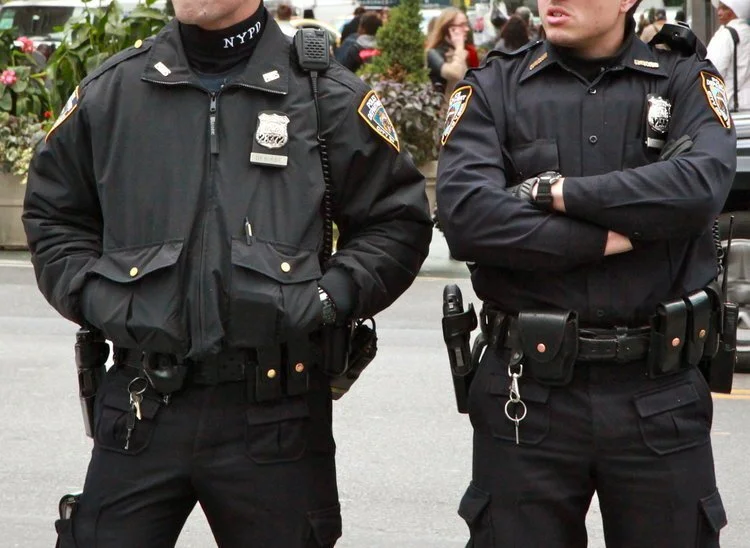
Police officers were instructed last week to stop giving out tickets for spitting and other low-level offenses. Eagle file photo by Torba K. Hopper
By Noah Powelson
The city told NYPD officers to stop ticketing New Yorkers for spitting, idling their cars and other low-level offenses following a year of criticism that the current administration is continuing a form of “broken windows” policing.
The NYPD issued guidance to its police officers on Friday ordering them to scale back enforcement of a variety of low-level criminal offenses that frequently get dismissed by judges. The guidance told officers to stop ticketing New Yorkers for spitting outside of the transit system and for idling cars that haven’t been reported through 311 calls. It also reminded officers that jaywalking is no longer a criminal offense and they cannot issue tickets for it.
The guidance comes as recent data shows police have continued to pursue quality-of-life offenses over the past year — a policy that saw a resurgence under Mayor Eric Adams and that Mayor Zohran Mamdani has faced criticism for continuing during his first year in office.
The NYPD said that the guidance was issued as part of its regular instructions and reminders to officers, and denied that it sent out the instructions in response to any media coverage.
“We regularly conduct checks to ensure that enforcement is being carried out lawfully and in accordance with Department priorities, and this is no different,” an NYPD spokesperson said.
On Tuesday, the Legal Aid Society praised the decision and said the enforcement of low-level, nonviolent offenses disproportionately targeted Black and Brown communities. Around 78 percent of all summonses in 2024 were issued to Black or Hispanic people, according to data from the Data Collaborative for Justice at John Jay College.
"We welcome the Mamdani Administration's decision to scale back enforcement of minor offenses that should never have been priorities for the NYPD in the first place,” a spokesperson for the Legal Aid Society said. “Policing New Yorkers for conduct that is no longer illegal, or deploying officers to issue summonses for trivial infractions, is an unnecessary and disproportionate use of police resources.”
Broken windows policing, or the targeting of low-level offenses as a means to deter major crimes, saw an increase under the Adams administration after reaching historic lows.
According to research released by the Data Collaborative for Justice on Nov. 4, the NYPD issued a record low number of criminal summonses during the height of the COVID-19 pandemic in 2021 – just over 22,000. But that number grew steadily over the last half decade, reaching more than 106,000 summonses in 2025.
During his mayoral campaign, Mamdani pledged to reverse the NYPD's approach to pursuing quality-of-life offenses, but data over the past year shows the policy has seen just as much use, if not more, under the current administration.
Based on analysis of data released on Nov. 4, the Data Collaborative for Justice said that the NYPD is on track to issue more than 101,000 criminal summonses by the end of 2026.
The rate of criminal summonses issued is still well below its all-time high in 2007 – when police issued over 530,000 tickets while Mayor Michael Bloomberg was in office. But legal advocates said the current rate represents a backpedaling of Mamdani’s campaign promises.
In August, members of Court Watch NYC, elected officials and other criminal justice groups who spent a week monitoring arraignments said that broken windows policing is still active under the Mamdani administration. The group said that, among the 360 arraignments they observed during the week of Aug. 10, 130 were for low-level accusations, for which police could have issued a ticket instead of making an arrest, and only 83 were for felony charges that would not qualify for a desk appearance ticket.
Queens Borough President Donovan Richards also appeared alongside Court Watch in August, and said the city needs to reexamine how it handles these low-level offenses if officials want to get the population on Rikers Island down.
“There is no way we're ever going to close Rikers Island if we keep arresting people for these low-level offenses,” Richards said at the time. “The only way to make our communities safer is through intentional investments – investments in our community centers, investments in the justice system that don't keep our people in the justice system when they get out.”
Advocates also questioned how effective this approach to policing is, given that a significant share of city summonses are tossed out for technical issues.
According to the Data Collaborative, 69 percent of all court summonses in the city were immediately dismissed at a court hearing in 2024. Twenty percent of all city court summonses were also defective in 2024, meaning they were rejected prior to arraignment due to a technical issue. In 2023, 16 percent of summonses were defective.
Additionally, fewer than 10 percent of summonses result in a conviction.
But even if it’s relatively rare for someone to face criminal punishment after receiving a summons, the loss of time New Yorkers face addressing them in court can still have a significant impact on their lives.
Michael Rempel, the executive director of the Data Collaborative for Justice, said that every summons can result in hours of lost time and wages.
“While criminal summonses largely involve minor misconduct, and prior research indicates that the overwhelming majority are dismissed in court, receiving a summons is not minor for people handed one on the street by the NYPD, who must then appear in court and potentially wait for hours,” Rempel said in a statement. “By creating a tool that will update automatically whenever new data is released, we hope to make it easier for policymakers and the public to have the latest information on a timely basis.”
The NYPD is expected to release new data on summonses issued in the third quarter of 2026 in the coming weeks.