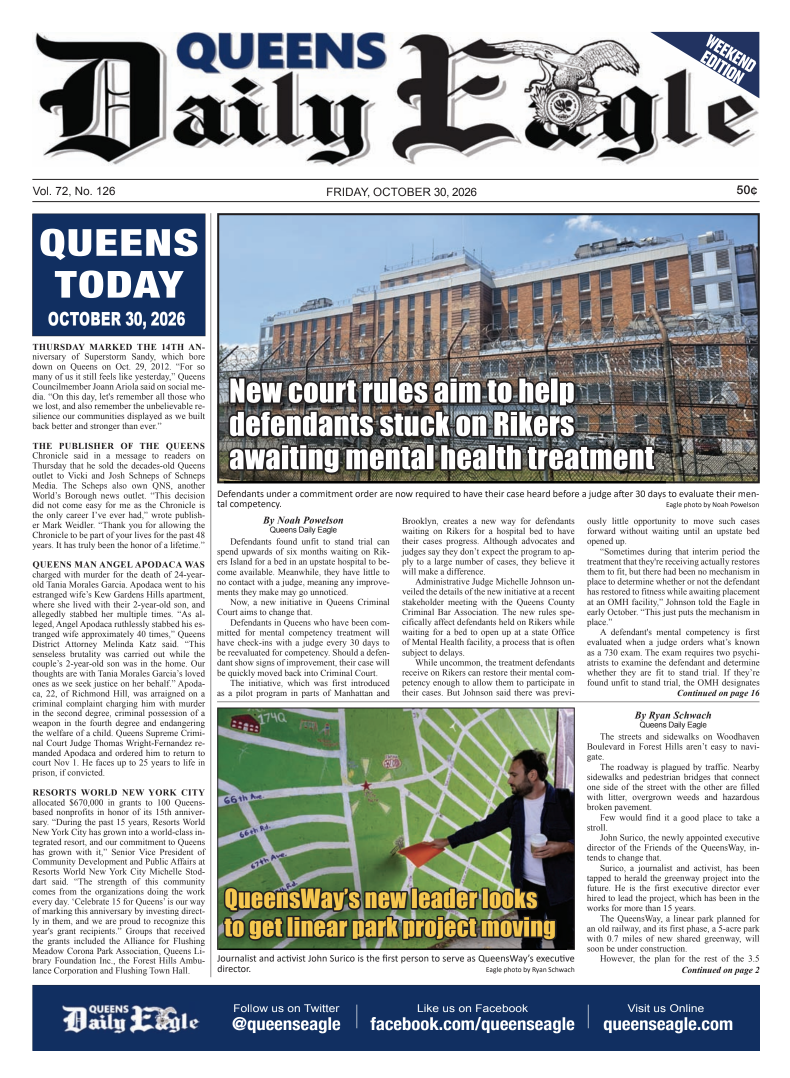
QueensWay’s new leader looks to get linear park project moving
/
Journalist and activist John Surico is the first person to serve as QueensWay’s executive director. Eagle photo by Ryan Schwach
By Ryan Schwach
The streets and sidewalks on Woodhaven Boulevard in Forest Hills aren’t easy to navigate.
The roadway is plagued by traffic. Nearby sidewalks and pedestrian bridges that connect one side of the street with the other are filled with litter, overgrown weeds and hazardous broken pavement.
Few would find it a good place to take a stroll.
John Surico, the newly appointed executive director of the Friends of the QueensWay, intends to change that.
Surico, a journalist and activist, has been tapped to herald the greenway project into the future. He is the first executive director ever hired to lead the project, which has been in the works for more than 15 years.
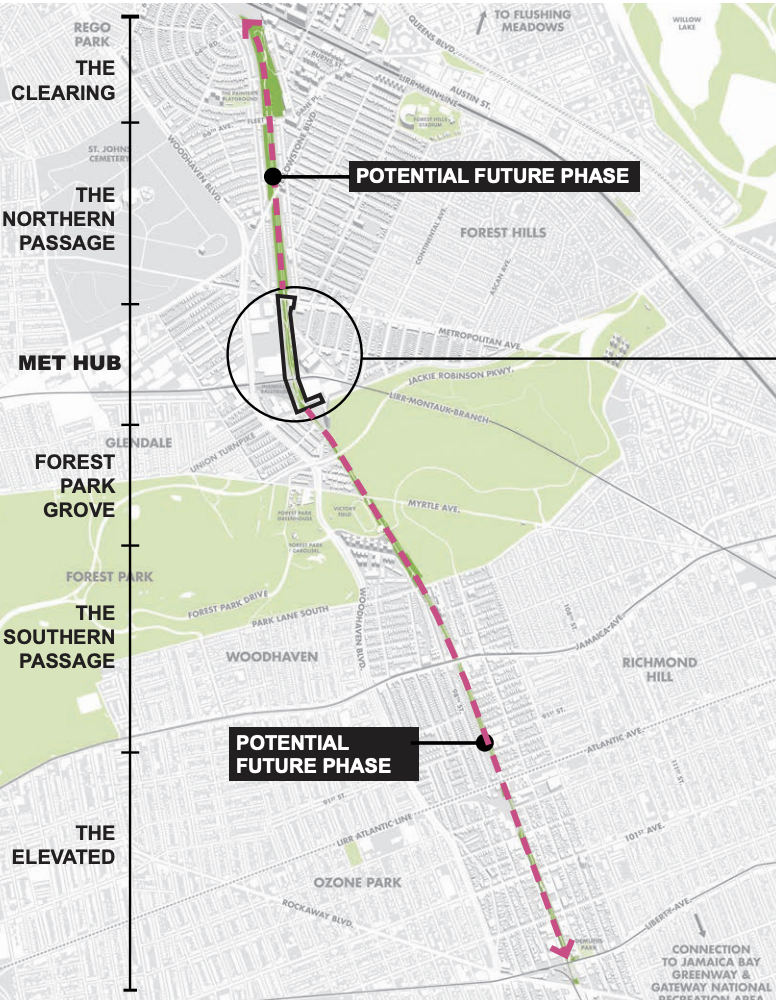
The QueensWay, a linear park planned for an old railway, and its first phase, a 5-acre park with 0.7 miles of new shared greenway, will soon be under construction.
However, the plan for the rest of the 3.5 miles of green space is facing funding questions, and is still competing for local support with the QueensLink, an ambitious idea to reactivate a train line on the same tracks where the city wants to build the park.
Earlier this month, Queens Community Board 6 overwhelmingly approved a resolution to support the first phase of the QueensWay, but ultimately included language that expressed their desire to not completely abandon the QueensLink idea. Both QueensWay and QueensLink supporters applauded the vote’s outcome as a victory.
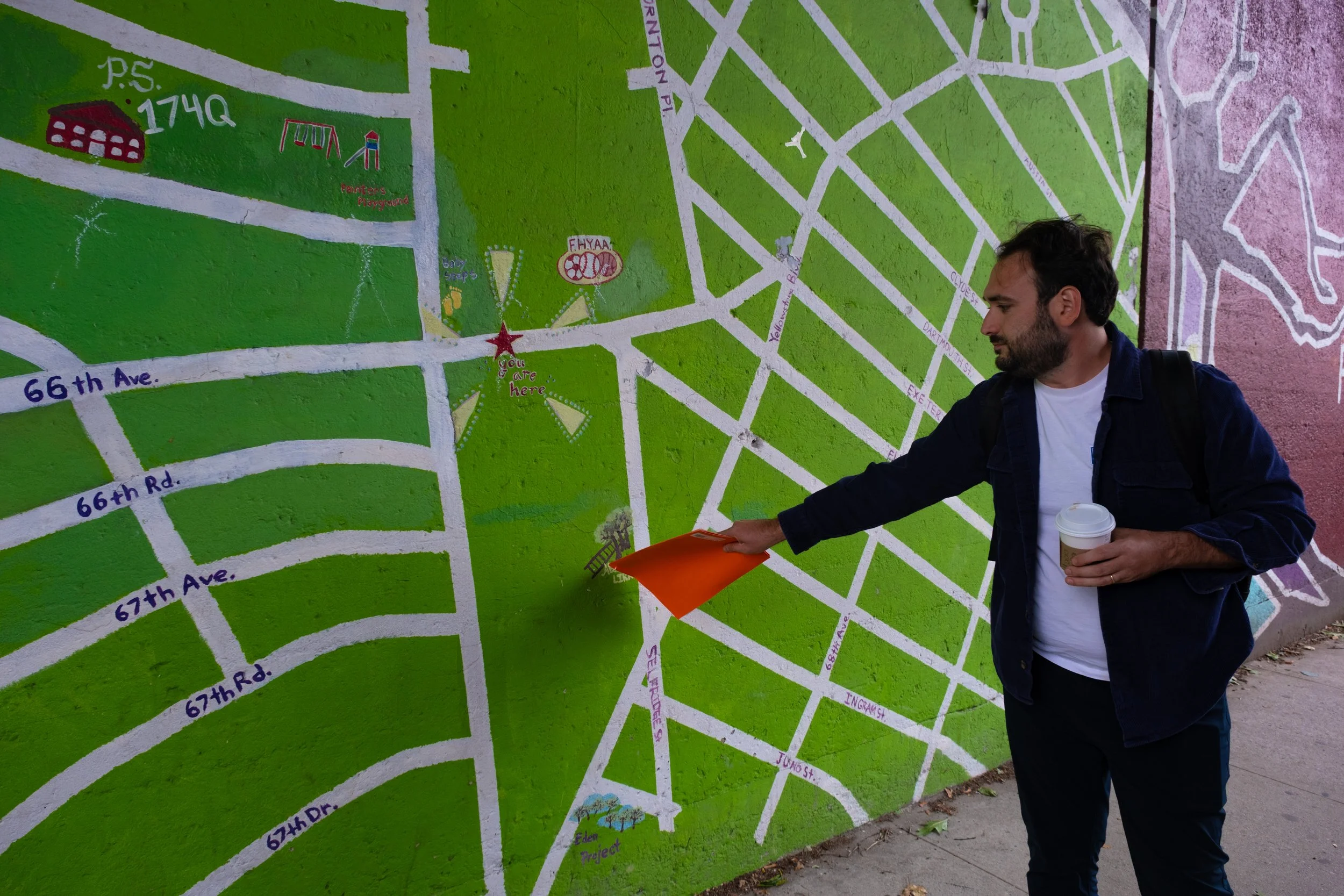
On a breezy, overcast September day, Surico took the Eagle on a tour of the future QueensWay site and talked about his vision for the park and the central Queens community that surrounds it.
“You need to show people what it can be,” Surico said, carrying a folder of renderings and other information on the planned park.
The linear park is often described as Queens’ own High Line, although Surico rejects that comparison.
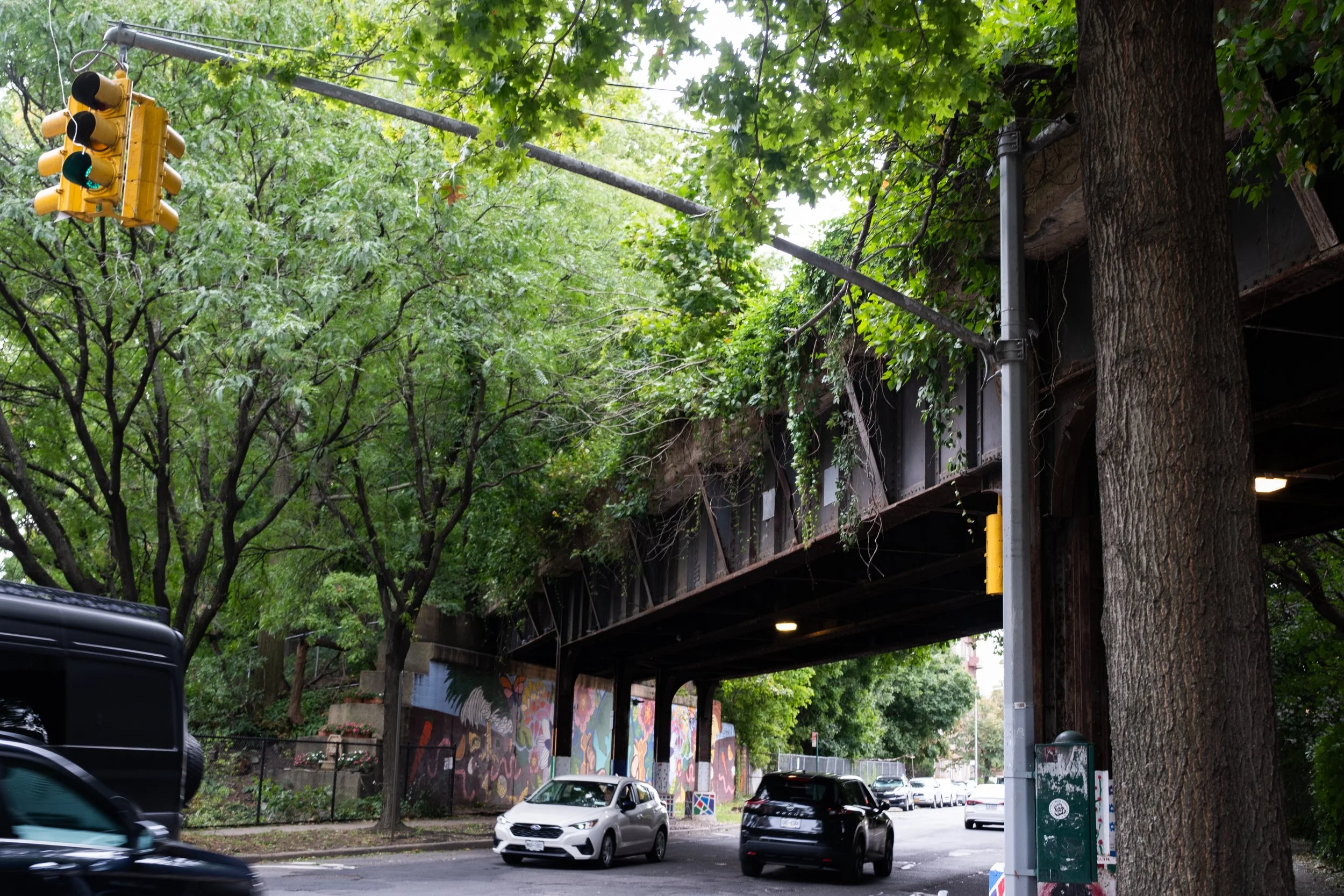
A part of the path that could one day be the site of the QueensWay park. Eagle photo by Ryan Schwach
“We're talking about Chelsea, the west side of Manhattan – mostly industrial, mostly commercial,” he said. “[Forest Hills] is all residential and a bit of commercial. Very different. And I would say [the High Line] was really for tourism and economic development.”
The first phase of the plan is called the Metropolitan Hub, and will take up a one-third mile segment north of Forest Park and run adjacent to the Metropolitan Expeditionary Learning School complex. It will include an outdoor learning and recreation space, partially designed for students from the school, as well as pedestrian paths and new plantings.
Surico has given tours to other local stakeholders and reporters as he works to drum up not just support for the project but awareness of it.
“Most people don't know the project is happening,” he said. “There's a huge information delta. A part of my job is just filling that.”
The project recently lost significant funding, adding to the confusion about its future. Last year, $117 million in federal funding for the second phase of the project was eliminated by the Trump administration.
“I've had reporters think that when Trump canceled the grant, that the project ended completely,” Surico said.
While the Metropolitan Hub portion of the project is funded with around $50 million from the city budget, future phases of the project remain unfunded.
A large portion of Surico’s role as the first executive director of the QueensWay is to figure out how to fund those future legs of the park. But for now, he is mainly focused on getting shovels in the ground for the first phase, which he hopes can be a proof of concept for the rest of the project.
“I think groundbreaking is a huge, existential moment,” he said. “It's a really big part of the inertia. I think so much of the will was dropped because it laid dormant. So, a lot of it is just reinvigorating that and making sure that people are aware that there's shovels in the ground.”
In order to get from one end of the abandoned rail to the other, Surico and the Eagle needed to traverse dilapidated pedestrian bridges that run adjacent to Woodhaven Boulevard, and carefully step around curbs and sidewalks where the road meets busy Metropolitan Boulevard.
It’s an “intense” journey, Surico said.
“Everything's quite disconnected, even though you have major parks nearby,” he said.
Other parts of the trail are overgrown with weeds and unstable trees.
Friends of the QueensWay and its partner, the Trust for Public Land, have led cleanups of the project site to get locals involved in the project, while also prepping the site for the future.
Surico’s vision for the QueensWay is for it to connect local schools, Little League fields, Forest Park and businesses along Woodhaven and Metropolitan Boulevards.
The project’s first executive director told the Eagle he wants to see the project to inspire and connect with other projects and initiatives, including Mayor Zohran Mamdani’s bus plan.
“I think it's extremely helpful that we have a mayor from Queens,” he said. “I think this is going to be an ongoing conversation to really socialize the project with his administration.”
Mamdani – who supported the QueensLink as a local Queens elected – has backed the QueensWay, but work beyond the first phase remains up in the air.
Still short of funding, other parts of the future route overlap with private property, including a parking lot for Forest Crescent View, a high-rise co-op building off Union Turnpike. In other parts, the land QueensWay wants to use encroaches on commercial parking lots.
Later phases will ultimately need a “much larger effort” from government and potentially private partners, Surico said.
A rendering of the future QueensWay plans. Rendering via Environmental Development Corporation
Then there's the QueensLink.
Backers of the QueensLink want the city to reactivate the Rockaway Beach line that was in use until the 1960s. They say the new line could shorten commutes to Manhattan by 20 minutes and could include new parkland around it.
The train dreams of QueensLink supporters have been marred by a lack of political will, and the insistence from the MTA that it would cost too much and wouldn’t serve enough riders to justify the price tag.
Like city officials, Surico said that by moving forward with the QueensWay, the city won’t be completely eliminating any future train hopes, though QueensLink supporters have questioned the claim.
Surico, whose personal advocacy work is mainly around transportation and open space, argues that the QueensWay project is essentially about transportation and improving navigation in a community that is not friendly to pedestrians.
“The greenway is a transportation project,” he said. “At the end of the day, QueensWay is not the same as a park where you go and sit. It's a linear park.”
As he begins the new role, Surico is full steam ahead on what QueensWay and its first phase Metropolitan Hub can do for the community in Queens.
“The idea that we could take this abandoned rail and do this really cool linear park in Central Queens, I think it's really profound,” he said. “We don't really have anything like it.”