Right to Counsel fails to live up to potential, report finds
/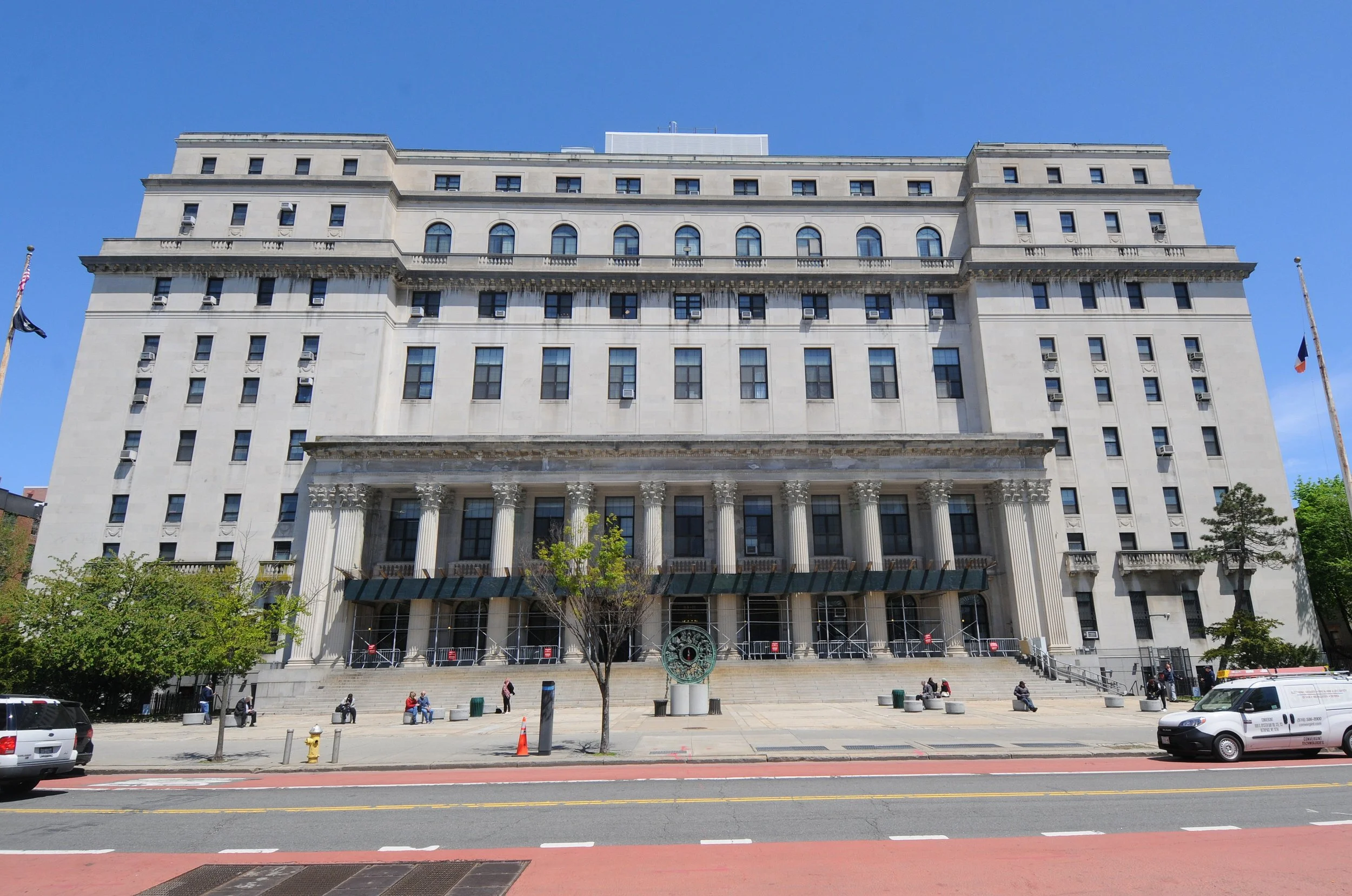
A new report from the Independent Budget Office shows that over half of eligible New Yorkers lack full legal representation in Housing Court, despite demand for Right to Counsel skyrocketing. Eagle file photo by Walter Karling
By Noah Powelson
The city’s first-in-the-nation right to counsel program has failed to live up to its potential after years of underfunding and mismanagement have left around three quarters of eligible New Yorkers without full legal representation in Housing Court, a new report shows.
New York City’s Independent Budget Office released a new report on the city’s RTC program last week, detailing how despite a growing number of eligible residents, a lack of funding and systemic changes to eviction law has left the program unable to keep up with demand.
While around 50 percent of tenants in Housing Court had representation in 2022, that number dropped to just 35 percent in 2024, leaving a vast majority of New Yorkers eligible for RTC services without a lawyer.
According to the report, eligibility for representation in Housing Court under RTC more than doubled from 2022 through 2024, roughly a 110 percent increase. But in that same time, government funding for RTC only grew by roughly 33 percent.
Between 2019 and 2024, the IBO estimated the annual number of eligible cases more than tripled, going from about 15,675 cases to 50,487 cases, a 222 percent increase. Over the same period, program spending increased only 129 percent.
First established in 2017, the RTC program aims to provide all New Yorkers facing eviction with free legal counsel, an oftentimes crucial factor in determining if a tenant will win their case.
Legislation expanding tenant protections and RTC coverage over the past years also created a new housing court landscape that the program has yet to fully adapt to, according to the report.
In 2019, the state passed the Housing Stability and Tenant Protection Act, which established a litany of new tenant protections that caused many eviction cases to progress through the courts at a much slower pace. HSPA, among many reforms, required landlords to give tenants longer notices ahead of hearings and increased the amount of time tenants have to answer legal filings and lengthened the time permitted for adjournments.
RTC was also originally meant to be implemented in a gradual rollout, where RTC would cover specific New York City ZIP codes that would expand over the years.
But the city pivoted when the COVID-19 pandemic arrived. With scores of New Yorkers facing new housing pressures, the city began a rapid expansion of RTC coverage, ending ZIP code screening and instituting RTC citywide. The extension was initially manageable with the institution of an eviction moratorium, significantly cutting back on the number of eviction cases on the courts’ docket, according to the report.
But once the moratorium ended in January 2022, RTC saw every rising demand for representation as landlords began filing cases alleging months of delayed rent payments.
As a result of the changes, exponentially more cases were filed post-pandemic, many of which were substantially more complicated and took more time to process than when the program was first implemented, according to the report.
For cases filed in January 2023 through June 2024, IBO estimated an average of 47 percent of cases were disposed and only 54 percent reached a first decision within six months. Before the pandemic, 88 percent of cases with tenant appearance were disposed and 93 percent had a first decision within six months.
“These trends toward longer case lengths, increased eligibility, and stagnant funding have resulted in a reduced capacity for full legal representation,” the report reads. “At present, over half of tenants with eligible cases are not getting the full representation they are legally entitled to and often instead face eviction proceedings with no meaningful legal support.”
According to the report, around 97 percent of general eviction cases were resolved within a year prior to the pandemic. But after the pandemic, case lengths grew, which researchers partially attribute to state-level rule changes in 2019. In 2023, 87 percent of eviction cases were resolved in a year.
Longer cases would continue to strain RTC’s resources as the city’s Human Resource Administration, one of the program's funding sources, implemented new limits on what cases would receive funding.
“Coinciding with lengthening case times, HRA announced that it would no longer fund representation for cases that took longer than one year, even though attorneys handling such cases would be ethically bound to continue working on them,” the report reads.
Because of the demands of longer cases taking of the RTC program’s resources, tenants seeking legal representation more often than not only end up with “brief assistance,” a one-time consultation often in a courthouse or through a hotline. Brief assistance is not legal representation, but IBO found it was the primary service of RTC last year.
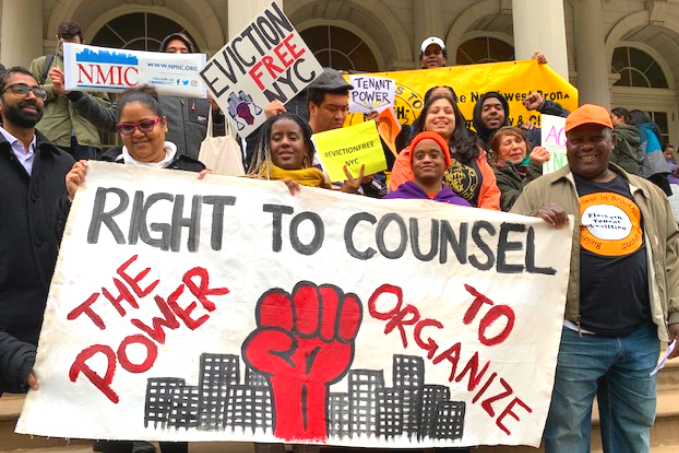
Right to Counsel eligibility has more than doubled from 2022 to 2024, but government funding only increased by 33 percent, which advocates say is not enough to meet the city’s demand. Photo courtesy of the Right to Counsel Coalition
In 2024, over half of all tenants served by RTC programs received only brief assistance, compared with 10 percent of those served by these same programs on average from 2017 through 2019, according to the report.
In May, the New York City comptroller’s office released a report that detailed how RTC remains underfunded and legal organizations that provide RTC services suffer from serious staff retention issues.
The report found that across all five boroughs, RTC representation rates dropped from 71 percent in 2021 to 42 percent in 2024, meaning only four of every 10 eligible New Yorkers facing eviction had legal representation.
Queens also saw a significant drop in representation, going from 81 percent in 2021 to 46 percent in 2024, according to the comptroller’s report.
In a response to an Eagle inquiry, a spokesperson for the Department of Social Services said Mayor Eric Adams has invested significantly into RTC,
“Since the start of the Adams administration, the city has doubled its investments in Right to Counsel and expanded it citywide on an accelerated timeline,” the spokesperson said. “Since implementing these changes, we are seeing promising results with a record number of households receiving legal services and supports in FY25. We continue to work closely with providers to address any challenges impacting their ability to meet agency goals and appreciate the IBO taking a comprehensive look at the program while also calling attention to external challenges.”
“We remain committed to building on these ongoing efforts to reach every eligible tenant at risk of eviction,” the spokesperson added.
Legal advocates have repeatedly said there is no single more important factor determining if a tenant will be evicted than if they have legal representation. The Office of Civil Justice reported that 89 percent of tenants who had full legal representation were able to win their eviction cases in 2024.
“Now more than ever, there is an urgent need for increased funding to ensure all New Yorkers have full and fair access to the zealous legal representation they need and deserve,” a Legal Aid Society spokesperson said in a statement. “Amid a historic affordability crisis, continuing to chronically underfund the RTC program will only result in increased rates of eviction and displacement among New York City’s most vulnerable populations.”
“Moreover, particularly given the federal government’s recent cuts to rental assistance, our City leaders must take immediate action to ensure RTC is fully funded to ensure all New Yorkers are protected against the devastating effects of eviction, displacement, and homelessness,” the spokesperson added.