Roosevelt Ave. crackdown pushes street vendors toward pricey black-market permits
/
To avoid fines and cart seizures, 56-year-old vendor Maria Namo relies on a black-market permit while selling Ecuadorian meringue in Queens. Photo by Juan Lasso
By Juan Lasso and Gabriela Flores
Street vendors in Queens are resorting to an increasingly expensive tactic to survive New York City’s multi-agency quality-of-life crackdown on Roosevelt Avenue: paying thousands of dollars for black-market food permits.
Since the city’s launch of “Operation Restore Roosevelt” in October — aiming to clean up brothels, sex trafficking and unlicensed food carts in and around Roosevelt Avenue — food cart vendors without permits have scrambled to avoid getting shut down or fined.
Some have turned to the black market, where they have paid up to $25,000 for a permit that ran its original owner no more than $200.
Maria Namo, who sells Ecuadorian street food from a cart on 37th Avenue, said she paid $14,000 for a "rented" permit — far from cheap, but essential to fend off the city’s heightened enforcement.
“Now I have to make back what I paid,” she said. “But thanks to the permit, the police don’t bother us, and we can work in peace to pay it off.”
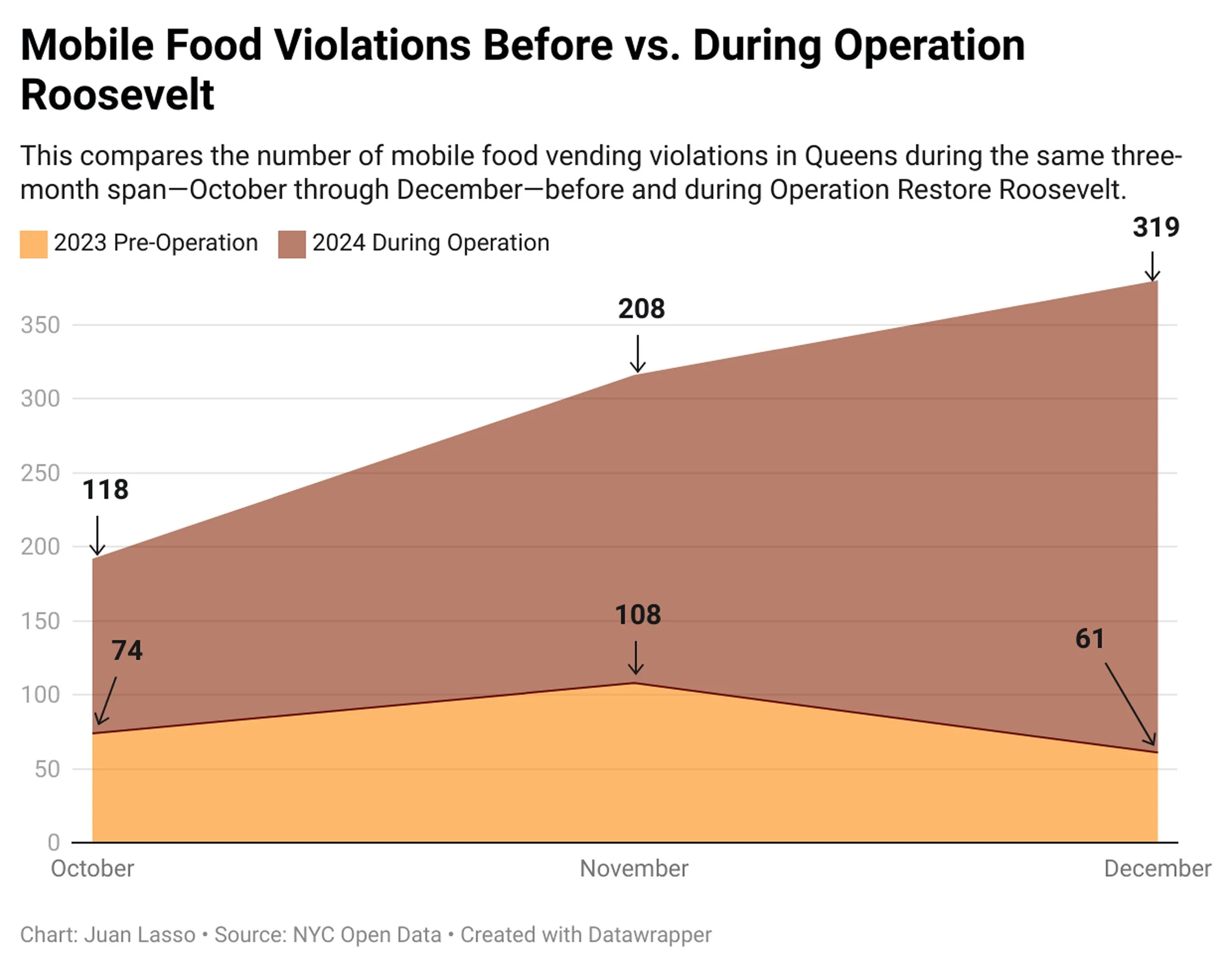
Under Operation Restore Roosevelt, illegal vendors have been increasingly put in the crosshairs of both police and the Department of Sanitation. City data shows mobile food vending violation summonses in Queens surged during the first three months of Operation Restore Roosevelt compared to the same period the previous year, rising 59.5 percent in October, 92.6 percent in November, and 423 percent in December.
Mayor Eric Adams vows the crackdown won’t be stopping anytime soon, according to a January release. But while unpermitted vendors are forced from the space, they say the legal path to securing a mobile food permit remains out of reach for far too many.
Across the five boroughs, there are roughly 20,500 mobile food vendors, according to a report by the Immigration Research Initiative, with about 5,100 legal mobile food vending permits in circulation. The fierce demand and limited supply have fueled a black market, long acknowledged by experts and city officials, where permits — originally fetching a few hundred dollars — are illegally transferred or rented for tens of thousands of dollars.
In 2021, the City Council approved legislation to issue 445 new “supervisory licenses” annually for the next decade. The new licenses offer a path to full-term food permits while cracking down on illegal permit resales by requiring vendors to operate their own carts. Yet a sluggish rollout has resulted in only a handful of new permits, leaving nearly 10,000 vendors on a citywide waiting list, as of October 2023, according to the NYC Independent Budget Office.
One fruit vendor on Junction Boulevard, who wanted to remain anonymous for fear of retribution, allegedly pays a permit holder between $18,000 to $25,000 every two years when it's time for permit renewal. After nearly three decades on the waitlist, she calls renting simply the cost of doing business.
"The owner rents me the permit, but I’m responsible for the sticker and keeping it in order,” she said. “The license is mine, the permit is his.”
“If I had my own permit, imagine how much I would save,” she added. “I have to work for three parties: the city, the owner of the permit, and myself.”
To operate legally, vendors must hold a food vending license and affix a city-issued permit decal to their cart or truck. Unlike permits, licenses aren't capped — applicants pay a $50 fee, complete a food safety course, provide tax or Social Security info and renew every two years.
While black market permits have allowed some previously illegal vendors to operate under the law, the vast majority remain without one. A 2021 survey by the Street Vendor Project at the Urban Justice Center found that 75 percent of mobile food vendors operated without a permit. In the competitive landscape of street vending, those with proper paperwork — even if acquired through questionable means — have long enjoyed an edge.
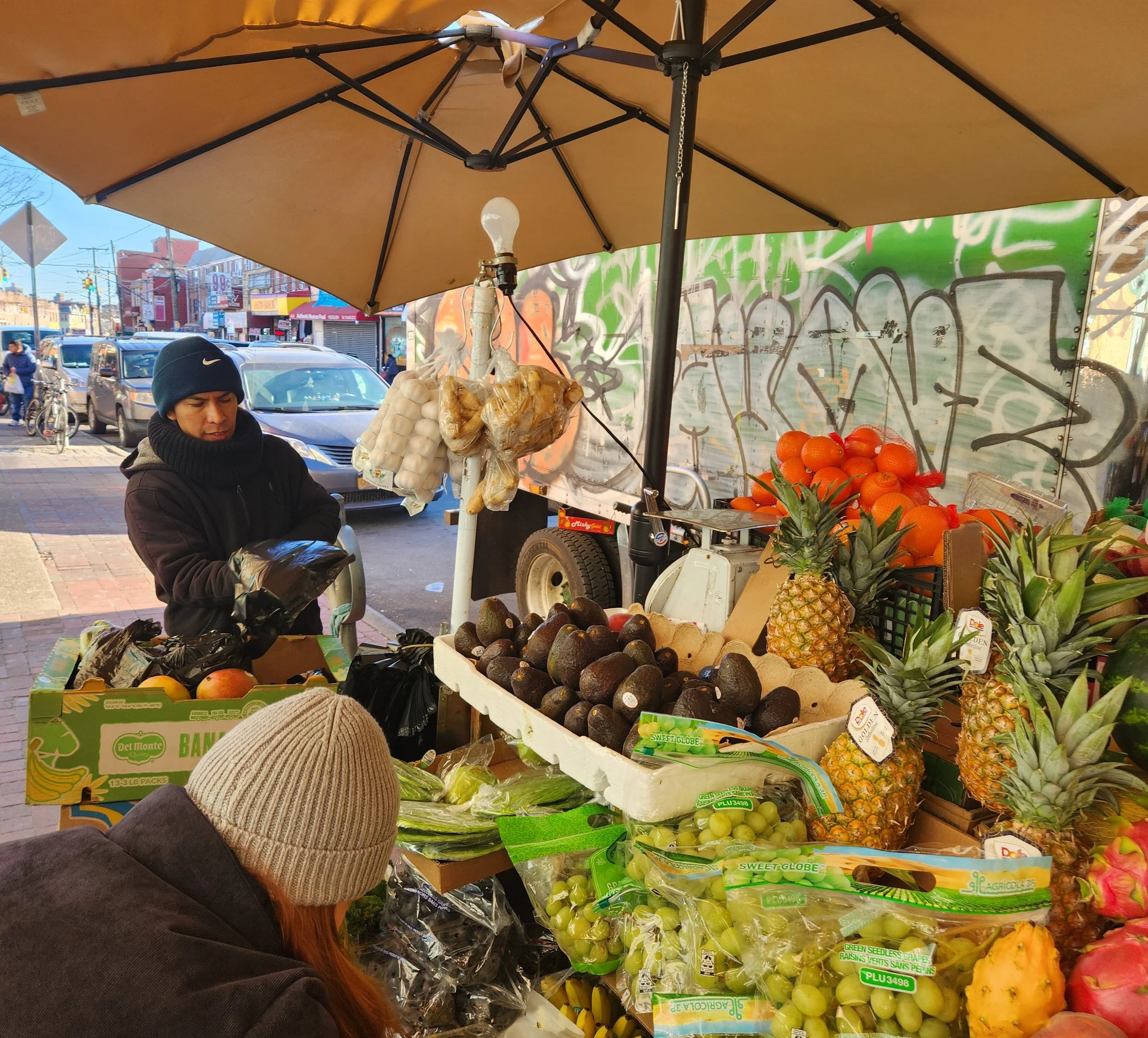
A fruit vendor on Junction Boulevard pays up to $25,000 every two years to rent a food cart permit on the black market — far above the city’s standard $200 fee. Photo by Juan Lasso
Supporters of Operation Roosevelt claim that tougher enforcement sends a clear message to vendors flouting health and safety rules, even if it inadvertently risks bolstering the black market for permits. Queens Councilman Francisco Moya, who launched Operation Restore Roosevelt alongside Adams, said the clampdown focuses on “restoring order” to chaotic streets.
“The community, along with local businesses who were experiencing a reduction in customers due to illegal vending, has strongly supported this initiative, as it fosters a more organized and fair environment for all,” Moya said in a statement.
During Operation Restore Roosevelt’s first 90 days, Noma, the Ecuadorian street food vendor, described scenes of unlicensed vendors weeping as they watched their carts confiscated. But the enforcement is not without an upside, she said.
“Before the police arrived, it was a complete disaster,” Noma said. “Vendors were piled on top of each other, surrounded by rat-infested trash, cardboard, and cooking oil spilling onto the street.”
Moya, who supported expanding mobile food vendor permits in 2021, has introduced a bill to further tighten regulations by banning vendors from selling in highly trafficked spots under bridges, overpasses, and elevated train stations.
But Ryan Devlin, assistant professor of City Planning & Community Development at Temple University, said the city’s strict regulations make it more difficult for new vendors to compete on a fair footing with established ones. Ramped-up enforcement will only drive this wedge deeper, he said.
"For a new arrival with limited resources, the costs and logistics of starting a food vending business are prohibitively high. That’s why many choose to vend informally,” he said. “If you define success purely in terms of eliminating vendors for quality-of-life reasons, Operation Roosevelt has been effective, but a more empathetic, inclusive approach would involve creating more pathways for legal operation.”
Ana Lucia Sarabia Paguay, an Ecuadorian immigrant, sells herbal detox drinks outside the Rite Aid on 37th Avenue, touting their benefits for kidney and liver health. When she and her husband struggled to find work, they saw the drinks as a niche market with a unique selling hook and turned to street vending four years ago. She does not have a permit or license. She knows the business can be stripped from her at any moment. She’s already lost one cart to the police and been hit with a summons.
Operation Restore Roosevelt has only made staying in business harder, she said.
“We have to be alert. That’s why we try to sell early because if the police come, we have to pack up and go home,” she said.
Paguay’s husband is on the waitlist for a permit and was set to take the mobile food protection course back in March, a key first step to obtaining a license. The process, however, is slow going with “a lot of red tape involved.”
In the meantime, she and her husband do their best to stay in business and avoid fines that they would never be able to pay.
“We have bills,” she said. “And sometimes we don’t have enough by the end of the month.”