Queens court officer honored for discovering gun smuggled in court
/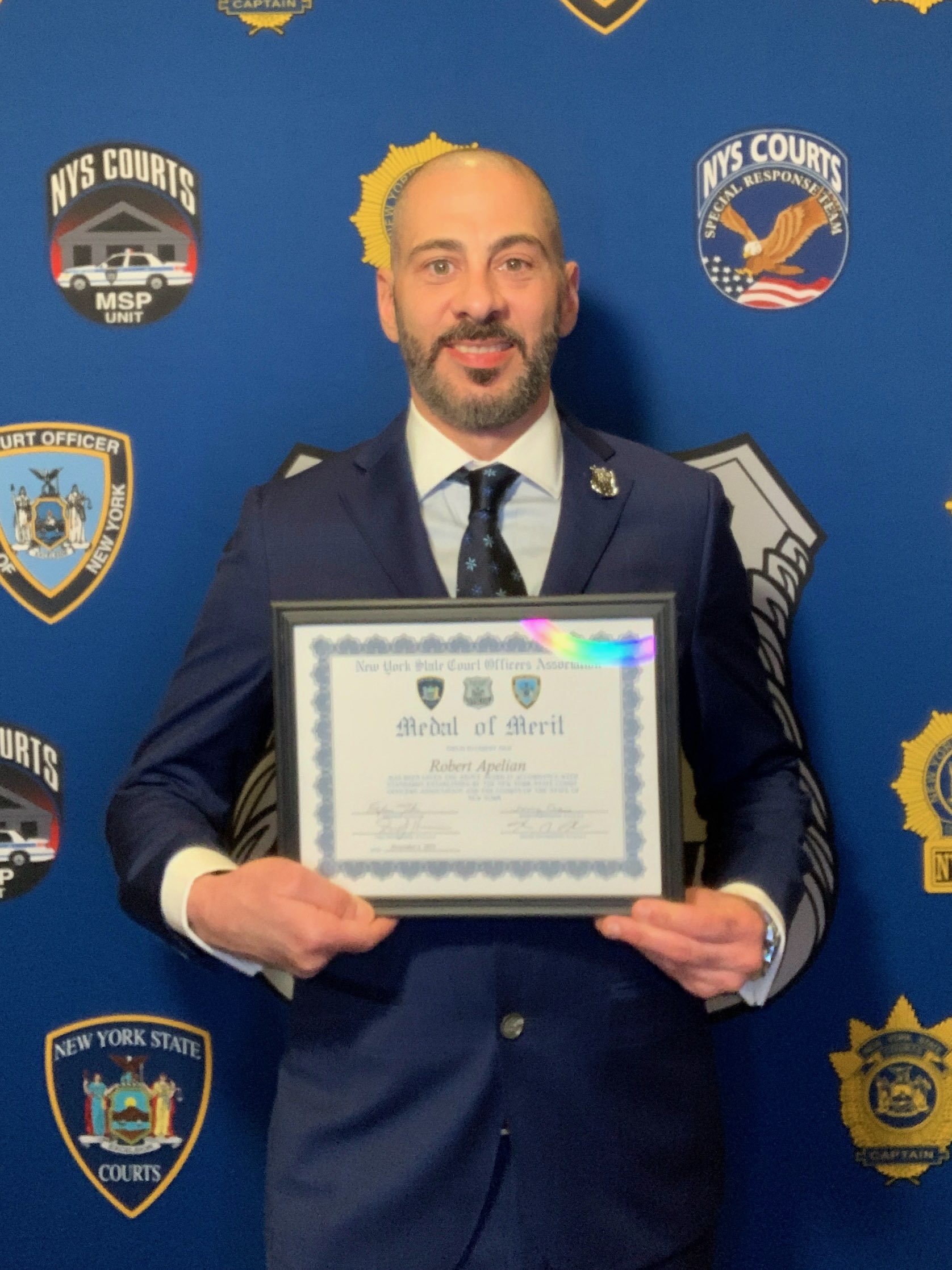
Court officer Robert Apelian was given a Medal of Merit from the New York State Court Officer Association for preventing a gun from entering Queens Criminal Court. Photo Courtesy of Robert Apelian
By Noah Powelson
Thousands of people come through the doors of the state’s Criminal Courts every day, where hundreds of court officers work to make sure the buildings remain safe.
One such officer in Queens Criminal Court was recently honored for stopping a man from bringing a gun to his court hearing.
Over 80 court officers were recently honored with a Medal of Merit by the New York State Court Officer Association on Monday, Nov. 3, all for performing their duties to the utmost degree. Among that crowd was roughly a dozen Queens officers, including Flushing born and raised Robert Apelian.
Apelian told the Eagle he was happy to be honored, but said finding and seizing a gun a man tried to bring into the court was all part of his job.
“It was very straightforward, but it was the combination of my partner doing his job well…and then me also following up and not being dismissive, that led to that arrest,” Apelian told the Eagle.
In June 2024, Apelian and his partner discovered someone attempting to smuggle a small pistol through security at Queens Criminal Courthouse in Kew Gardens.
According to Apelian and the criminal complaint, 60-year-old Roman Mosheev had entered the Criminal Courthouse on June 4, 2024, to attend a court hearing. Apelian said nothing about the man in question aroused any initial suspicion as he walked to security, but the metal detector went off when Mosheev passed through.
After Mosheev insisted he didn’t have any metal on him, Apelian and his partner used a hand metal detector and got a response in the defendant’s coat pocket. Inside his pockets, Apelian found a small metal object wrapped up in a napkin, which Mosheev claimed was a pocket lighter.
“But then as I go to inspect it, I'm like, ‘This is a gun.” Apelian told the Eagle, recalling the day. “[Mosheev] said, ‘No, no, it's just a gun lighter.’”
“And I'm like, ‘No, no, it isn't,’” Apelian said.
The gun, which a spokesperson for the Queens district attorney’s office said was later discovered to be inoperable, was a .22 Derringer. The small firearm, sometimes referred to as a pocket gun, is just slightly bigger than a finger and can often only hold only one or two bullets.
Mosheev claimed he found the firearm on the sidewalk, and that he believed it was just a lighter. Whether he was being truthful or not, Apelian couldn’t say, but he did arrest Mosheev and retrieved the pistol. Mosheev didn’t resist arrest, and later pleaded guilty to illegal possession of a firearm.
But the incident is not isolated, Apelian said. Every day people, whether intentionally or unwittingly, bring illegal items, materials or sometimes weapons through court security, though it is rarely as severe as a firearm.
Whether it’s pepper spray or brass knuckles, both of which are illegal in New York City, or even pairing knives, court officers daily and often multiple times per day have to seize weapons brought in through security. The vast majority of these items are not brought in for nefarious means, more often than not people don’t stop to consider an item they carry with them every day might not be allowed in court.
“People never cease to amaze you,” Apelian said. “There are a lot of people who are completely aloof to the laws.”
At the award ceremony on Nov. 3, Apelian received a certificate in recognition of his work, alongside a merit bar which he wears alongside his badge while on duty. Apelian also said while he was happy for the acknowledgement, he also wants to make sure his partner for the arrest, Peter Romano, gets the credit he deserves for his part.
“We worked together, he did his job properly and told the defendant to empty out his pockets,” Apelian said. “So it was him checking it out that means we were able to find [the gun] after the fact.”
Apelian, who has worked as a court officer for Queens Criminal Court for the last seven years, has a long history of civil service. Before becoming a court officer, Apelian worked as an EMT for 17 years.
While he had participated in other arrests and intervened in other incidents that could have resulted in someone being hurt, the incident with Mosheev was the first where he and his partner discovered the transgression.
“I was happy I was there, and I was happy that I was able to do my job well,” Apelian told the Eagle. “It's these types of incidents that really showcase how important it is for what we do to protect the people of the courthouse.”