
Notorious jail barge cut from city’s shores
/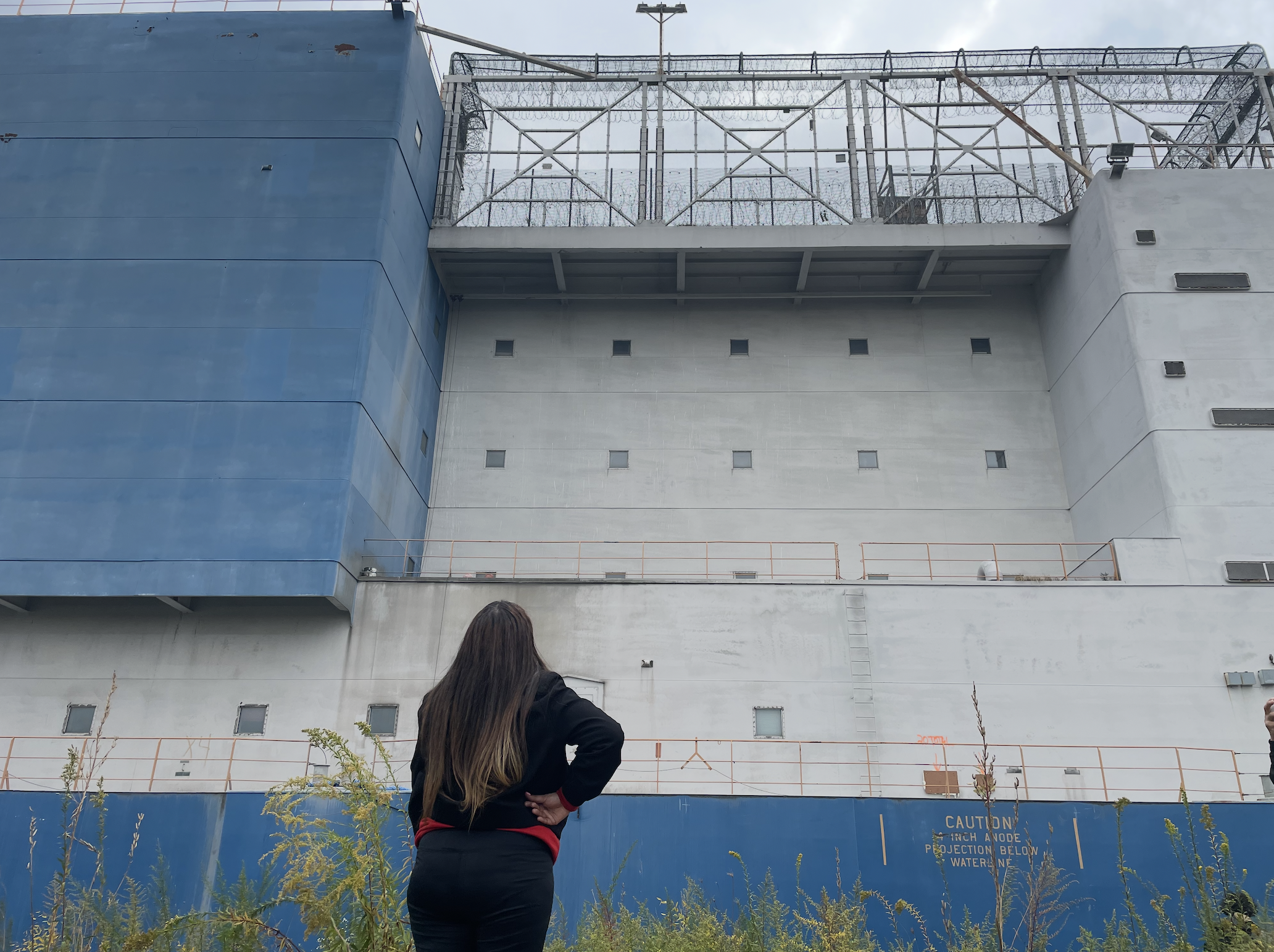
Lezandre Khadu, whose son, Stephan Khadu, died in the Vernon C. Bain Center after contracting meningitis there in 2021, watched as the jail barge departed from the city’s shores. Eagle photo by Jacob Kaye
By Jacob Kaye
The city’s notorious jail barge was cut from its shores last week and sent south to be turned into scrap metal, putting an end to a dark chapter in the city’s history.
The Vernon C. Bain Center, better known as “The Boat,” was tugged out of New York’s waters by a Louisiana scrap metal company last Monday after sitting on the shore of the Bronx for over 30 years.
While a momentous occasion for the effort to close Rikers Island, the jail barge’s departure was witnessed only by a small group of city workers, advocates and families whose lives had been upended by The Boat.
Among them was Lezandre Khadu, whose son, Stephan Khadu, died in the jail facility after contracting meningitis there in 2021. Following her son’s death, Khadu has dedicated her time to ensuring The Boat and Rikers Island’s broader jail complex be shut down in accordance with city law.
As the jail barge departed on its two-week journey down the east coast last week, it revealed a view of Rikers Island from the Bronx’s shore.
“One stain off of New York City,” Khadu said. “On to the next one.”
While the Vernon C. Bain Center had not been used by the city as a jail facility since 2023 when it was decommissioned, its destruction is a notable moment of progress in the city’s massively delayed effort to reform its jails.
“Good riddance,” Adolfo Carrión, the commissioner of the Department of Housing Preservation and Development, said. “This is a big moment.”
The Vernon C. Bain Center first arrived in New York City in the 1990s, when the city’s jail population ballooned to over 20,000 people, an all-time high – coincidentally, the barge was built in Louisiana, the state where it will now be turned into scrap.
But long after arriving in the five boroughs, the city’s use for it wasn’t as obvious. The jail population began to decline and The Boat sat vacant. Eventually, the city began using it as an intake center and eventually as a housing facility.
Though The Boat was supposed to be a temporary measure, it soon became a fixture of the city’s jail system. It was permanently secured to the dock by large metal clamps that had to be cut through last week before the jail could float off.
Over the years, the floating jail became a symbol of the city’s inability to reform its crumbling jail system, which a federal judge earlier this year ordered be put under a federal receivership. While detainees, lawyers, advocates, judges, correctional officers and others have claimed conditions across all Department of Correction jail facilities are poor, conditions on The Boat were, at times, described as being particularly bad.
At 625 feet, The Boat stretched nearly as long as two football fields and weighed around 16,700 tons. It had the capacity to hold 800 people.
At the time of its decommission in 2023, the Vernon C. Bain Center was believed to be the only operating jail barge in the U.S.
The barge was a first for Louisiana Scrap Metal, the company that purchased the boat for $1.45 million.
The company tugged the barge out of New York City’s shores and has been bringing it down the East Coast for the past week. Eventually, the jail boat will be pushed around Florida and up into Louisiana, where it will be stripped of its non-metallic materials and then cut into scrap.
“Being in this industry, we come across a lot of unique projects,” said Randy Bourdreaux, the company’s development manager, who added that he was “really surprised at how big it was.”
In The Boat’s place, the city plans to create the Hunts Point Marine Terminal, a site to move freight off of ships and onto their last mile in their delivery. The transition has been handled by the city’s Economic Development Corporation.
Carrión described the effort as a new and restorative start for the area, which he formerly represented as a city councilmember and as Bronx borough president.
The Boat’s departure was particularly gratifying for a group of advocates who have been fighting to get the facility shuttered for years.
Edith Mayfield, whose late husband, Marvin Mayfield, was a leader in the movement to close Rikers, said that she was pleased to know all the years of advocacy work were not in vain.
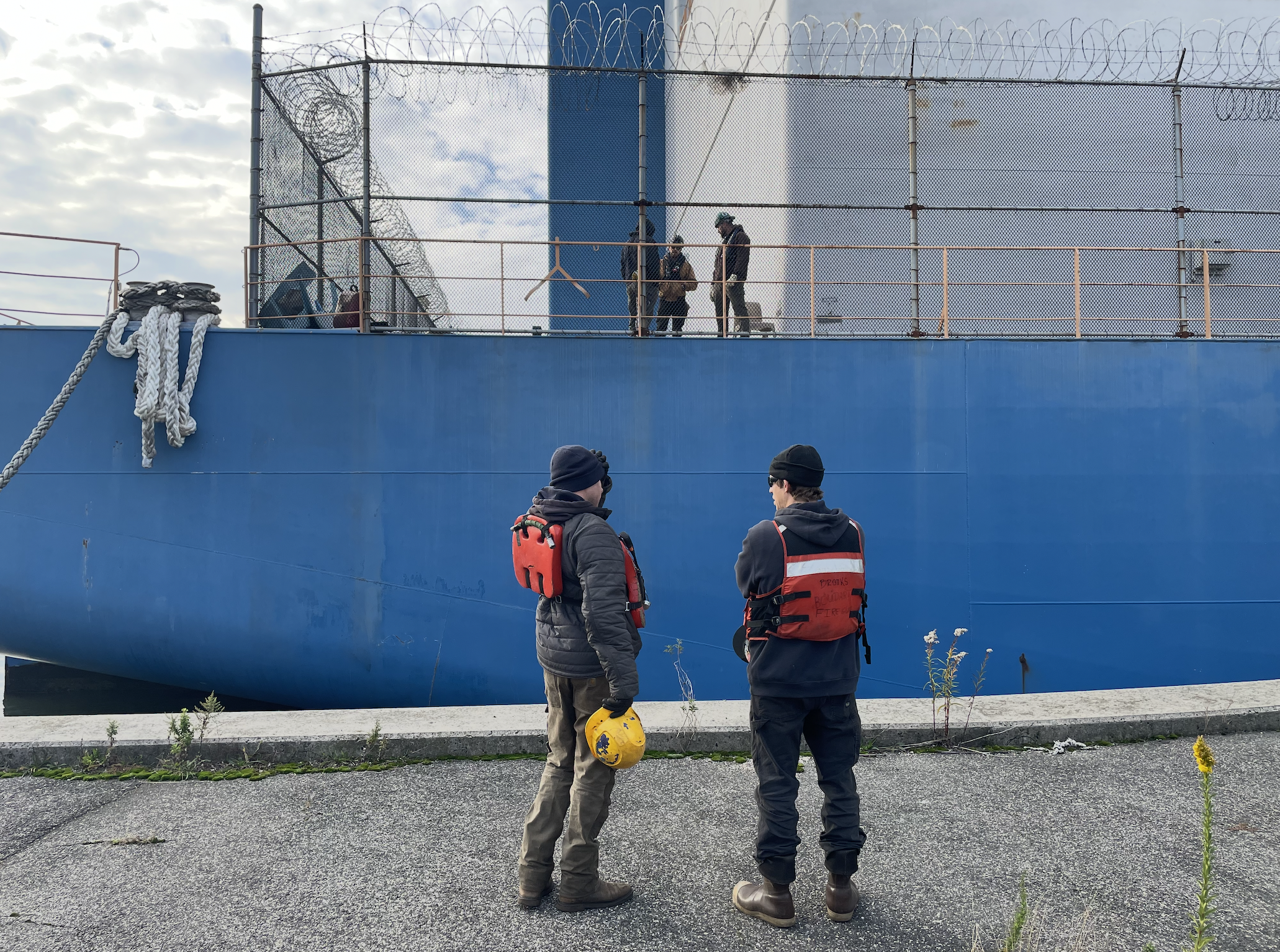
Workers prepare to cut the Vernon C. Bain Center from the city’s shores. Eagle photo by Jacob Kaye
“No more Vernon C. Bain,” she said after the barge had been cut from the shore. “I’m just overwhelmed with emotion right now.”
The Vernon C. Bain Center is one of a handful of jail facilities closed by the Department of Correction over the past five years. Nonetheless, the city remains deeply behind schedule when it comes to shutting down Rikers Island as a de facto penal colony and opening four borough-based jails to replace it.
The first of the borough facilities, which are currently under construction, is not going to open until 2029, two years after the city is legally mandated to close Rikers. The last jail isn’t expected to come online until 2032, five years after the deadline.
Still, Darren Mack, the co-director of Freedom Agenda, said The Boat’s departure was significant.
“This is just the beginning,” he said.
While the city appeared pleased to say goodbye to the facility last week, at least a part of it will remain in the five boroughs.
When workers with Louisiana Scrap Metal were preparing the ship for its journey, they came across a mural painted on a wall by detainees in honor of Stephan Khadu.
The workers told his mother that when The Boat arrived at their facility, they’d cut the mural out, and get it back to her for safekeeping.