Queens pols demand gov sign medical language access bill
/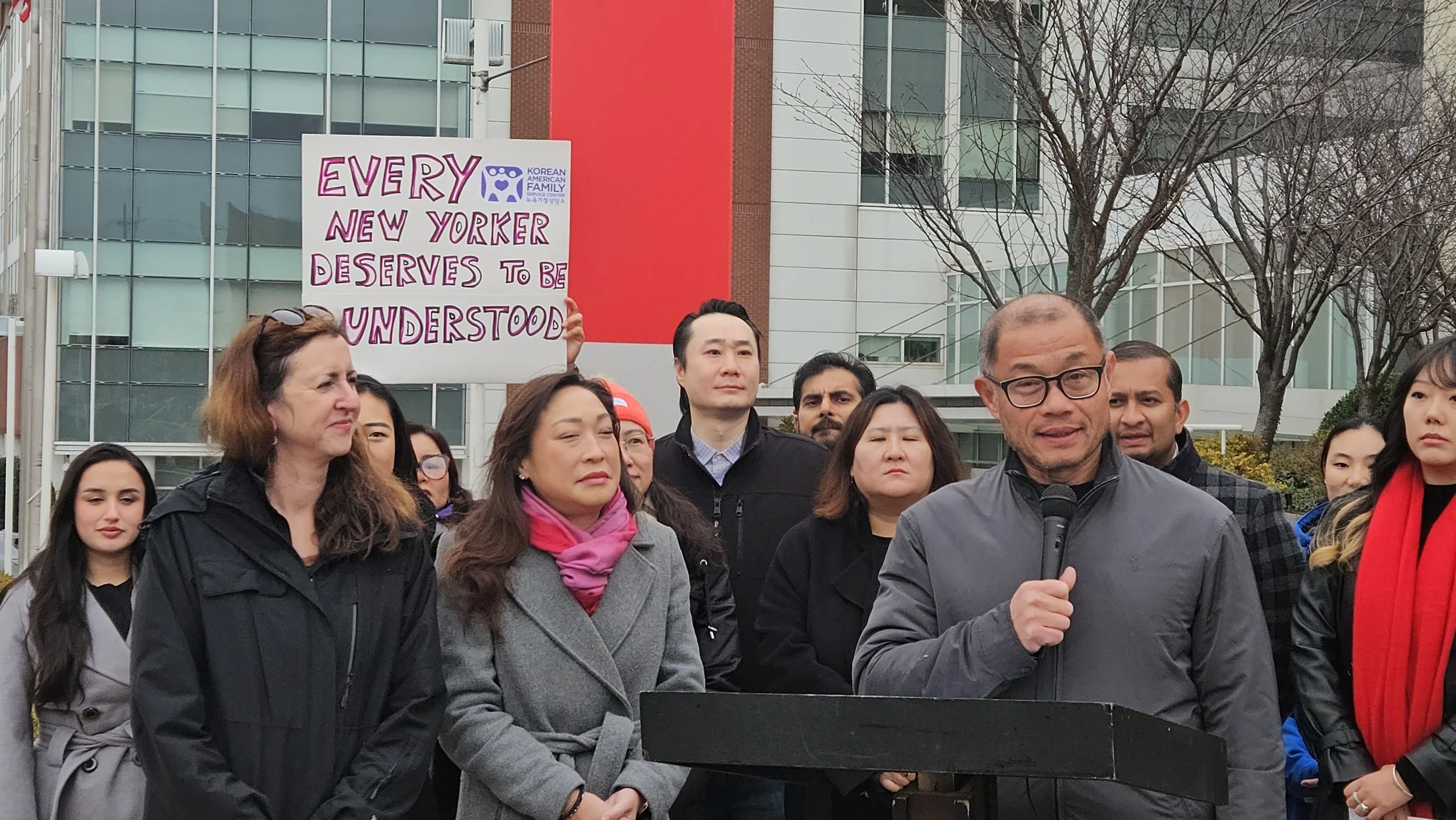
From left to right, Queens Assembly Member Nily Rozic, Queens City Councilmember Linda Lee and Queens State Senator John Liu rally outside New York-Presbyterian Queens hospital, demanding Governor Kathy Hochul sign a new medical language access bill.Eagle photo by Noah Powelson
By Noah Powelson
Children of immigrants and non-native English speakers often become their family’s translators growing up, a task they are often unequipped for when their parents are seeking precise clear instructions for their medical care.
Advocates said the current system places the burden on families and children to find their language needs, and called on the governor this week to address the issue through a piece of legislation from two Queens officials.
On a brisk Wednesday morning in Flushing, a coalition of elected officials, community advocates and immigrant services representatives called on Governor Kathy Hochul to take action in creating more medical access and services for non-native English speakers before the year is up.
Standing outside the New York-Presbyterian Queens hospital, Queens State Senator John Liu and Queens Assemblymember Nily Rozic demanded the governor sign a bill the two legislators sponsored which would expand language services in New York general hospitals.
“It’s hard enough for a fully English proficient person to understand all the forms they have to sign and all the options that they have,” Liu said. “We need to make it somewhat easier for patients, as well as family members, to know what’s going on. That’s the crux of the bill.”
“Governor Hochul, please do the right thing,” Liu added.
The bill would require general hospitals in New York State to create language assistance programs, each with a designated Language Assistance Coordinator to oversee services. It would also require hospitals to properly display available language services for patients, and record patients’ acceptance or refusal of services.
The bill’s sponsors said the proposed legislation is common sense, especially for New York City and Queens, known for being some of the most culturally and ethnically diverse areas in the world.
“For too long language barriers have stood between patients and the care they need,” Rozic said. “Here in Queens, one of the most linguistically diverse places in the world, that barrier can mean the difference between actually understanding a diagnosis or missing critical information. Between following a care plan or falling through the cracks.”
The bill would also prohibit family members of patients from acting as interpreters, unless the patient denies language services offered by the hospital and consents non-hospital persons to translate for them.
According to the Coalition for Asian American Children and Families, over half of all adverse medical events for Limited English Proficient patients are linked to communication errors. Sherry Chen, the health policy coordinator at CACF, said that LEP patients experience longer emergency hospital stays and higher readmission rates than English speaking patients.
“When the system fails them, their families – especially their children – are forced to step in. Often being relied on to translate complex medical information,” Chen said. “This raises serious concerns around patient privacy and the ability for family members to be able to provide accurate information, which heavily impacts the provider’s ability to avoid misdiagnosis.”
Queens City Councilmember Linda Lee also voiced her support of the bill.
The bill passed through both the State Senate and Assembly with near unanimous votes in approval. It is currently waiting for the governor’s signature before it comes into law.
Spokespersons for the Asian American Federation, Asian Americans for Equality, the American Pakistani Advocacy Group, Korean American Family Service Center and the Chinese American Planning Council, also attended the event and added their voices in support of the bill.
A spokesperson for the governor’s office said Hochul would review the legislation.