Mayor’s judicial committee releases first-ever code of conduct
/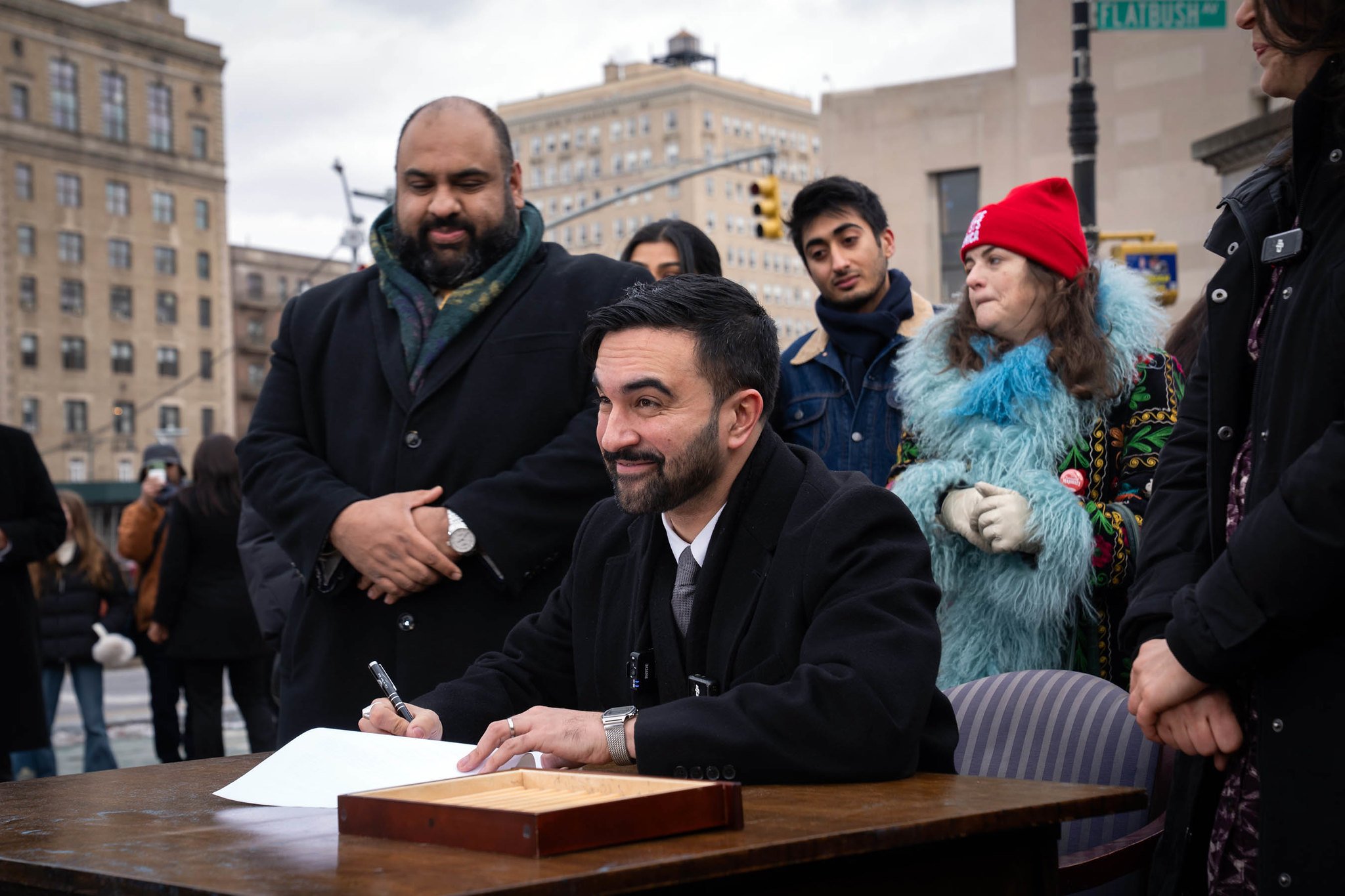
The Mayor’s Advisory Committee on the Judiciary, led by Queens lawyer Ali Najmi, published its first-ever code of conduct, which it was ordered to do by Mayor Zohran Mamdani in January. File photo by Ed Reed/Mayoral Photography Office
By Jacob Kaye
The group charged with nominating the city’s judges recently published its first-ever code of conduct for its members to abide by, an attempt to fulfill, in part, the mayor’s promise to make the powerful committee more transparent.
The Mayor’s Advisory Committee on the Judiciary, which recommends judges for Family Court and Civil Court to the mayor, and interim appointees to the city’s Criminal Courts, made public its three-page code of conduct.
The document spells out the committee’s conflict of interest policies and outlines its core principles, including its commitment to merit-based evaluations, confidentiality and professionalism.
The document marks the first time the committee, which has been in existence for decades, has publicly presented a code of conduct.
Advocates have long called for the 19-member committee to conduct its work more transparently.
The committee has been accused in the past of being guarded about its selection process, leaving the public with little understanding of why someone was selected to serve on the bench and why others were passed over. The committee has also been criticized for often recommending prosecutors or court attorneys for judicial positions, ignoring entire swaths of the city’s legal community, like public defenders.
During his first days in office, Mayor Zohran Mamdani issued a five-page executive order, detailing measures the committee should take to make its work less opaque. Among the directives was an order to create a code of conduct.
“New Yorkers can rest assured that those entrusted with the weighty charge of nominating our judges are guided by the highest standards of ethics, independence, and integrity,” Ramzi Kassem, the mayor’s chief counsel, said in a statement. “This Code of Conduct – the first ever by any administration – codifies those standards, with clear rules for merit-based evaluations, impartiality, disclosures, and recusals.”
“The judiciary exercises immense power in New Yorkers' lives, and the Mamdani Administration takes seriously the responsibility to ensure that the process for selecting judges is rigorous, transparent and worthy of the public's trust,” he added.
The document released this week includes details about when a committee member should disclose any actual, potential or perceived conflict of interest involving a candidate, which could include personal relationships, professional associations, business partnerships, or ongoing or previous litigation with a candidate.
The code of conduct also notes that committee members, including the chair, will be required to recuse themselves from certain matters if the committee’s executive director determines there is a conflict.
It also defines how committee members should judge potential candidates.
“Committee members shall evaluate all candidates based solely on qualifications relevant to
judicial service, including integrity and ethical conduct, temperament and professionalism, legal
knowledge, professional competence and experience, commitment to fairness and impartiality,
commitment to equal justice and access to justice, and respect for the rule of law,” the document reads. “Political affiliation, political ideology, personal and professional relationships, or other non-merit-related factors shall not influence candidate evaluations or recommendations.”
The code of conduct also notes that committee members “shall exercise independent judgment in all deliberations and review every candidate with an open mind and without preconceived bias” and bans them from soliciting, accepting or offering gifts, favors or preferential treatment.
Oded Oren, the founder and executive director of Scrutinize, a judicial watchdog group, largely praised the committee’s code of conduct, which his group recommended the committee adopt in a December 2025 report.
He called the release of the document a “big step forward” for transparency.
“This is the first time that we actually have a publicly available code of conduct and conflict of interest policy,” Oren said. “That's not to say that it didn't exist for other iterations of the committee, but we certainly don't know if it did or did not because they didn't publish it.”
Oren largely celebrated the contents of the code, which, in many ways, reflect the recommendations Scrutinize made in its report about the committee’s work last year.
But the executive director also said that he was somewhat concerned about the enforceability of the code.
“We proposed that violations by committee members could result in removal by the full committee, or, where necessary, by the mayor for cause,” Oren said. “Whereas, in this code of conduct, there is no real articulation of any process or anything.”
“We want to see a process because seeing how it should be laid out and what the rules are is where the appearance of impartiality comes into play, it’s where the public can gain more confidence in the process,” he added.
Oren said that while it was too early for him to judge whether the committee’s work has truly been reformed to become more transparent – its members were appointed in July and it is not expected to make its first judicial recommendations until October – he believes it's important for them to continue to strive to be more open.
“I think public trust in the courts and in the judiciary is dependent on being able to perceive and understand what is happening, why people are on the bench, why they get elected or appointed, why they get reappointed or re-elected,” he said. “You could trust that the process is fair, but it has to appear so to everybody for the public to trust in both the process and actual results of the judiciary itself.”
Ali Najmi, who served as Mamdani’s attorney during his historic campaign and who works as an attorney in Queens, was named chair of the Mayor’s Advisory Committee on the Judiciary in January. At one point, after the committee’s former executive director stepped down, he was the committee’s sole member.
In July, 18 legal professionals, including a handful from Queens, were appointed to the committee by Mamdani, Chief Judge Rowan Wilson, and the supervising judges of the First and Second Departments of the Appellate Division.
The committee’s members include practicing attorneys, law professors, legal nonprofit leaders and judges.
Mamdani came under fire following the appointments after a group of Jewish bar association leaders criticized him for not appointing a Jewish person to the committee.
Among the committee’s members are a former candidate for Queens district attorney, Mina Malik, who currently serves as the CEO of The Cochran Firm – New York. Also appointed was Martin LaFalce, a professor at St. John’s University School of Law who spent over a decade with the Legal Aid Society; Juan Luciano, a divorce lawyer who practiced in Queens; Judge Kristen Booth, a former Supreme Court justice and dean of Queens’ CUNY School of Law; A. Camila Popin, a divorce and family law attorney who runs a private practice in Queens; Thomas Principe, a former prosecutor with the Queens district attorney’s office who now works as a partner at Kramer, Dillof, Livingston & Moore in Manhattan; Julia Hernandez, a professor at the CUNY School of Law; and Jared M. Trujillo, a professor at the CUNY School of Law and former president of the Association of Legal Aid Attorneys – UAW Local 2325.
Also on the committee are Dianisbeth Acquie, the assistant dean of the Office of Judicial Careers at Columbia Law School; Jill Soffiyah Elijah, the founder and former executive director of the Alliance of Families for Justice; Everett Hopkins, the managing attorney of Hopkins Law Group, LLC; Sherbune Paul, an attorney at Russo & Gould LLP; Amber Baylor, the founding director of the Criminal Defense Clinic and Clinical Professor of Law at Columbia Law School; Judge Milton Tingling, the first African American county clerk of New York County; Joseph Drayton, a partner at Proskauer Rose LLP; Danielle Jones, the assistant managing attorney at Proskauer Rose LLP; Judge William Mastro, who served in New York State Supreme Court and the Appellate Division, Second Department; and Dennis Fan, the founder and director of Columbia Law School’s Appellate Litigation Clinic.