‘People could die’: City, state sue Trump admin over immigration rule change
/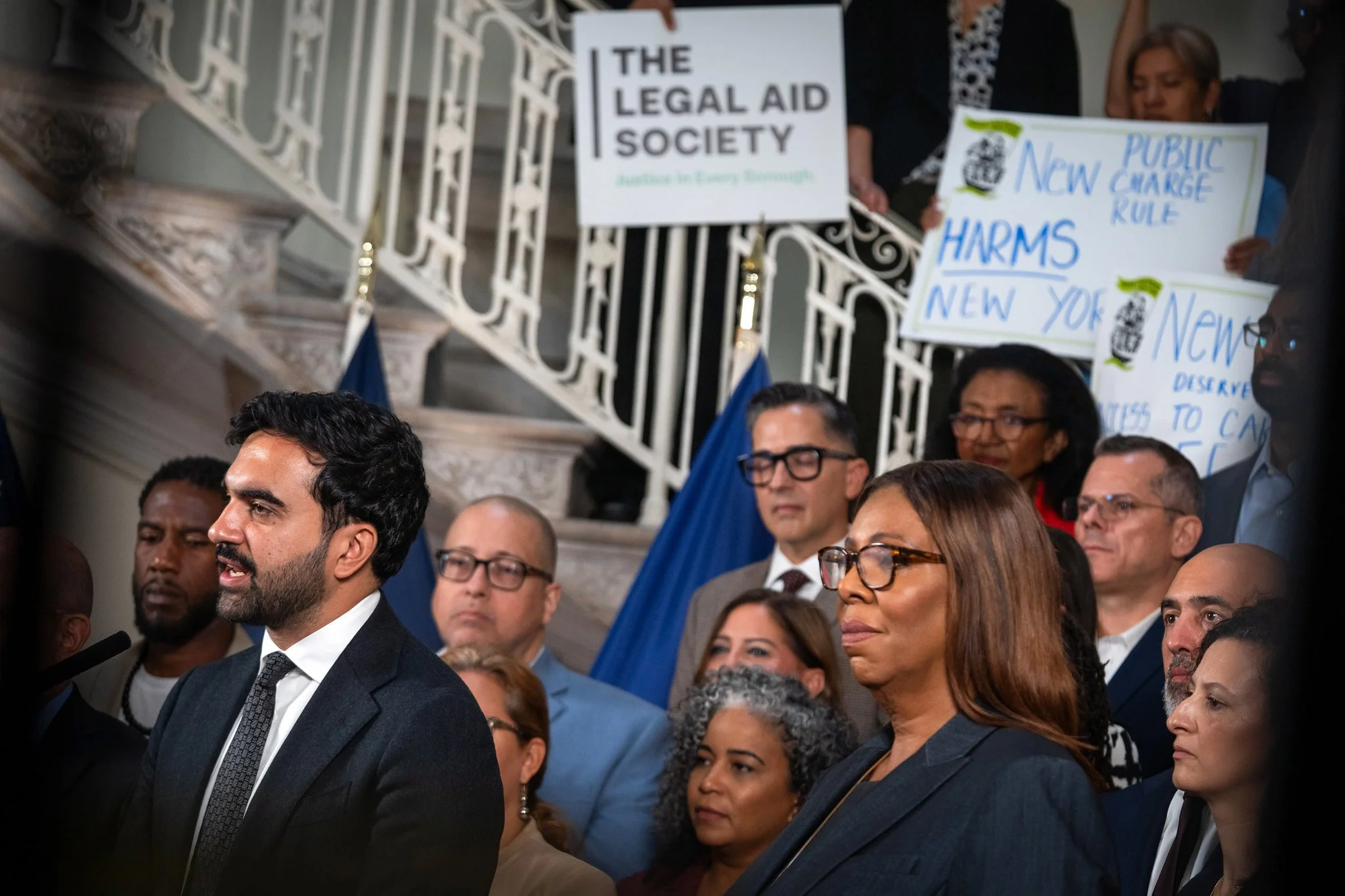
City and state officials announced a new lawsuit on Monday against a Trump administration rule change that would allow the federal government to deny immigration status to people because of their use of a broad range of public assistance programs. Ed Reed/Mayoral Photography Office
By Ryan Schwach
New York City and State sued the Trump administration on Monday over a new rule that would force immigrant families to choose between their immigration status and potentially life-saving public programs and assistance.
Officials announced the lawsuit from City Hall on Monday after they filed the 208-page complaint alongside a host of other municipalities and attorneys general from across the country.
The suit challenges a new expansion of the “Public Charge Rule” – a more than century-old law that denies immigration status to immigrants on the grounds that they would not be able to support themselves in the future and would rely primarily on government assistance, thus becoming a “public charge.”
With a new rule set to take effect later this month, the Trump administration is seeking to radically broaden the definition of the public charge rule and give immigration officials sweeping discretion to deny green cards and block pathways to permanent residency based on someone’s use of public programs.
Previous iterations of the rule were more specific to cases where an individual would be fully dependent on government assistance, but the new changes would include individuals who use more basic public programs like SNAP, Medicaid or free school lunches.
Mayor Zohran Mamdani, Attorney General Letitia James and immigration advocates said Monday that the new rule, which goes into effect on Friday, would force New Yorkers to pick between those needed public programs or their immigration status.
“People could die as a result of these changes,” Mamdani said. “The new federal public charge rule not only sweeps aside more than a century of established law, it is intentionally vague as a means of creating uncertainty and fear to isolate immigrant New Yorkers to force them to make an impossible choice between meeting their own basic needs and continuing to live in the city that they love.”
“Make no mistake, this is an undisguised effort to strip New Yorkers of the services they rely on, the public benefits they are entitled to,” the mayor added. “Families, including those with children who are U.S. citizens, have already begun to forego essential services like SNAP, Medicaid, and affordable housing out of the fear that if they use these programs, immigration officers could use it as justification to deny them a future in our country.”
This is not the first time President Donald Trump has tried to expand the public charge law. In 2019, Trump’s first administration attempted to broaden the rule, but was stopped by a similar lawsuit brought by James.
On Monday, the AG said the rule change is even broader than the one attempted seven years ago.
“Cruelty is the point,” she said. “Having a chilling effect on immigrants is the point. Letting individuals know that they are not welcomed here is the point. Immigration animus is the point. The fact that you are different from everyone else is the point. The fact that you're going to deny individuals who are sick, and hungry, and homeless benefits is beyond the pale, and that's why we are seeking in the state of New York to vacate this rule.”
The lawsuit calls on a judge to temporarily halt the change before the federal government has the opportunity to implement it.
“It is unconstitutional, illegal, and we urge the judge to make that decision before Friday,” she added.
Immigration advocates said that should the new changes go into effect, they will have a lasting impact on not just the individuals, but the communities they live in.
“The consequences are profound,” said Arlene Cruz Escobar, the director of health programs at Queens-based immigration group Make the Road New York. “We are already witnessing the chilling effects that the new rule is intended to create. The federal government itself estimated that reduced participation in public programs could decrease government spending by up to $13 billion annually, largely due to lower enrollment among U.S. citizens and lawful permanent residents, especially children.”
The over 200-page lawsuit filed on Monday in the Southern District of New York argued that the new rule goes beyond previously agreed-upon legal definitions of a “public charge.”
“The [rule change] is premised on an interpretation of the public charge statute that abandons its core settled meaning of what makes someone a ‘public charge’ which has existed for over a century,” the lawsuit read.
Corporation Counsel Steven Banks said the lawsuit earned its length because the expansion of the rule by the Trump administration is so ripe with legal issues.
“There's so much illegality in the rule that that's what was required,” he said. “This is not just a repeat of 2019 when the city and state went to court and beat back a similar public charge effort. It's even more harmful and more extreme.”