Queens officials call for safety overhaul on new ‘Boulevard of Death’
/
Queens officials are calling on the city to increase road safety along Northern Boulevard. Eagle photo by Ryan Schwach
By Ryan Schwach
Queens officials in Jackson Heights want the city to fix longstanding dangerous road conditions along busy Northern Boulevard, which they dubbed the borough’s new “Boulevard of Death.”
Officials and transportation advocates called on the Department of Transportation to take a holistic approach to fixing the major roadway, which cuts through neighborhoods in Northern and Western Queens.
Addressing accessibility and safety for the many cyclists and delivery workers who use the thoroughfare is at the top of the officials’ wishlist.
“It's time for us to prioritize the safety of everyone,” said local Councilmember Shekar Krishnan.
“New Yorkers are used to cramming into subway cars and buses and small apartments, but we can't compromise when it comes to having enough space in our streets to travel safely.”
The officials want a dedicated lane for cyclists and delivery workers, along with charging stations, rest areas and dedicated parking for the riders – known as deliveristas.
“Not only will they give them this, give them a safe, dedicated space to ride, but it will also keep regular travel lanes for buses and cars,” said Queens Borough President Donovan Richards. “It's not rocket science. We need to make sure that our streets are safe for everybody.”
Northern Boulevard currently has a dedicated bus lane, and is being targeted by the Mamdani administration for increased bus infrastructure.
Assemblymember and Democratic nominee for the State Senate Jessica González-Rojas, a longtime street safety advocate, wants the administration to go further.
“Northern Boulevard is still one of the busiest and most complicated corridors in Queens, and people navigate it every day,” she said. “Our deliveristas, cyclists, and other micromobility riders deserve infrastructure design with their safety in mind.”
“We need to stop thinking of safety as a competition for street space,” she added. “We can design Northern Boulevard so that buses, delivery workers, cyclists, pedestrians, and drivers can all move safely and efficiently.”
Dawn Siff, a local advocate with the Alliance for Paseo Park, said that she wants the DOT to look at safety along roads more broadly in addition to a micromobility lane.
“This is an opportunity to think more holistically about how we move people safely,” she said. “We don't want to be too prescriptive. We trust the city and the Department of Transportation to do their jobs. They have the thinkers and the experts on this. We're identifying this important problem. We're pointing to some possible solutions.”
For years, Queens Boulevard was known as the “Boulevard of Death” in the borough. But after fixes to the roadway and an increase in crashes along Northern Boulevard, officials say a new street is inheriting the moniker.
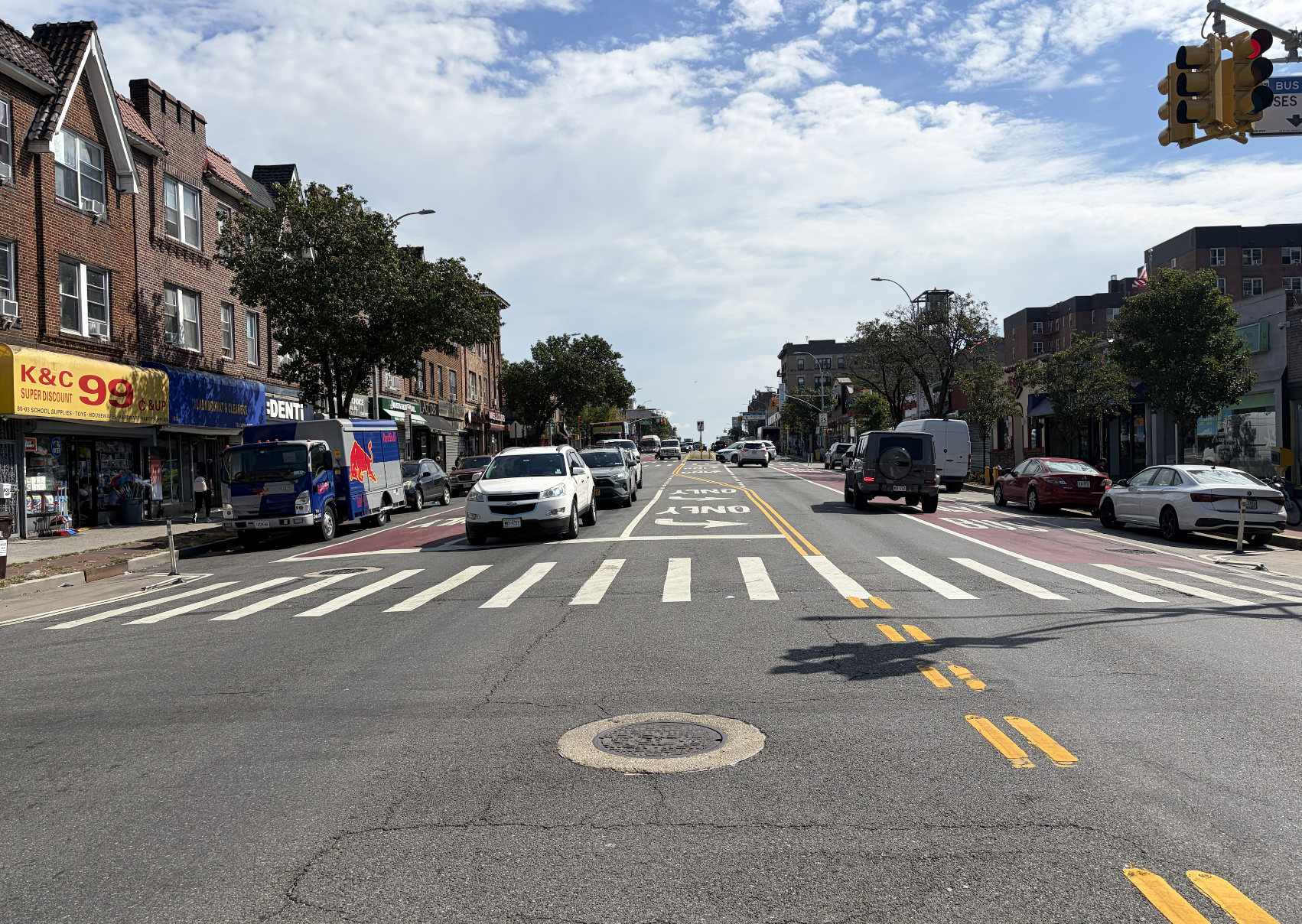
Officials want the city to build a micromobility lane along Northern Boulevard in Queens. Eagle photo by Ryan Schwach
Between 2022 and 2025, 11 people were killed and 133 were seriously injured along Northern Boulevard, including 39 pedestrians and 18 bicyclists, according to data from Transportation Alternatives.
One of those injured was Molly Lister Weissman’s son, who was swiped by a hit-and-run moped driver as the two crossed Northern Boulevard.
“I was walking right beside him,” Weissman said. “We stopped at a corner, waited for a green light. The light was green. Looked both ways. I said, ‘Go ahead, bud,’ and he went. He was probably two steps in front of me, and he got swiped by a moped.”
“We were really lucky because he's okay,” she added. “But we ended up in the ER. It was scary.”
Officials said Northern doesn’t need to become the new Queens Boulevard.
“It being the ‘Boulevard of Death’ is a policy choice,” said Richards. “We just need political will.”
Krishnan said the city should approach fixing Northern Boulevard the same way it did Queens Boulevard.
“We have seen Queens Boulevard transformed to be safer for pedestrians, with a protected bike lane, and green space,” he said. “We should take the same approach here.”
The DOT said in a statement to the Eagle that they are reviewing the request for more safety infrastructure on Northern Boulevard.
“As the school year begins, NYC DOT is delivering safety upgrades at more than 300 schools—including piloting an innovative new Open Street gate to protect students,” a” department spokesperson said.
Speeding up slowing things down
Mayor Zohran Mamdani has largely been supportive of street safety efforts. He touted his record on the issue ahead of the start of the school year this week. Among the policies he highlighted was his administration’s expansion of Sammy’s Law, which allows the city to lower its speed limits without state approval.
“Every student deserves to feel safe when they make their way to school, and every parent deserves the same peace of mind,” said Mamdani. “From Sammy’s Law and Open Streets to installing street redesigns near 300 City schools, our administration will continue to take action to ensure our streets are safe, especially those surrounding our children’s schools.”
The Queens officials who spoke along Northern Boulevard on Wednesday were all proponents of Sammy’s Law before and after it made its way through the legislature.
Now, they say they’d like to see the city speed up when it comes to slowing things down.
“No one wants to see children or anybody facing death just crossing the street,” said Richards. “We should see a faster rollout, and we should see an expansion even along more corridors across the borough as well.”
Democratic nominee for the State Assembly Brian Romero worked for González-Rojas when she promoted Sammy’s Law in Albany.
“I know [the administration] is moving as quickly as they can, but I also know that for our neighbors quick is not quick enough,” he said.
With a mayor supportive of the law in office, Krishnan said now was the time to get street safety projects underway.
“We have both the will at the city level, you have the will of the elected officials, and most importantly the community here to get this done,” he said. “There’s a perfect alignment of both will, political support, and creative energy at every level of government to make this happen. Now's the time. It couldn't come sooner.”