Man convicted twice in 1993 Queens murder sentenced again to 25 years to life
/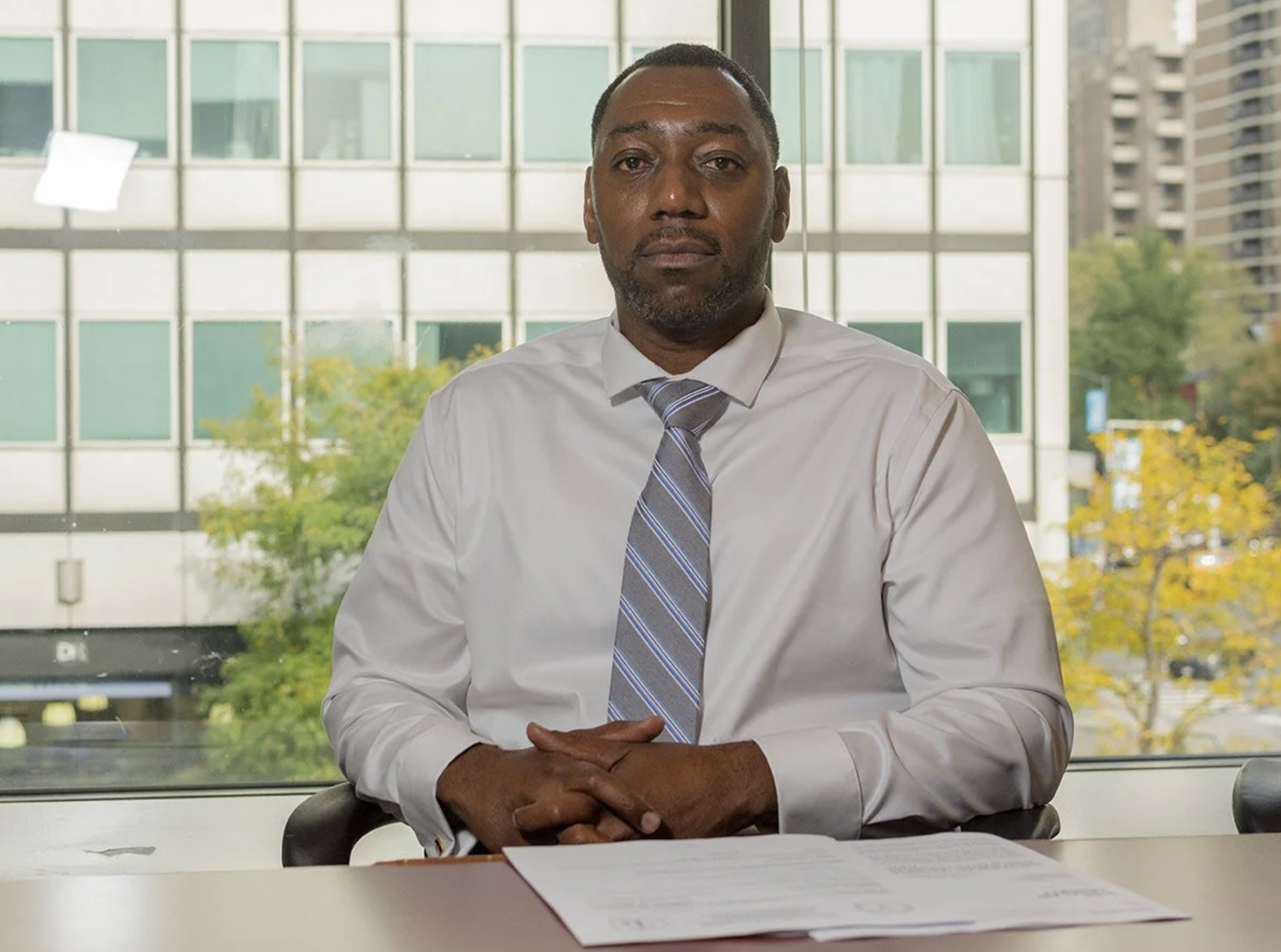
Michael Robinson was sentenced to 25-years-to-life for the second time in the 1993 killing of Gwendolyn Samuels, his estranged wife. File photo via Legal Aid Society
By Noah Powelson
A 1993 murder in Queens has become a gruesome case of déjà vu after a man found guilty of killing his estranged wife by two different juries three decades apart was sentenced to 25 years to life in prison on Wednesday, seven years after he completed his 26-year prison term for the same crime.
Michael Robinson, who was found guilty of the murder of Gwendolyn Samuels last month after his initial conviction was overturned in 2023, was hit with the maximum sentence by Queens Supreme Court, Criminal Term Administrative Judge Michelle Johnson, who presided over the case that has lingered in the Queens court for decades.
Because Robinson already served 26 years of his original 25-years-to-life sentence, he will be sent before the parole board and could very well be released well before the completion of his new sentence.
But that process likely won’t happen as quickly as Robinson or his attorneys at the Legal Aid Society would like.
Robinson was sent to Rikers Island on Wednesday and will likely be transferred to an upstate prison facility in the coming days or weeks. Once he arrives, he will have to wait anywhere from a couple of months to a year before his paperwork is processed and a parole hearing is scheduled.
Robinson’s attorneys declined to comment on this story.
While Wednesday’s sentencing hearing marked the end of the retrial, it likely won’t spell the full conclusion of Robinson’s case, which has been litigated in Queens and in appellate courts for the past three decades.
The first and second times
The courtroom was divided down the middle on Wednesday, as family members of both Robinson and Samuels filled the pews on opposite sides of the courtroom.
Samuels’ daughter, who was 12 when Samuels was killed, called on the judge to issue the maximum sentence again, noting that her mother’s death has continued to affect her and her family 30 years after the murder.
“You got it right the first time, and you got it right the second time,” Samuels’ daughter said. “Twenty-six years in prison was not enough.”
Robinson also addressed the judge during sentencing. His comments were short and simple. He neither denied nor admitted his guilt in Samuels’ murder, but said he had devoted his time behind bars to becoming a better man and had met the very high standard to be released on parole.
“Today I stand before this court as I did more than three decades ago,” Robinson said. “For the entire 26 years in prison, and the following seven years...I have done everything I can to become the most responsible, reliable person I could be.”
But Johnson said she found his remarks lacking.
“I really don’t quite know what to say to you,” Johnson said to Robinson.
“Your lack of comments today speaks volumes,” she added. “Total rehabilitation would look like ownership of your actions. It would look like having the courage to look at the family and say you are different.”
During the sentencing on Wednesday, Robinson’s attorneys attempted to argue Robinson should be released back out on parole by law, because he was already out on conditional release when his conviction was first overturned in 2023. Johnson rejected the argument, stating that Robinson needed to have made an application for such a release before sentencing.
Robinson’s attorneys moved to adjourn the proceeding for a few days to make the application, but Johnson denied the motion.
After receiving the maximum sentence, Robinson was handcuffed and wordlessly taken out of the courtroom.
For over three decades, Robinson has said his arrest, conviction, prison sentence and retrial were the result of mistaken identity.
Samuels, who was pregnant with her new boyfriend’s child, was stabbed inside a Bayside home where she worked as an aide to a legally blind elderly woman, then-88-year-old Elvina Marchon. Robinson and Samuels had been separated for about a year before she was killed.
Prosecutors said that Robinson went over to Marchon’s two-story, two-bedroom home on a cold January Monday in 1993. He allegedly sat briefly with Marchon before joining Samuels on a trip to the grocery store.
When the two returned, prosecutors claimed that Robinson followed Samuels upstairs and stabbed her multiple times in the back and then slit her throat before turning the knife on Marchon and fleeing the house.
Marchon was the only eyewitness to the killing, and there was no physical evidence tying Robinson to the scene.
Robinson and his attorneys argued that Marchon was an unreliable witness who hadn’t been entirely forthcoming about the poor condition of her eyes during the original trial, and claimed she had confused Robinson with Samuels’ new boyfriend, who had the same last name.
But the Queens district attorney’s office has always maintained that Robinson stabbed Samuels to death in a jealous rage.
Robinson was first found guilty in 1994, and spent 26 years in prison.
He was eventually released on lifetime parole in 2019, but Robinson continued to deny his guilt and worked to have his conviction overturned.
Robinson hit a breakthrough in 2023, around four years after he had completed his sentence, when the Appellate Division, Second Department found that he had been wrongly convicted.
Through a 2013 Freedom of Information Law request, Robinson found a police report that indicated that there was additional DNA evidence not presented at trial, including bloodstains, hair and nail scrapings.
After years of roadblocks and court hearings, the Office of the Chief Medical Examiner tested the evidence and said they could not rule out that male DNA found in Samuels’ fingernail scrapings belonged to Robinson. But a different private lab, Cybergenetics, determined that it was 78 trillion times more likely that Robinson was not the killer, a finding the OCME, which conducted further testing, later agreed with.
Robinson asked a Queens judge to vacate his conviction because of the new evidence, but the motion was denied.
Then, the appellate court in 2023 overturned that judge’s ruling, stating that not only could the DNA evidence have convinced a jury of Robinson’s innocence, but that Marchon’s testimony of the killing was shaky.
“Under the facts of the case, it would not have been unreasonable to conclude that Marchon confused Samuels's estranged husband with her current boyfriend in making her identification to the police,” the ruling read.
But the Queens DA’s office was not done with the case.
Six months after the conviction was overturned, Queens prosecutors said they would retry Robinson for the 1993 murder.
Nearly all of the witnesses involved in the original trial had since died, including Marchon. In Robinson’s most recent trial, much of the prosecution’s witness testimony was read from transcripts from the 1994 trial spoken aloud by a member of the DA’s office.
The jury, after a one-and-a-half-week trial, deliberated for about a day before again finding Robinson guilty on June 10.
Additional reporting by Jacob Kaye