New York’s top court hears judicial age limit case
/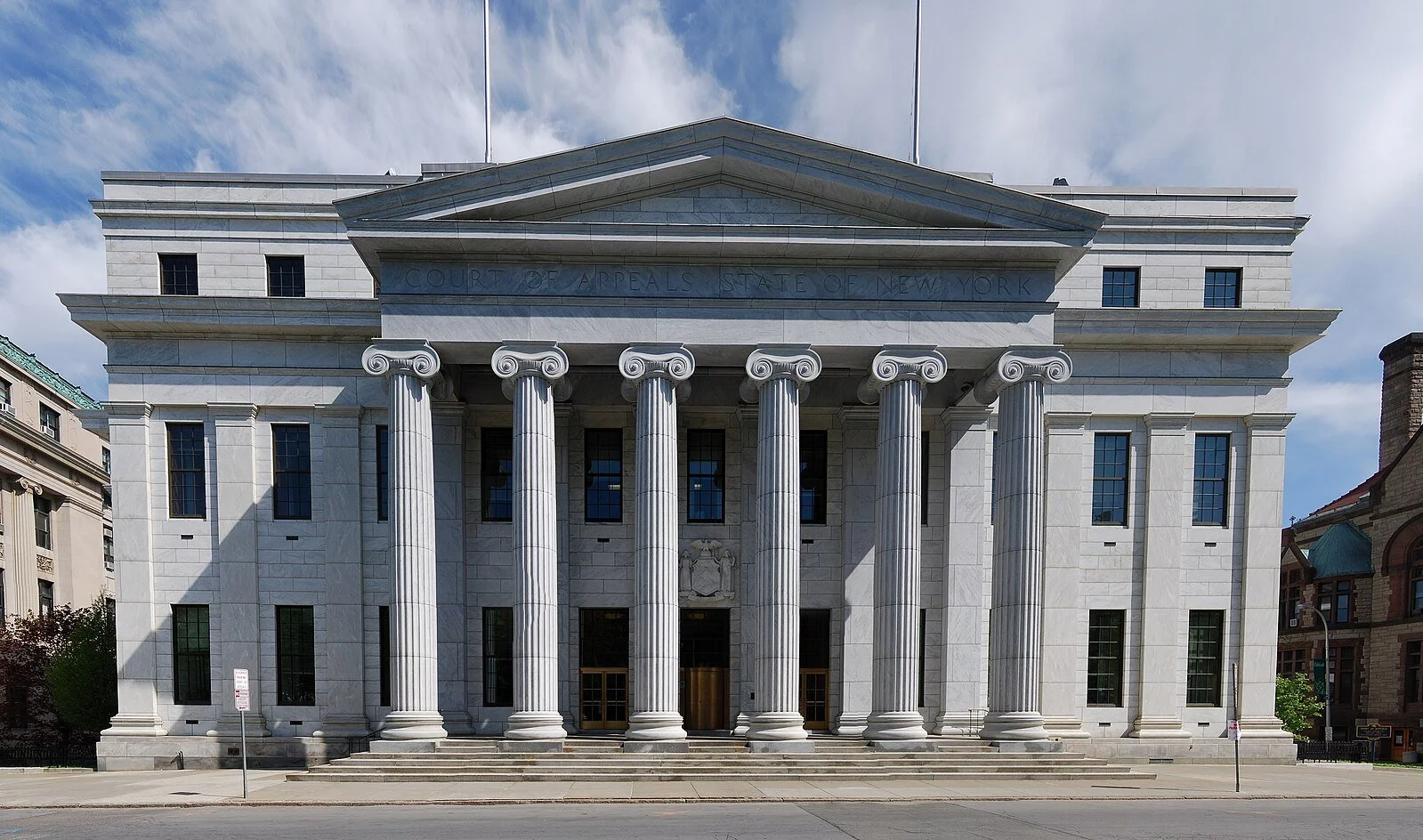
The Court of Appeals heard oral arguments about whether a 2024 constitutional amendment makes judicial age limits unconstitutional. Photo by UpstateNYer via Wikimedia Commons
By Noah Powelson
The fight over age limits for judges reached New York’s highest court last week, in a case that could have lasting implications for who can hold a seat on the bench.
The New York Court of Appeals heard arguments from three elderly judges who claimed the state’s judicial age limit laws violate a new constitutional amendment and that their forced retirement was discriminatory.
The case came before the top court after the judges appealed a previous ruling in the Appellate Division rejecting their claims, which were centered around an alleged violation of the state’s landmark 2024 Equal Rights Amendment.
Under the New York State Constitution, judges are required to retire when they turn 70 years old, but are allowed to apply for recertification every two years to extend their term until they turn 76. Once they turn 76, they have to step down from the bench.
However, when the state passed the ERA in 2024 a number of new anti-discrimination protections were established, including age protections. Soon-to-be retiring Justices Robert J. Miller, 76, Richard J. Montelione, 70, and Orlando Marazzo, 75, filed a lawsuit arguing the ERA made the age limits unconstitutional in October 2025.
The state requested the suit be dismissed the following November, which a State Supreme Court judge granted. The three judges appealed the decision, but it was upheld by the Appellate Division, First Department in March 2026.
John Leventhal, a retired judge who previously served on the Appellate Division, Second Department, represented the three judges before the Court of Appeals last week and made the case that while no one had the constitutional right to be a judge, everyone had the right to the opportunity to pursue the bench. The age limits, Leventhal argued, deprived many people of that opportunity based solely on their age, an inherently discriminatory law that cannot be reconciled with the new ERA protections.
“We’re asking for the opportunity to finish our term that we were elected to, to finish a term you were appointed to,” Leventhal said. “We’re not asking for a right to be a judge.”
Speaking before the Court of Appeals, Leventhal responded to a barrage of questions from the court ranging from the legislature’s intentions behind the ERA, to whether the ERA implicitly repealed judicial age limits.
Several judges voiced incredulity at Leventhal’s arguments, particularly to the idea that imposing an age limit on a public office would classify as discriminatory. While the case is focused on judicial maximum age limits, Judge Anthony Cannataro pointed out minimum age limits, such as being 21 to purchase a gun, could also be considered discriminatory under the same argument.
Though much rarer, some government agencies implement maximum age limits for various cases. The NYPD, for example, requires potential police officers to be 35 years or younger when they first apply.
Cannataro said that if the court sided with Leventhal’s argument, it would have sweeping implications for any laws that impose age limits.
“What is before this court is whether this Equal Rights Amendment that was enacted subjects every other statute, including constitutional provisions, that discriminate on the basis of age – sometimes for good reasons, sometimes for other reasons – makes them all subject to strict scrutiny,” Cannataro said. “Which sounds remarkable to me.”
In response to Leventhal, the attorney representing the state, Ester Murdukhayeva, made the argument that being a judge is not a civil right protected by the ERA, and age limits for public office cannot be considered discriminatory.
“Being a judge, holding that office, is not a civil right, and it's not discrimination in employment to impose that requirement on a judge,” Murdukhayeva said. “That is because the state is not acting in its proprietary capacity as an employer.”
Judge Jenny Rivera pushed back on Murdukhayeva’s interpretation, countering that judges are employed by the state, and if the policies of UCS discriminated based on age they would obviously be a civil rights violation. Murdukhayeva responded by arguing that the judicial age limits were not created as a policy by the state as an employer, but are a matter of constitutional law.
“The state is not making an independent decision as an employer, the constitution has made that decision,” Murdukhayeva said.
The court, in general, seemed to have mixed reactions to both sides’ arguments. Some judges suggested that allowing judicial age limits to continue would be a form of “permissible discrimination,” while others pointed out that revoking age limits would, in practice, give many judges lifetime appointments so long as they keep getting elected.
After hearing the arguments, the Court of Appeals will now meet and render a decision, which could take weeks.
Judicial age limits have been changed before. At one point, the maximum age was 60 before the state constitution was amended in 1869.
The judges’ lawsuit is not the only challenge to judicial age limits – lawmakers have also begun to question them.
The pressure to remove the current age limits has been presented as a way to address high case backlogs. Some proponents of raising or removing the age limit argue it’s important to keep experienced jurors on the bench for as long as possible to efficiently meet case demand.
Filling empty bench seats is a long costly process. While the case backlog has noticeably improved in recent years as the state poured more funding into the court system, it’s still an uphill battle.
One bill, introduced by former State Senator Brad Hoylman-Sigal, would raise the judicial age limit from 70 to 76, and allow for judges to recertify to a maximum age of 82.
However, Hoylman-Sigal left the Senate after being elected Manhattan borough president last year. With the bill’s primary sponsor no longer in office, its future is unclear.