Historic group of Queens court leaders reflect on Women’s History Month
/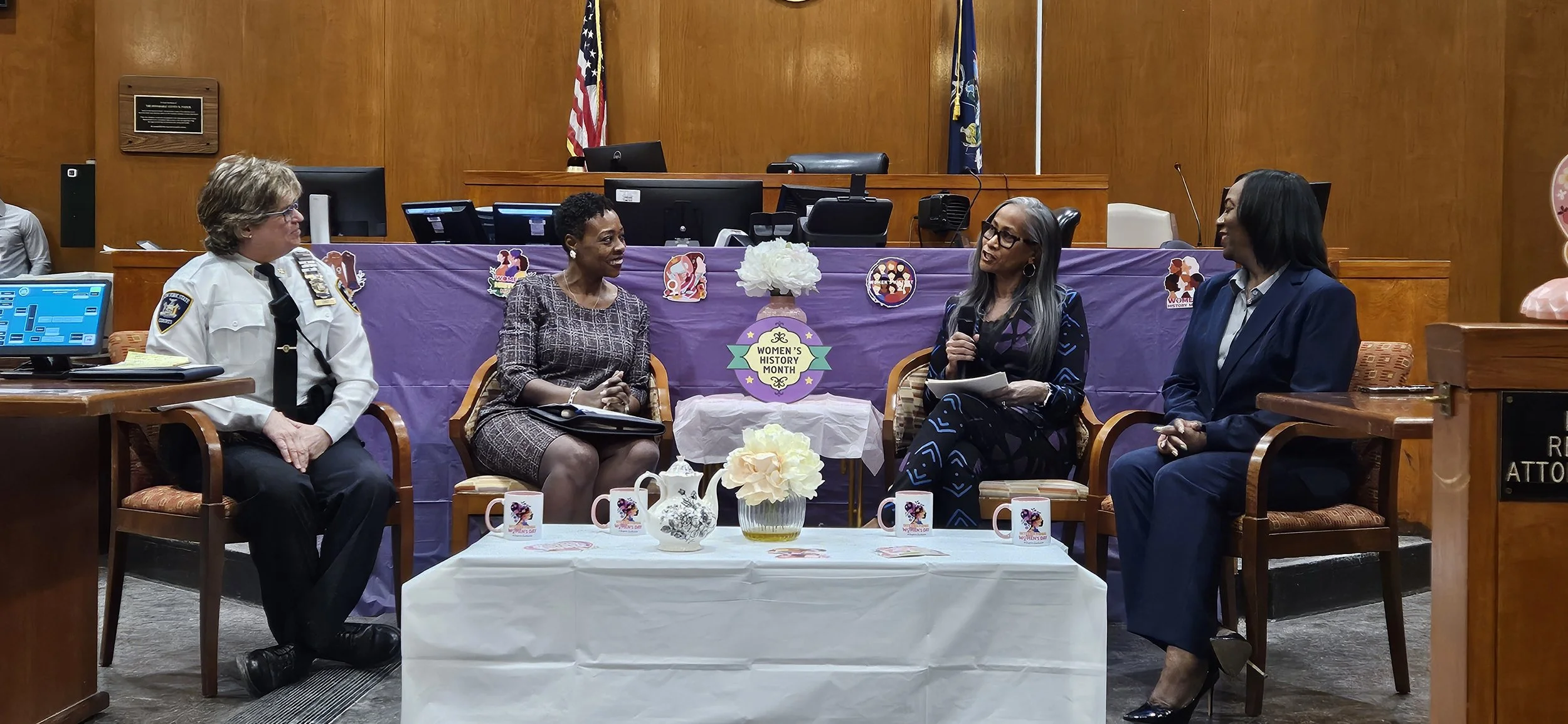
From left to right, Major Donna Ehret, Administrative Judge Michelle Johnson, Chief Clerk Sherise Ellison and Principal Court Reporter Nancy Samms hold a roundtable discussion during a Women’s History Month celebration. Eagle photo by Noah Powelson
By Noah Powelson
Queens Criminal Courthouse finds itself in a historic moment this Women’s History Month – for the first time, four of its leadership positions are held by women.
On Wednesday, Queens Supreme Court’s Equal Justice in the Courts Initiative hosted a celebration of Women’s History Month, where over 100 court community members gathered for food, drinks, poetry and to reflect on how women's roles in the courthouse have shifted over the decades.
At the center of the event was a roundtable discussion between Administrative Judge Michelle Johnson, Chief Clerk of Queens Supreme Criminal Court Sherise Ellison, Principal Court Reporter Nancy Samms and Major Donna Ehret. The four women all hold the highest leadership position for their respective roles in the courthouse, the most women leaders Queens Criminal Court has seen at any given point in time.
All four of the women have been working in the courts or legal field for decades, and all of them said they entered their fields at a time when women were a minority of the court staff.
For many, a career in civil service or in law wasn’t even in consideration when they were starting out and said they almost wandered into their roles as they took various civil service or college tests in attempts to find their paths.
Johnson, who was appointed administrative judge of Queens Supreme Court, Criminal Term in 2024 after serving in an interim capacity, said she had no ideas about even becoming a lawyer until college. It took a professor encouraging her to take the LSAT before she even began to consider it. None of the women in her family at the time had gone to law school.
“My mom, my grandparents, my great grandparents, all strong Afro Latino women who were very driven, very focused, they came to this country and they opened up a world to me that I didn't know existed. And I will tell you, law was never on the table,” Johnson said. “We were steered, including my mother, to careers like nursing and home attending and things like that.”
Gender demographics in the courts have changed significantly over the years, the speakers said Many of the problems they encountered coming up have been significantly mitigated with that change.
According to a 2014 report from the New York State Bar Association, approximately 34.2 percent of judges at the time were women.
But according to currently available data through the Office of Court Administration, women and men take up a much more even distribution of bench seats.
Across all courts in Queens County, roughly 51 percent of judges identified themselves as female in 2025, while 39 percent identified as male and 11 percent chose not to disclose their gender identity. The overall makeup of female judges is up since 2020, the furthest back OCA has data available, when 47 percent of judges identified as female.
Across New York state, between 2020 and 2025, female judges went from roughly 42 percent of the total to 43 percent.
But women show the most representation in court staff roles. Across New York State, women make up over 90 percent of court reporters, 72 percent of court clerks and 64 percent of court attorneys. Men still make up the vast majority of court staff employed in security or technology roles.
In Queens, roughly 54 percent of all non-judicial court staff are women.
Samms, who is set to retire this year after a 35-year career as a court reporter, said the gender landscape of her job has shifted dramatically since she first came to Queens courts in 1996.
“Court reporting, at one time, was all men,” Samms said. “Now it’s almost all women.”
Ellison started out her career as a court officer before transitioning into a clerk role. She was one of only a handful of female court officers, and was often required to rush between multiple court parts to handle female defendants.
“I am happy to see that here in the courts, we do have a lot more female court officers, so they may not have to get called too many different ways,” Ellison said.
To other women considering a career in the courts, perseverance and self-belief was the most important factor, especially in the face of hardship, the speakers said.
“I remember when I took the first test from lower court criminal to lower court sergeant, I didn't pass it, I was devastated,” Ehret said. “The next two tests, I aced it…I made it so that they had to take me.”
“It's just work. Work, persevere, keep going, keep learning. I'm still learning,” Ehret added.
Johnson said women are often expected to be everything at once – a worker, a daughter, a wife, a mother – and rarely have a moment for themselves. To the mostly women audience on Wednesday, Johnson encouraged them to think of themselves as well.
“My advice would be, just take a moment sometimes to be just a little selfish,” Johnson said. “It means you are still a good mom, you're still a good colleague, you're still a good friend, you're still great at your job, but you owe yourself just that time to remove and reset. And I think that prepares you for whatever's coming next.”