DA improperly indicted Jabez Chakraborty, attys allege
/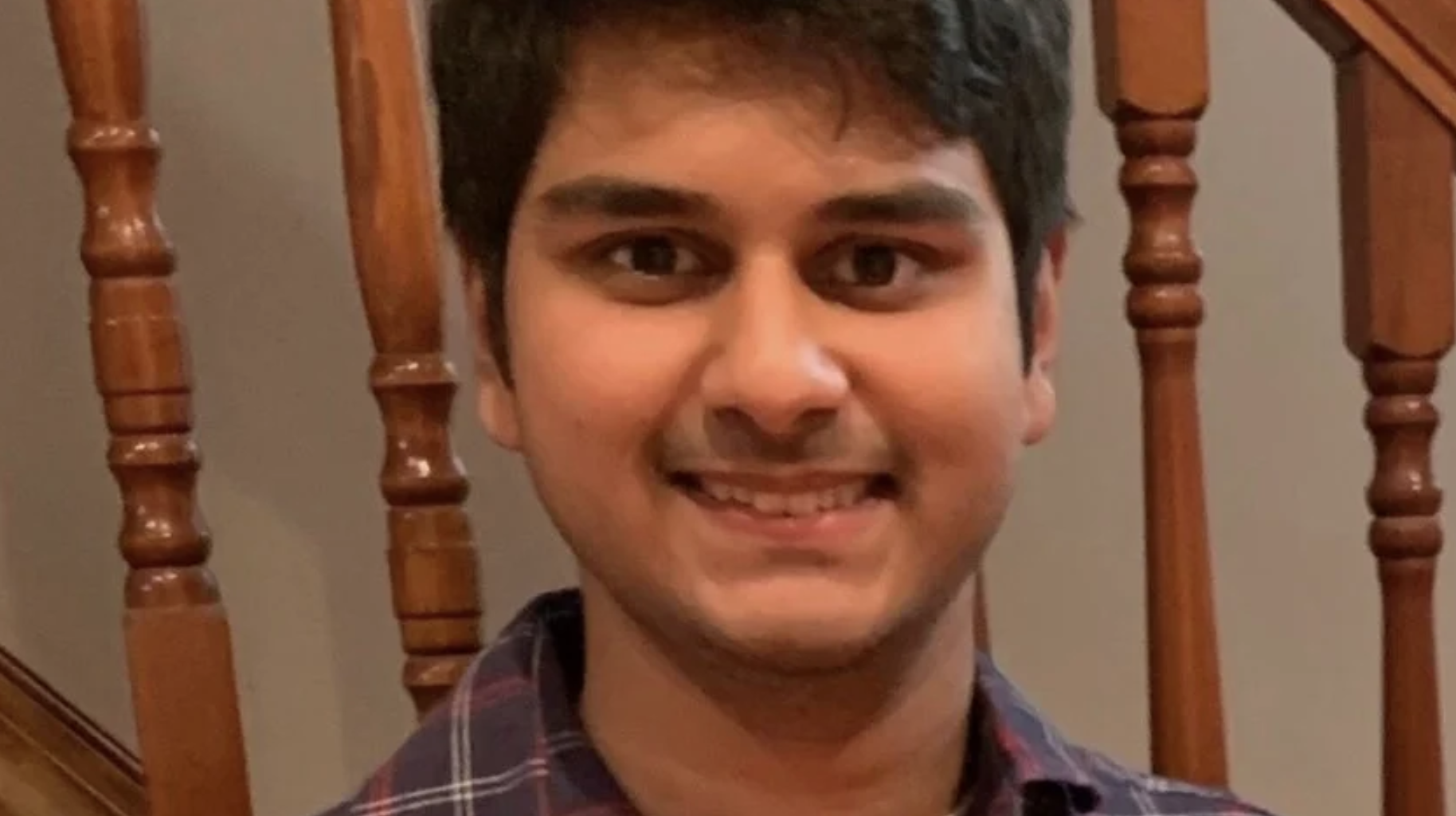
Attorneys for Jabez Chakraborty, a Queens man with schizophrenia who was shot by police in late January, say the Queens district attorney quietly went ahead with charges against the 23-year-old while he was still in the hospital. Photo via Chakraborty family
By Ryan Schwach
The Queens district attorney’s office quietly brought charges against Jabez Chakraborty, a 23-year-old Queens man with schizophrenia who was shot by police during a mental health crisis in late January, denying his right to testify on his behalf, his lawyers allege.
Attorneys from the Legal Aid Society representing Chakraborty said in a February motion that Queens District Attorney Melinda Katz’s office secretly brought grand-jury charges against the man while he lay shackled to a Queens hospital bed. They called on a judge to dismiss the case.
Chakraborty was shot by police on Jan. 26 after his family called 911 in the hopes police would come to their Briarwood home and involuntarily remove their son – who was in the throes of a mental health crisis – for treatment.
Instead, two police officers showed up and were met by Chakraborty, who was wielding a knife and moving toward them. Police officer Tyree White fired his gun, striking Chakraborty four times.
Chakraborty has since been charged by the DA with attempted assault and criminal possession of a weapon, charges his lawyers say were unfairly moved without their knowledge and without giving Chakraborty a chance to testify before a grand jury.
“The prosecution failed to produce Mr. Chakraborty for a timely arraignment and failed to advise any of the attorneys who reached out on his behalf about the grand jury presentation,” Laura Eraso, Chakraborty’s attorney, said in the filing. “Instead, the prosecution used the days following Mr. Chakraborty’s shooting and immediate arrest to investigate and try to build a case against Mr. Chakraborty, and to protect the NYPD and Officer White, who shot Mr. Chakraborty inside his home multiple times at close range in front of his family members.”
Eraso argued that the DA’s office did not keep her, the Legal Aid Society, or Chakraborty’s family appraised in the course of the investigation into the shooting or grand jury proceedings.
On Feb. 12, more than two weeks after the shooting, Legal Aid filed in court to protest Chakraborty’s “prolonged detention” without any filed charges.
“Up until that point, QDA continued to maintain to lawyers, community groups, and elected officials that they were still investigating,” the filing read. “It was not until the writ was filed that the prosecution finally scheduled Mr. Chakraborty for arraignment on the charges.”
Chakraborty was ultimately arraigned on Feb. 13 before Queens Judge Jessica Earl-Gargan.
In response to Legal Aid’s argument, the DA’s office says that it did not rush or hide the proceedings, but were instead waiting for Chakraborty to be medically cleared by the hospital.
“Defense counsel argues that the People ‘deliberate[ly] delay[ed]’ arraigning defendant that unfairly prevented defendant from exercising his rights to testify and request witnesses be heard before the grand jury,” Assistant District Attorney Hugh McCann wrote in a filing in response. “But counsel knows full well that defendant could not have been arraigned before he was medically cleared.”
McCann attested that he reached out to Jamaica Hospital several times to check on Chakraborty’s medical status, and if he was cleared to be arraigned, but that he wasn’t medically cleared until Feb. 12, the day before he was virtually arraigned from his hospital bed.
“As soon as he was cleared, the People immediately made arrangements for defendant to be arraigned,” McCann said. “Thus, there is absolutely no basis for counsel's accusation that the People denied defendant his right to testify or seek to present witnesses before the grand jury by delaying his arraignment.”
McCann said the DA had no intention of proceeding with a “silent” arraignment, because they were under no obligation to serve Chakraborty with charges because he was not medically cleared – nor did they need to allow him to testify before the grand jury.
“The subject of a criminal investigation has no right under either the state or federal constitution, or, for that matter, the common law, to testify before a grand jury,” McCann wrote.
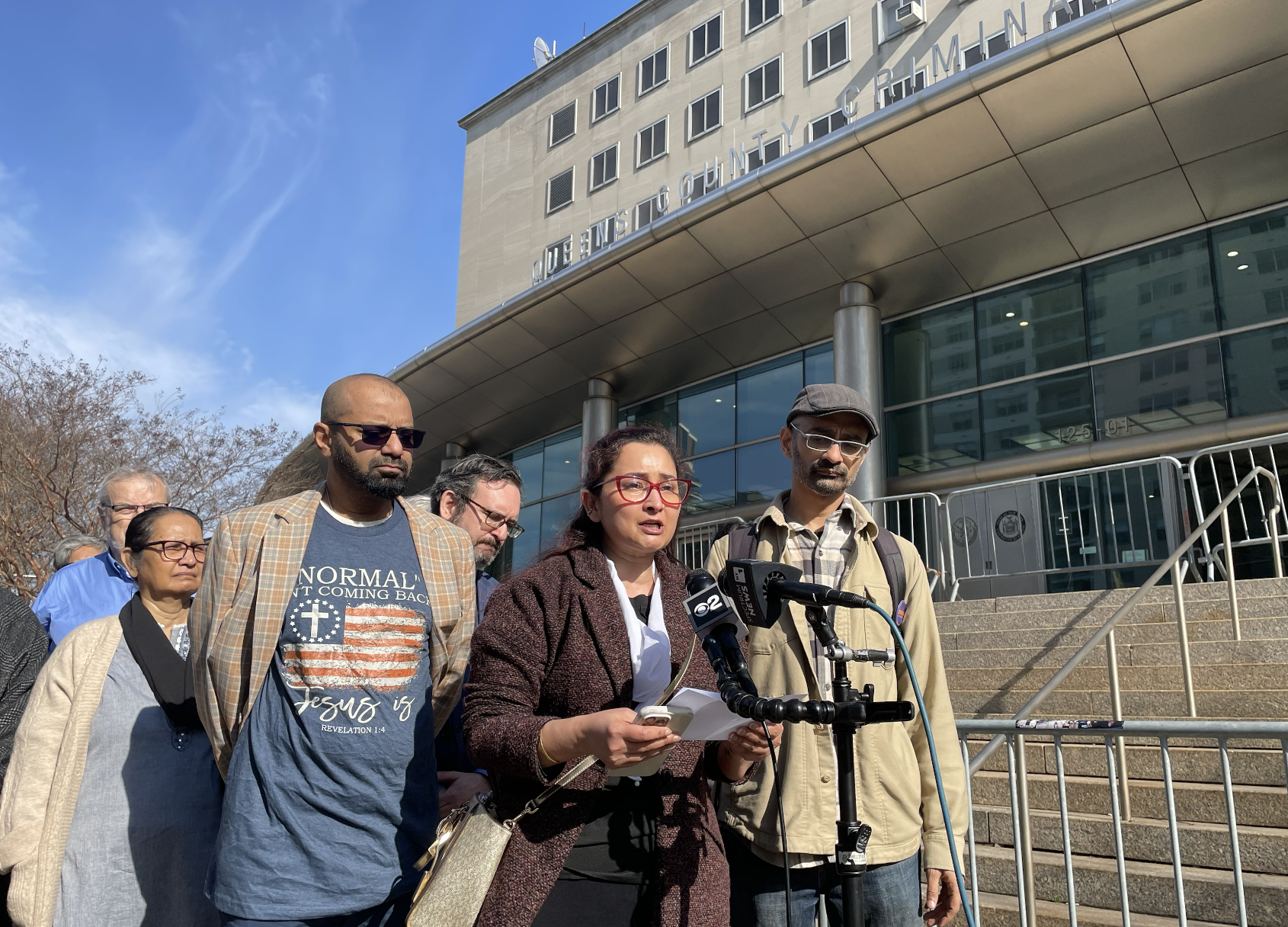
The family of Jabez Chakraborty and advocates are calling on Queens District Attorney Melinda Katz to drop the charges against the man. Eagle photo by Jacob Kaye
Queens Criminal Court Judge Toni Cimino, who is now overseeing the case, will rule on Legal Aid’s motion and their request to toss the case on April 1.
In the weeks that followed the Jan. 26 shooting, advocates and elected officials, including Mayor Zohran Mamdani, called on Katz not to prosecute Chakraborty, who was diagnosed with schizophrenia three years ago and who was scheduled to begin increasing his treatment at a Queens psychiatric hospital the day after the shooting.
Instead, Katz went ahead with the charges filed last month and also requested that Chakraborty be remanded to Rikers Island.
In court, Eraso described the DA’s wish to move Chakraborty to Rikers as "unconscionable and deeply disturbing.”
Katz has defended that request and the charges brought against the man, telling reporters in a rare press conference after the February arraignment that she was “duty bound to follow the facts, evidence and circumstances where they lead us.”
The district attorney said that bringing the charges also would be the first step toward forcing Chakraborty into a mental health treatment program through the courts. While she didn’t commit to seeking a mental health disposition, she noted that bringing the criminal case wouldn’t “preclude” the alternative path.
Earl-Gargan, who oversees Queens’ treatment courts, called the case a “tragic situation, to say the least.”
“The mental health system in this state has failed many,” the judge said.
Outside Queens Criminal Court on Thursday, Chakraborty’s family and advocates pleaded with Katz to drop the case.
“DA Katz wants to pursue a case against my son and add to our family trauma,” said his mother, Juli Chakraborty. “We only called 911 for medical transport, instead of getting support at treatment, Jabez got shot multiple times.”
“Our lives are now changed forever,” she added. “We would like to focus on recovery and stabilize our life.”
Fahd Amed, the executive director of Queens-based advocacy group Desis Rising Up and Moving, called it an “absurd situation.”
“It is absurd that after what the family has suffered through, they have to keep continuing to now be dragged through this process,” he said. “If somebody is having a mental health episode, what purpose does it serve to then prosecute them?”
“It's hard to understand any logic from the DA’s office,” he added.
The Chakraborty shooting, a case where family members of the victim called 911 with the hope that responding personnel would help their relative, only for the incident to devolve into gunfire, bears striking similarities to two recent police shootings in Queens.
Win Rozario, a 19-year-old with a history of mental illness, was fatally shot by police in his Richmond Hill home after he called 911 amid a mental health episode in March of 2024. He came at police with a pair of scissors as his mother tried to hold him back.
Chez Fray was shot and killed earlier in December by police in Far Rockaway after his parents called 911 because he was emotionally disturbed. Fray was shot in a hallway outside his apartment as he held a small knife and charged toward officers.