Courts hold second annual civic essay contest
/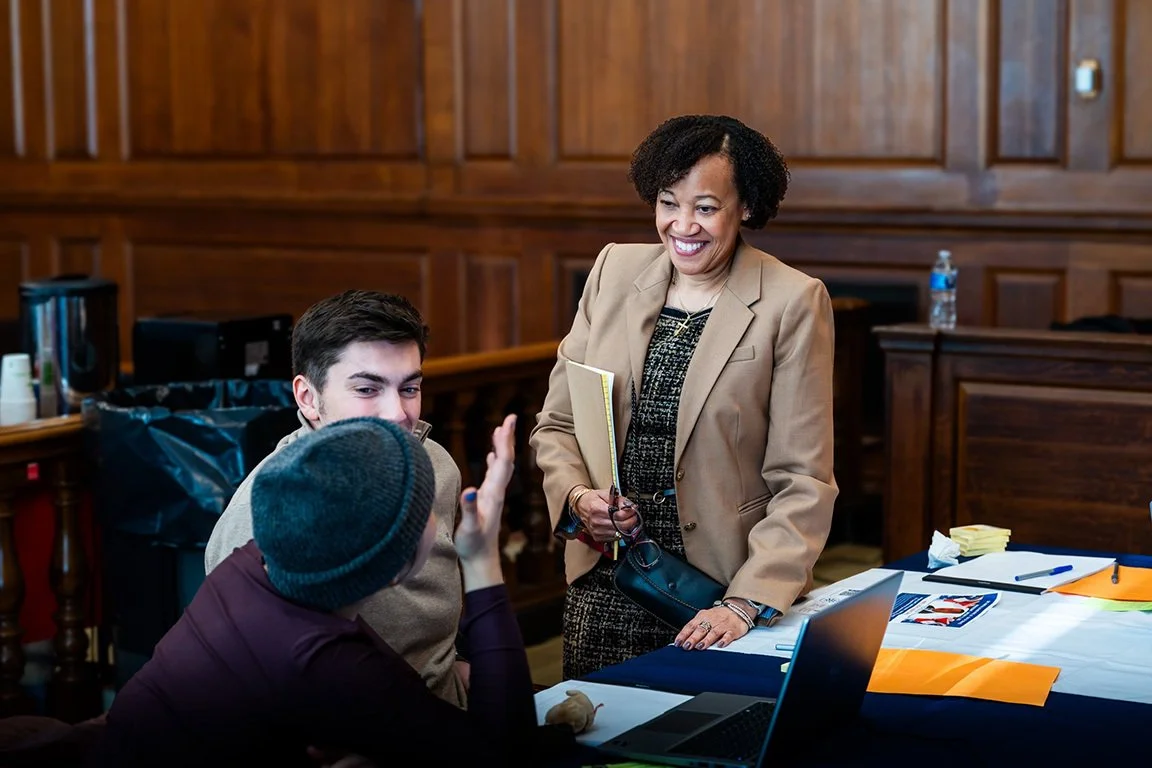
The Unified Court System’s Office of Civic Engagement, led by Zenith Taylor, held an essay contest this year that invited students to create a new constitutional amendment. Winners will defend their arguments before a group of sitting judges. File photo via UCS
By Noah Powelson
For the second year in a row, Queens high school students competed in a civic essay competition, this time with the chance to defend their argument for a new constitutional amendment in front of the borough’s judges.
The Unified Court System’s Office of Civic Engagement held their second annual civic essay contest for New York high school students, and several finalists will present their arguments later this month to Queens jurists.
This year’s contest, called “Amend and Defend,” received over 165 essay submissions from students across the state. Queens students accounted for nearly a third of all submissions.
Unlike last year’s traditional essay contest, this year students from across the state were asked to draft their own amendments to the U.S. Constitution. Those behind the top entries will be selected to defend their proposals to sitting judges.
Fifty-five Queens students submitted essays this year, and of those, nine were selected to go onto the final presentation. In their essays, finalists explained the benefits of their proposed amendments, identified the challenges and discussed the ratification process all in preparation of defending their proposal before a panel of judges.
Queens students will present and defend their proposals on March 23 to six Queens judges, including administrative justices and presiding judges.
In addition to the students from Queens, students from Nassau, Saratoga, Erie, and New York Counties also submitted essays for the contest.
After oral arguments across all participating counties are concluded, the Office of Civic Engagement will announce three finalists. The final winner of the contest will be announced on Law Day, May 1st.
All finalists will also receive a certificate of recognition for the work they put in.
“This initiative is not a traditional essay contest,” the UCS Office of Civil Engagement stated in a release. “It combines research, writing, and public speaking with an authentic judicial experience, giving students a rare opportunity to engage directly with constitutional principles in real courtrooms.”
The Civics Essay contest was one of the first programs created and managed by Zenith Taylor, the state’s first-ever Statewide Civic Engagement Coordinator. Taylor, who used to be a Queens attorney and past president of the Queens County Bar Association, said it’s been her goal to increase civic engagement and courtroom knowledge in as many schools as possible.
Last year’s Civic Essay contest proved a surprising success for a first-time initiative, garnering hundreds of responses from students across the state. Queens students also made up the largest group of participants that year as well.
But Taylor said her vision for the contest was not just a simple academic exercise, but an engaging program that will make the youth of today consider how the law can best serve them.
“This program asks students to do something bold — not only draft a constitutional amendment, but defend it before judges,” Taylor said in a statement. “It moves beyond a traditional essay contest by requiring students to think critically about constitutional change and articulate their ideas in a courtroom setting.”
Students focused their proposed amendments on a variety of issues that have dominated legal headlines in recent years, especially for New Yorkers. Student proposals included amendments related to gun-related reforms, digital privacy and technology regulation, universal healthcare, citizenship pathways, social-media age restrictions and artificial intelligence.
By prompting students to make constitutional amendments that would directly apply to them, Taylor said, she was hoping to foster real understanding and appreciation for the laws that impact their daily lives.
“This gives students a rare opportunity,” Taylor told the Eagle. “I wanted to create something more meaningful than a traditional essay contest. I wanted them to really engage with the Constitution, think about how it affects them. It’s all very exciting.”