BP says Queens still getting shortchanged in city budget
/
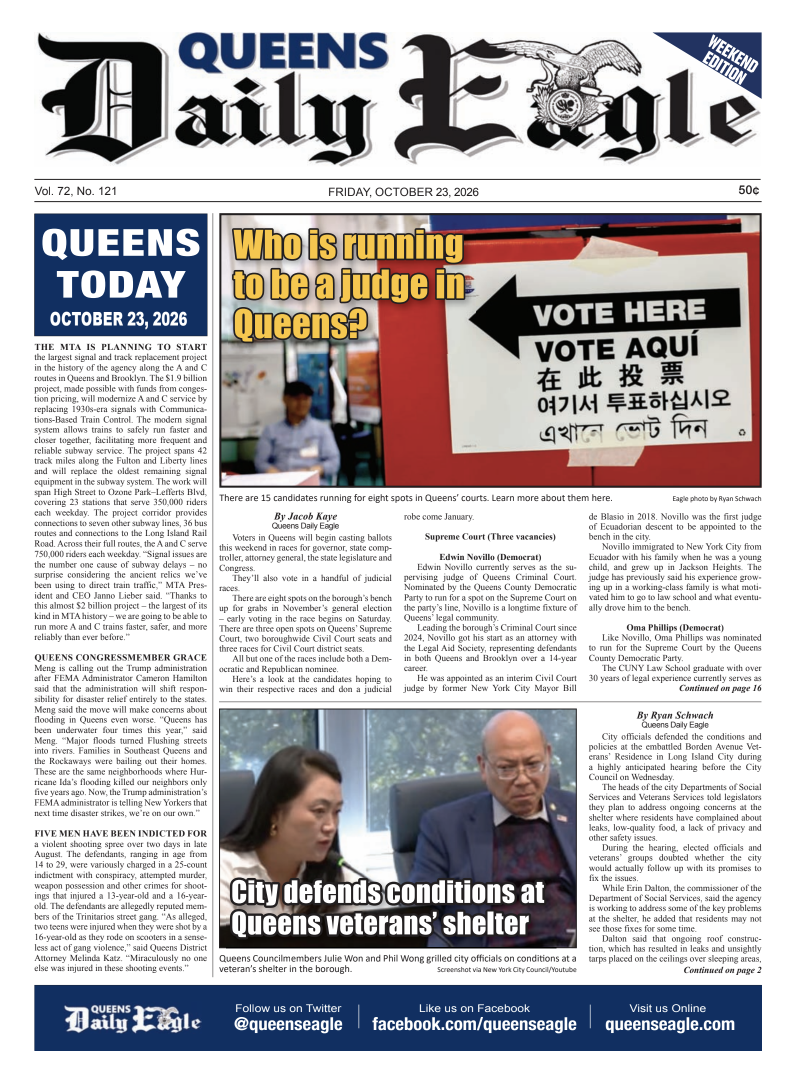
Queens Borough President Donovan Richards discussed the city’s budget with local leaders on Monday, March 9, 2026. Screenshot via the Queens Borough President’s Office/Youtube
By Ryan Schwach
Queens would receive less money per person than any other borough under the mayor’s proposed budget, Queens Borough President Donovan Richards said this week.
The World’s Borough would be allocated less money per capita in expense funding than any of the city’s four other boroughs, an issue that pre-dates the city’s current budget crisis and one Queens Borough President Donovan Richards is again trying to solve.
During a presentation to Queens’ community boards and elected officials on Monday night, Richards called on Mayor Zohran Mamdani to help increase Queens’ share of the financial pie, while also recommending the city restore other cuts to the borough.
“Fixing that per capita support is really an equity issue,” Richards said. “We still have work to do in this area.”
Under Mamdani’s budget proposal, Queens would be given the least amount of funding for its borough president and community boards per capita when compared to Brooklyn, Manhattan, the Bronx and Staten Island.
The Queens borough president would receive $2.43 per capita in expense funding, or nine cents less than the Brooklyn BP’s office and more than $7 less than the Staten Island BP’s office.
Queens’ community boards would also be given $1.75 per capita, two cents fewer than Staten Island, which ranks fourth in per capita funding.
Queens’ funding issues aren’t new – the borough has seen the least money per resident for years.
And it’s not entirely the choice of any one mayoral administration. Borough funding is set by a formula spelled out in the city’s charter. While Queens has the second-largest population in the city, it’s also the largest borough by land mass, making it less densely populated than the other four boroughs and skewing the funding formula.
Richards said he has attempted to convince the city to alter the formula in years past but has had no luck.
“We will need a mayor who really has some political will to fix this,” he said. “Because there's no reason a kid in Staten Island is receiving more on the dollar within their classroom as opposed to a kid in Queens.”
As the city faces a $5 billion budget gap, the financial squeeze could result in cuts to the BP’s expense budget, capital funding distributed to the borough’s 14 community boards and money for local institutions.
The BP’s budget is facing a cut just shy of $1 million, and the CBs are facing a slight decrease.
Earlier this month, Queens’ 14 community board managers went before Richards to ask that the borough’s funds be used to pay for their top priorities. Most of the boards were concerned with flood mitigation and sewer infrastructure, as well as sanitation and public safety.
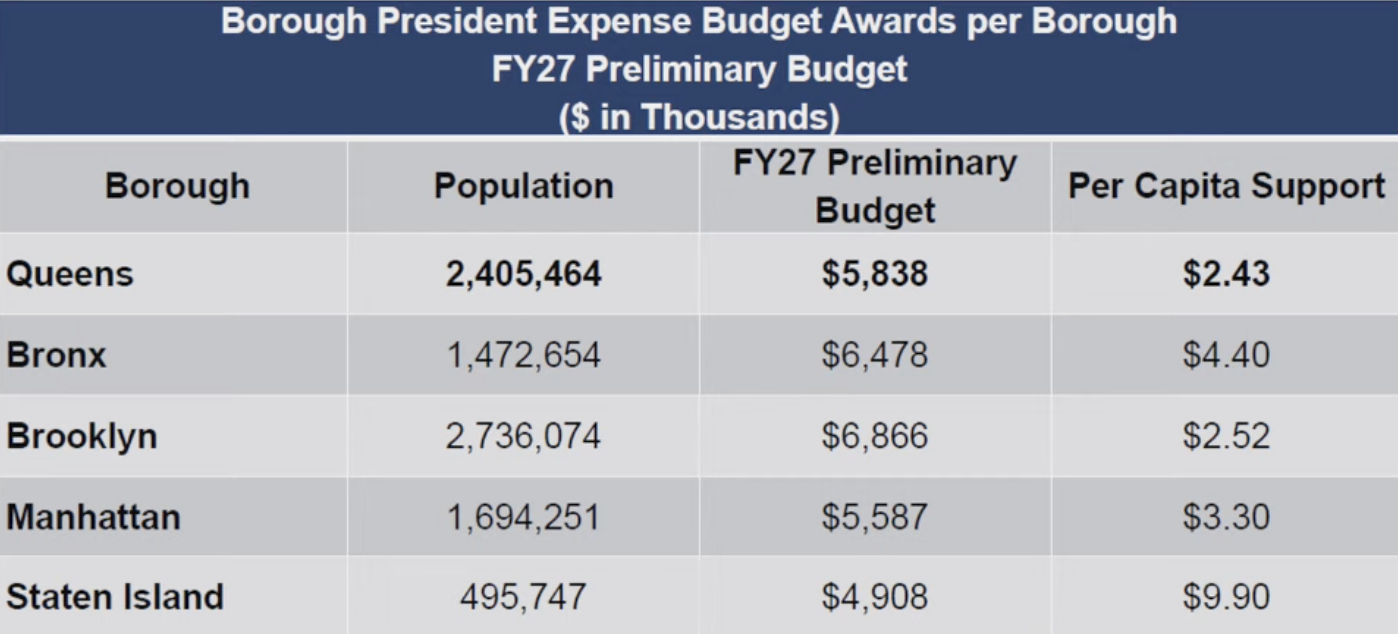
Queens would receive the least amount of money per capita of any borough under the mayor’s budget proposal. Table via the Queens Borough President’s Office
The BP’s budget director, Fanny Lin, recommended the city fund the top priorities for each board, provide live broadcasting services for meetings and provide an urban planner for each board.
Richards’ office also asked the mayor and the City Council to fund a new police precinct in Northern Queens, a longtime request from Community Board 7, which includes the neighborhoods of College Point, Whitestone, Flushing and Willets Point. Former Mayor Eric Adams promised the board that City Hall would explore creating a new precinct in the area to supplement the 109th Precinct in anticipation of the creation of an entirely new neighborhood in Willets Point expected to come online in phases beginning this year.
“The time for them to make any kind of meaningful response from the 109th, which is located down in the southwest corner of our district, out to the top corner, is just insurmountable,” Apelian told the Eagle last month.
The BP’s office said a new precinct would “be very helpful.”
Richards called it a matter of political will, just as it was with the 116th Precinct in Southeast Queens, which took more than a generation of advocacy before it opened last year.
“It's a political, mayoral conversation,” he said. “I think the data speaks for itself, and I think…it's just a no-brainer.”
Queens is also facing general cuts to its schools, libraries and cultural institutions – funding the BP’s office wants to restore.
The city is currently gearing up for budget negotiations.
On Tuesday, the City Council said they found $1.7 billion in savings, which could potentially halt the city from needing to reach into rainy day funds – as suggested by Mamdani – to pay for programs in this year’s budget.
Mamdani has proposed widespread cuts and savings to fill the gap, and has controversially floated a nine percent increase in property taxes to fill the rest if the state does not step in and raise taxes on millionaires and corporations.
The mayor has called the hike a “last resort,” but just the suggestion of the tax increase drew widespread criticism from his usual detractors but also his close allies – including Richards.
“I'm firmly against…the property tax proposal,” he said at a budget hearing last month.
Closing out Monday night’s meeting, Richards doubled down on that sentiment but seemed hopeful the city could find a budget solution while avoiding the tax increase.
“We are facing some serious federal headwinds, and we're going to be working with Albany to do all we can to close this gap without property taxes being raised on us,” he said.