Mandatory court fees harm low-income families, advocates say
/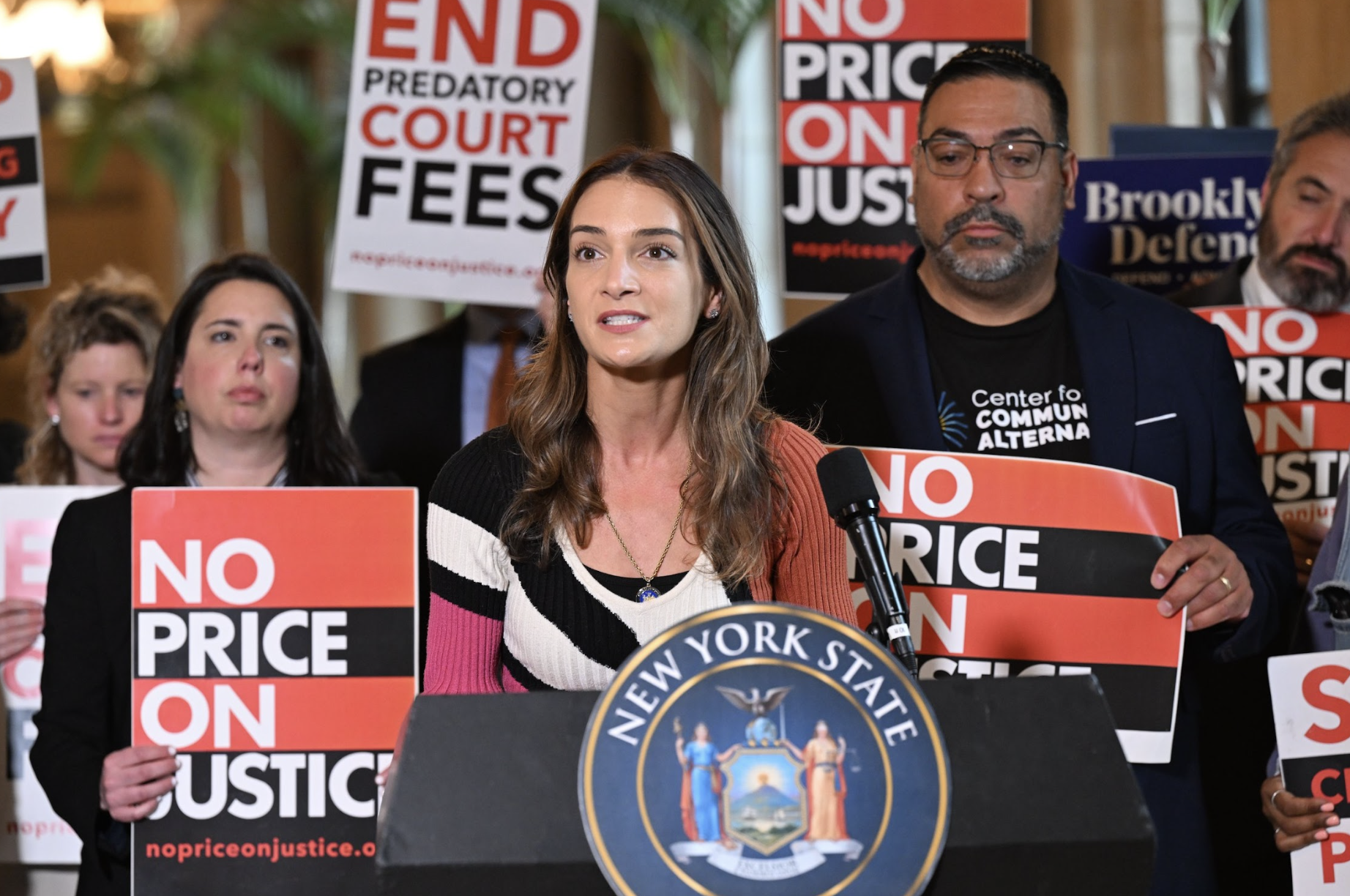
Queens and Brooklyn State Senator Julia Salazar calls on Albany to pass the End Predatory Court Fees Act. Photo courtesy of the Center for Community Alternatives
By Noah Powelson
When Melissa Taylor finished her probationary period for a crime she committed as a teenager, she thought that was the end of that dark part of her life.
She said stayed out of trouble, got a job. But she had no idea there was a $90 probationary fee looming over her head – or that it would one day put her in jail.
Over a decade after her probation was long over, police officers appeared on the steps of Taylor’s front door with a warrant for her arrest for not paying the $90 fine, which she said she never received any warning about. Taylor missed work while she spent the night behind bars.
“I never thought I’d spend a night in jail over $90,” Taylor said. “I also never thought that something from my teenage years – a probation fee I didn’t even know existed – would follow me for more than a decade, quietly waiting to upend my life. I spent the night in jail confused, terrified, and humiliated because I was poor, young once, and trapped in a system that criminalizes poverty.”
Stories like Taylor’s are why legal advocates and elected officials say administrative court fees for penal violations need to be eliminated.
Outside the State Capitol on Wednesday, Feb. 4, elected officials, legal advocates and family members of formerly incarcerated people rallied to demand lawmakers pass the End Predatory Court Fees Act during this year’s legislative session, which kicked off last month.
The bill, if passed, would eliminate fees and surcharges for violating penal, vehicle and traffic laws, as well as ban the practice of incarcerating those who haven’t paid court fines and fees. Those who have been arrested for being unable to pay court fees said during the rally that the current system turns what should be simple administrative costs into immense financial and emotional burdens for working class New Yorkers.
Taylor, a member of the Center for Community Alternatives, said these court fees are not just an administrative cost, but a tool of punishment used against New Yorkers.
“That night cost me far more than $90,” Taylor said. “It meant me missing work, it meant me explaining to my family where I was, it meant fear and shame that I still carry.”
Another CCA member, Peggy Herrera, said she had accumulated over $12,000 in court fees after her mentally ill son had been arrested several times over the course of five years. Herrera said it took years to pay off the fees, which resulted in massive cuts in her spending for food, bills and other necessities.
“I went into credit card debt, I had to get food for my family from my church,” the Queens resident said. “Because if I wanted to pay off the court I had to choose between affording groceries or other bills.”
The rally came as the state legislature gears up to debate the proposed executive budget for 2027. Advocates at CCA argue the collection rates for these court fees are poor and getting worse, and said annual collections have decreased by approximately 49 percent over the past five years.
Ismael Diaz, a community organizer with CCA, said the benefit of collecting these fees was small for the state, while their impact on working class New Yorkers is potentially life changing.
“No one should be forced to miss rent or for their kids to go hungry to fund the government,” Diaz said in a statement. “No one should face a potentially deadly interaction with police because they do not have the means to pay. As lawmakers debate the state budget, we demand an end to New York’s dangerous reliance on court fees – a regressive form of taxation that traps millions of low-income residents in a vicious cycle of debt and punishment.”
The End Predatory Court Fees Act was first introduced by Queens and Brooklyn State Senator Julia Salazar and Bronx Assemblymember Karines Reyes in the 2021-2022 legislative session, and has received a wide swath of legislative co-sponsors in both chambers.
In the Senate, the bill has 24 co-sponsors, including Queens State Senators Leroy Comrie, Kristen Gonzalez, Jessica Ramos, James Sanders and Toby Ann Stavisky.
In the Assembly, the bill has 51 co-sponsors, including Queens Assemblymembers Vivian Cook, Steven Raga, Catalina Cruz, Jessica González-Rojas, Andrew Hevesi, Khaleel Anderson and Alicia Hyndman.
Mayor Zohran Mamdani, when he was an assemblymember, also signed on as a co-sponsor.
But despite the growing support the bill has seen, the End Predatory Court Fees Act has yet to make it out of committee during any legislative session, which Salazar called “unbelievable.”
“The Senate held a hearing on this legislation and 100 percent of the testimony was in support,” Salazar said. “It is unbelievable that we continue to burden low-income New Yorkers with these fines and fees. They are essentially a regressive tax. It’s more important than ever that we finally pass the End Predatory Court Fees Act.”