Queens candidate charged in AI fraud case asks judge to move case out of borough
/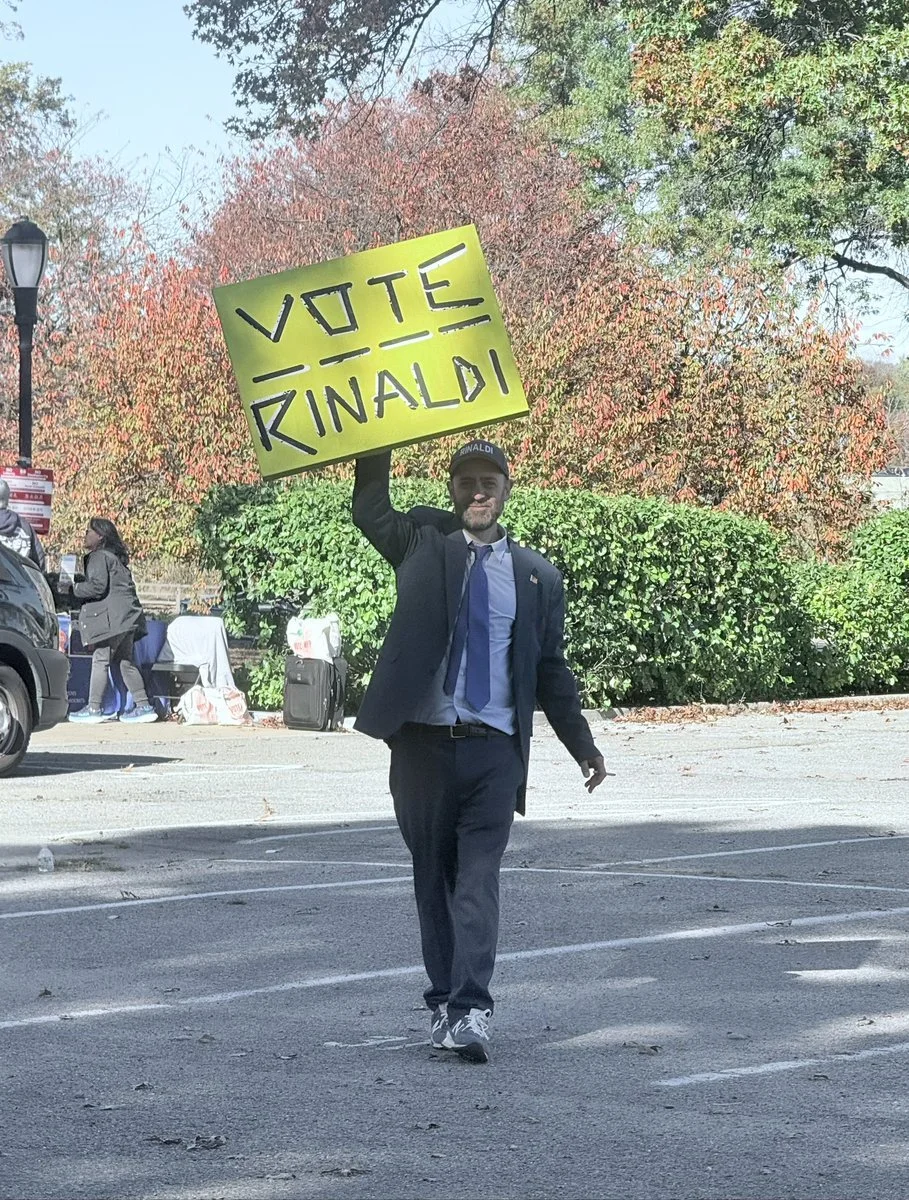
Perennial Queens political candidate Jonathan David Rinaldi appeared in court on Wednesday in the criminal case over his artificial intelligence-generated campaign materials, which claimed endorsements he never received. Screenshot via Jonathan David Rinaldi/X
By Ryan Schwach
Jonathan David Rinaldi, the perennial Queens political candidate facing fraud charges for AI and computer-generated campaign ads, wants his case moved out of the borough.
On Wednesday, Rinaldi’s attorney told a judge he intends to file a motion to send the case to a court outside of Queens.
In June, on the day of the primary election, Rinaldi was arrested and charged with fraud for a plethora of social media posts he made during his 2025 campaign for the City Council. Rinaldi made several computer generated posts, some using AI, to create fake news stories and graphics flaunting endorsements he did not actually receive.
He faces three counts of forgery in the third degree and 15 counts of criminal possession of a forged instrument in the third degree. He faces up to two years in prison, if convicted.
His court-appointed attorney, Andry Cleghorn, said that since Rinaldi was running for political office in Queens, the borough was not an appropriate venue for the case.
“Queens [County] has a conflict of interest,” Cleghorn said.
The lawyer declined to comment further because Wednesday was his first day representing Rinaldi.
The Queens District Attorney’s office has until mid-December to file their reply to the motion, and the DA declined to comment on Rinaldi’s request on Wednesday.
Speaking with the Eagle outside the courthouse, Rinaldi openly admitted to making the ads and described the DA’s case against him as “lawfare.”
Rinaldi’s Wednesday’s court appearance came just hours after he received over 1,600 votes on a third-party line in the race for the 28th Assembly District. He previously lost the Democratic primary to longtime incumbent Assemblymember Andrew Hevesi, who won reelection to the seat this week.
Rinaldi continued to post AI-generated ads during this year's campaign, including an AI-deep fake of Hevesi.
Rinaldi previously denied he made the posts, telling the Eagle in 2025 that he was “hacked,” later claiming it was the work of his then-opponent, Councilmember Lynn Schulman.
However, on Wednesday ahead of the hearing, Rinaldi admitted he made the posts, claiming the fake endorsements were “satire.” When the Eagle asked about his previous claims that he was hacked, he responded, “Who cares? It literally doesn’t matter.”
“The minute that I do a little campaign artwork, now I got to go to jail?” he told the Eagle.
"Satirical commentary is one of the benchmarks of our politics. Satire is protected.”
“Are they going to start arresting people for memes?” he added.
He claimed that the case against him was a coordinated effort to stop him from running for office.
“I think that the punishment is the process,” he said “So this is just going to drag out. They're just trying to get me to not run for office. That's what they're trying to do today. They're trying to say that if I accept a deal, that I'm not allowed to run for office. That's what they want.”
Rinaldi has been known to loudly accost his political rivals and others on the campaign trail, a behavior that got him arrested on Election Day in 2024.
“I understand that I have been a pain in the ass, and I try to do things to like because I'm in a race against these people,” he said. “I'm trying to win.”
During his 2025 bid for the City Council as a Republican, Hevesi created news articles and
graphics claiming endorsements from Andrew Cuomo and then-Councilmember Bob Holden.
He also made AI ads and videos claiming that Schulman endorsed Zohran Mamdani for mayor, which she had not done.
Schulman declined to comment on Rinaldi’s court appearance.
Queens DA Melinda Katz said the case is the first-of-its-kind regarding the use of AI in political campaigns.
“Enough is enough,” she said in a statement in June. “In today’s world it is important to hold people accountable for materially misrepresenting facts.”