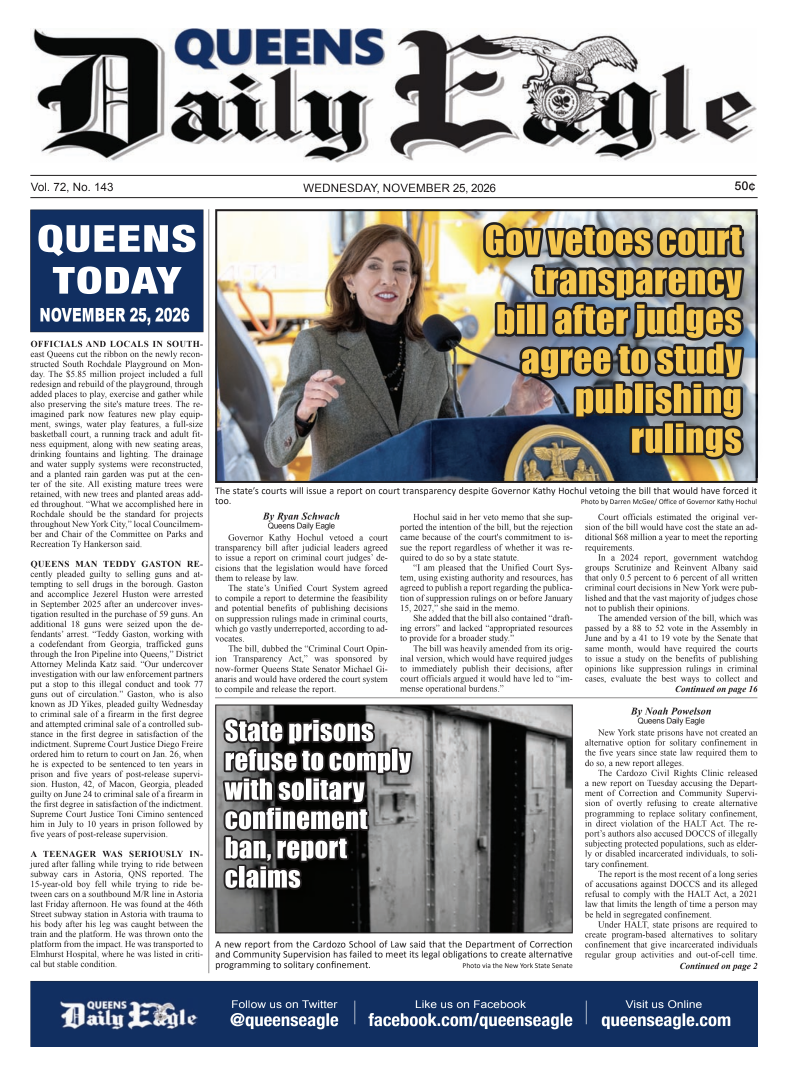
Gov vetoes court transparency bill after judges agree to study publishing rulings
/
The state’s courts will issue a report on court transparency despite Governor Kathy Hochul vetoing the bill that would have forced it too. Photo by Darren McGee/ Office of Governor Kathy Hochul
By Ryan Schwach
Governor Kathy Hochul vetoed a court transparency bill after judicial leaders agreed to issue a report on criminal court judges’ decisions that the legislation would have forced them to release by law.
The state’s Unified Court System agreed to compile a report to determine the feasibility and potential benefits of publishing decisions on suppression rulings made in criminal courts, which go vastly underreported, according to advocates.
The bill, dubbed the “Criminal Court Opinion Transparency Act,” was sponsored by now-former Queens State Senator Michael Gianaris and would have ordered the court system to compile and release the report.
Hochul said in her veto memo that she supported the intention of the bill, but the rejection came because of the court's commitment to issue the report regardless of whether it was required to do so by a state statute.
“I am pleased that the Unified Court System, using existing authority and resources, has agreed to publish a report regarding the publication of suppression rulings on or before January 15, 2027,” she said in the memo.
She added that the bill also contained “drafting errors” and lacked “appropriated resources to provide for a broader study.”
The bill was heavily amended from its original version, which would have required judges to immediately publish their decisions, after court officials argued it would have led to “immense operational burdens.”
Court officials estimated the original version of the bill would have cost the state an additional $68 million a year to meet the reporting requirements.
In a 2024 report, government watchdog groups Scrutinize and Reinvent Albany said that only 0.5 percent to 6 percent of all written criminal court decisions in New York were published and that the vast majority of judges chose not to publish their opinions.
The amended version of the bill, which was passed by a 88 to 52 vote in the Assembly in June and by a 41 to 19 vote by the Senate that same month, would have required the courts to issue a study on the benefits of publishing opinions like suppression rulings in criminal cases, evaluate the best ways to collect and publish such decisions, determine the resources required and report all findings to the governor and the legislature.
The Office of Court Administration confirmed on Tuesday that it plans to compile and release the report without the legislation forcing them to do so.
“The UCS has already taken steps to study the issue and draft a report in mid-January 2027, as the proposed legislation would have required,” spokesperson Al Baker said in a statement.
Oded Oren, the executive director of Scrutinize, told the Eagle that the UCS has indicated it would release the report, and has already reached out to his group and Reinvent Albany to seek input.
“We are going to get the report, and I think that's the main takeaway,” he said, admitting he was still "disappointed" Hochul chose to veto the measure.
“I am confident that they are going to publish a report,” he added.
Scrutinize has long called for the increased publication of court decisions, which allows for more transparency and public knowledge of court proceedings, the advocates say.
Under New York State law, judges have discretion over which opinions they choose to publish, and there are numerous reasons why a judge would or wouldn’t do so. Judges often publish more decisions when they are overseeing a case that receives major media attention and higher public scrutiny.
Oren said he still has some concerns about the report because of the court’s previous opposition to the bill.
“Historically, what we have seen is that the court system says that it is costly for them to undertake the measures of transparency that we've advocated for, specifically on publication,” Oren said. “So I would look closely to see whether that is something that they discuss and where they fall in terms of how costly it is and how beneficial the transparency is.”
“My concern is that the report might not be as rigorous and as thoughtful about the importance of the publication,” he added.
However, he doesn’t think the governor’s signature on the bill would have influenced the report’s thoroughness or its conclusions.
“It could be that they would have felt more pressured to do a more rigorous analysis, but my intuition is that it doesn't really matter,” he said.
Gianaris, who left the legislature a few months before his term was set to end in January and now works for Steve Cohen’s Metropolitan Park, said that the veto isn’t important as long as the report is actually completed.
“If they follow through and actually produce the report, it matters less whether it's written down in law or if they just do it,” he told the Eagle. “I've had lengthy discussions with the administration at OCA, and I think they’re approaching this from an honest point of view in terms of what they're capable of doing.”