Federal judge hears arguments in St. John’s union labor dispute
/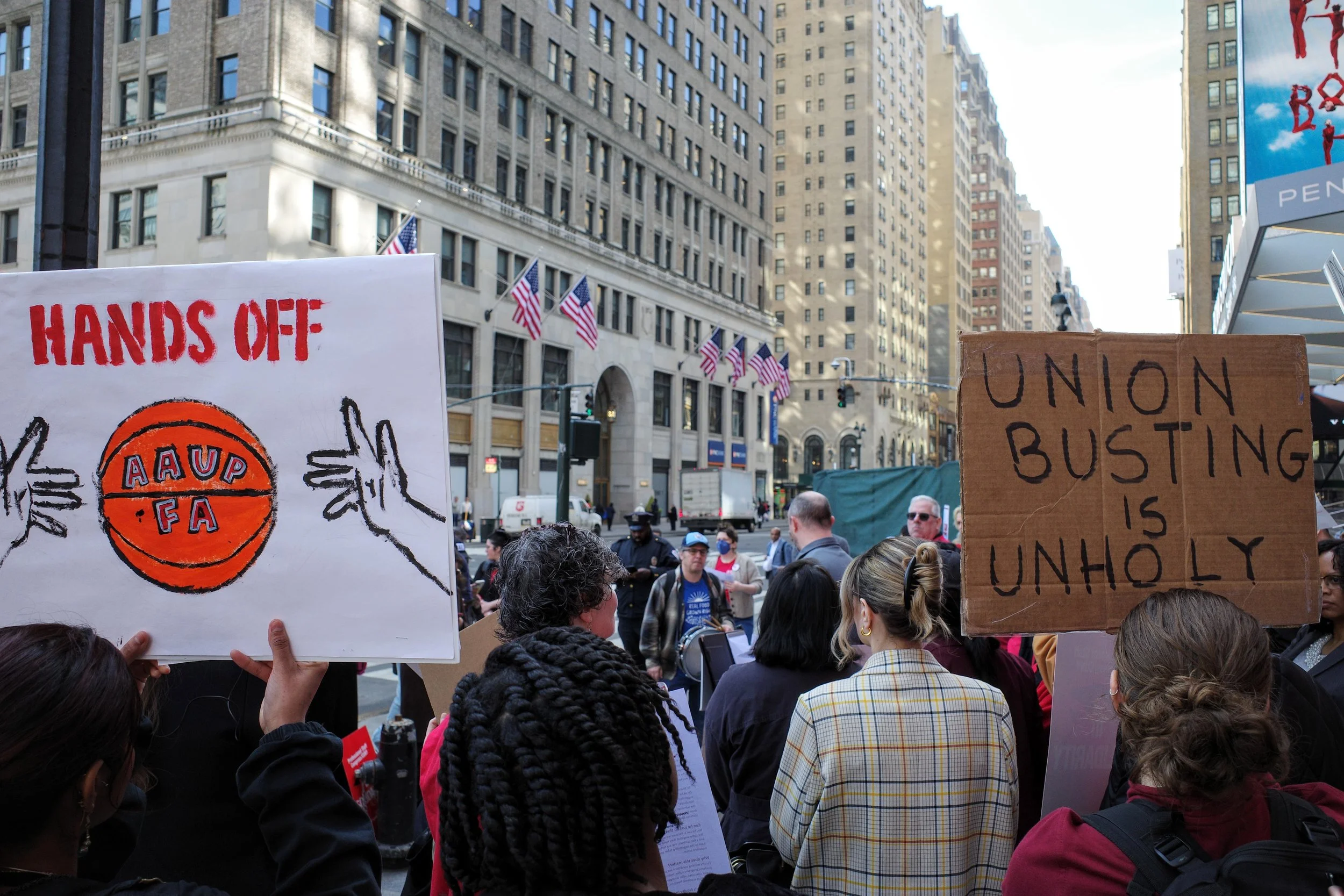
U.S. District Court Judge Frederic Block heard arguments from St. John’s University on their lawsuit against the state Public Employment Relations Board, which was filed after the PERB heard a complaint from the school’s American Association of University Professors and Faculty Association union chapters, pictured here. File photo via St. John's University AAUP Chapter
By Noah Powelson
The battle between St. John’s University and its former faculty unions headed to court last week as a federal judge began to weigh whether state labor laws are applicable to the Catholic institution.
U.S. District Court Judge Frederic Block heard arguments from St. John’s University on Oct. 13, when its attorneys claimed the state’s Public Employment Relations Board did not have jurisdiction over the religious university. The hearing was the first in what is likely to be a lengthy legal battle between St. John’s and its former American Association of University Professors and Faculty Association union chapters.
The fight between the school and the unions began in February, when St. John’s decided to no longer recognize the labor groups after they had been operating at the Queens college for nearly 60 years.
St. John’s sued the PERB in June, after its former unions filed unfair labor practice charges against the school. In their complaint, St. John’s asserted that the First Amendment protected it from a “regime of mandatory collective bargaining that impermissibly entangles the government (and the faculty union) in its internal governance of religion.”
By attempting to establish jurisdiction over St. John’s through the New York State Employment Relations Act, the university argued, PERB was violating the university’s First Amendment protections against excessive government entanglement with religion.
“St. John’s brings this action to vindicate its fundamental constitutional right to operate independently as a Catholic and Vincentian institution, free from outside interference from
PERB or the faculty Union,” the complaint filed in June reads.
St. John’s also sought a preliminary injunction barring PERB from enforcing the State Employment Relations Act against the school, an argument its attorneys made before Block on Oct. 13.
Sophie Bell, acting president of AAUP-SJU, told the Eagle they also presented their arguments in court, claiming the university violated state labor laws.
“The law and the facts are clearly on our side,” Bell told the Eagle. “We have a very strong case, and we're hopeful that after you know these really engaging questions, that the judge will see this when he you know keeps digging into the materials and making this decision.”
Block will issue his decision on the university’s request for an injunction at a later date, though the timeline for that decision is not clear.
A spokesperson for St. John’s declined to comment on the ongoing litigation.
Problems between St. John’s and its former faculty unions began when their labor contracts expired in June 2025. After months of bargaining without progress, St. John’s announced it would no longer recognize the unions, 56 years after they were established.
The move drew widespread protest from students, faculty and labor advocates in the following months, prompting the unions to file unfair labor practice charges with the PERB in April. In the filing, the union claimed that the school surveilled and recorded faculty who participated in union-related activities and solicited faculty members to join a working group to unilaterally change the terms and conditions of their employment without negotiations.
Despite calls from elected officials to roll back the decision, including from Reps. Grace Meng and Gregory Meeks, St. John’s declined to bring the unions back into the school.