Queens public administrator takes control of Bayside home after squatters’ eviction
/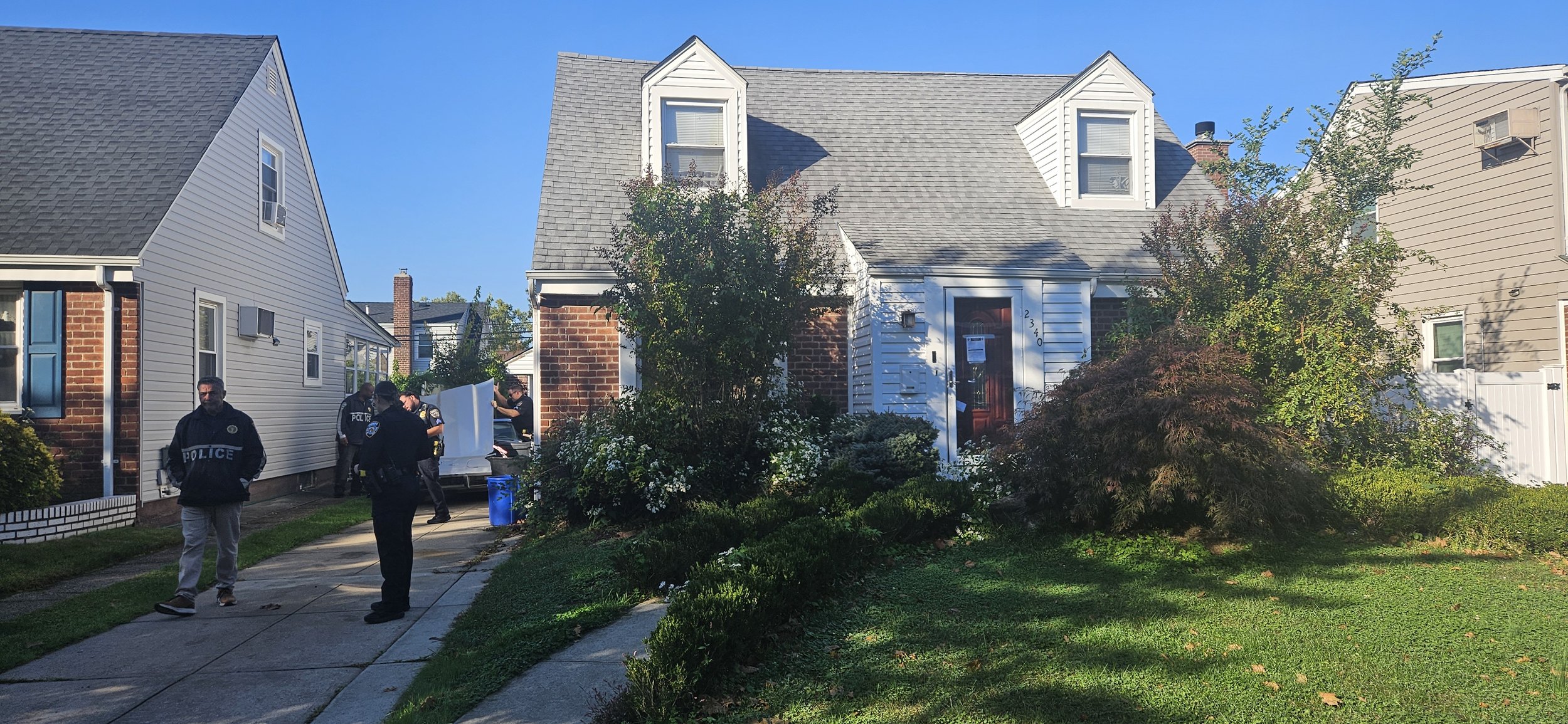
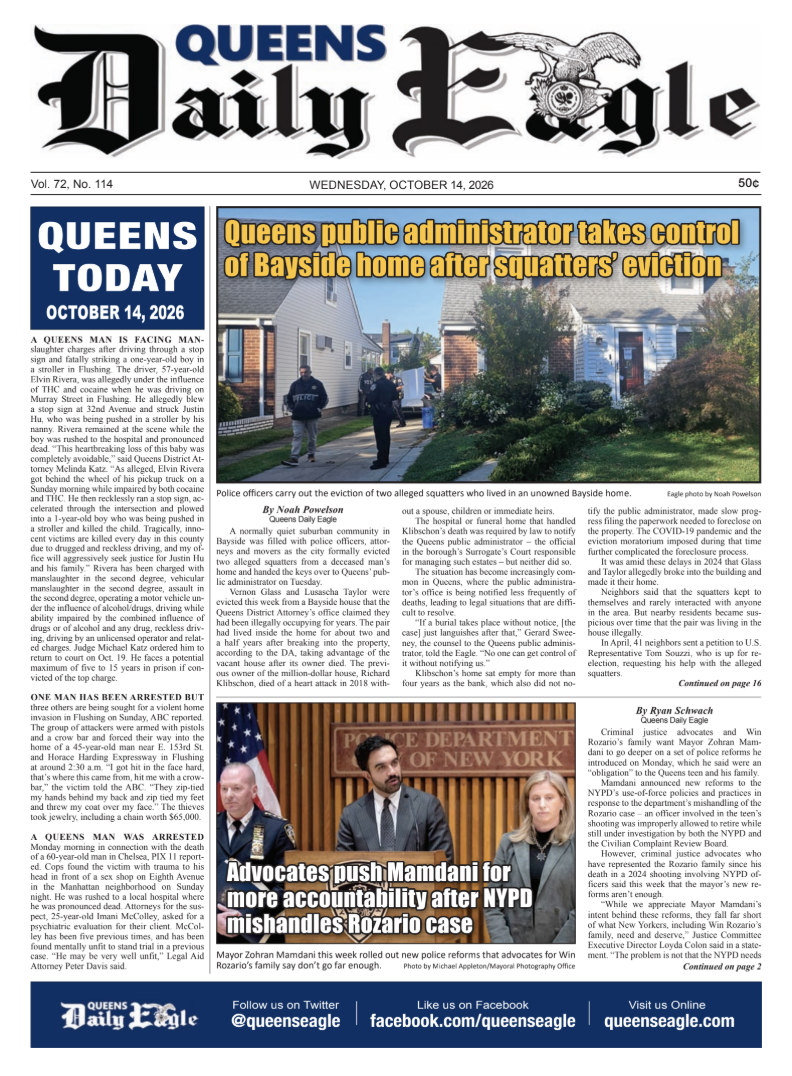
Police officers carry out the eviction of two alleged squatters who lived in an unowned Bayside home. Eagle photo by Noah Powelson
By Noah Powelson
A normally quiet suburban community in Bayside was filled with police officers, attorneys and movers as the city formally evicted two alleged squatters from a deceased man’s home and handed the keys over to Queens’ public administrator on Tuesday.
Vernon Glass and Lusascha Taylor were evicted this week from a Bayside house that the Queens District Attorney’s office claimed they had been illegally occupying for years. The pair had lived inside the home for about two and a half years after breaking into the property, according to the DA, taking advantage of the vacant house after its owner died. The previous owner of the million-dollar house, Richard Klibschon, died of a heart attack in 2018 without a spouse, children or immediate heirs.
The hospital or funeral home that handled Klibschon’s death was required by law to notify the Queens public administrator – the official in the borough’s Surrogate’s Court responsible for managing such estates – but neither did so.
The situation has become increasingly common in Queens, where the public administrator’s office is being notified less frequently of deaths, leading to legal situations that are difficult to resolve.
“If a burial takes place without notice, [the case] just languishes after that,” Gerard Sweeney, the counsel to the Queens public administrator, told the Eagle. “No one can get control of it without notifying us.”
Klibschon’s home sat empty for more than four years as the bank, which also did not notify the public administrator, made slow progress filing the paperwork needed to foreclose on the property. The COVID-19 pandemic and the eviction moratorium imposed during that time further complicated the foreclosure process.
It was amid these delays in 2024 that Glass and Taylor allegedly broke into the building and made it their home.
Neighbors said that the squatters kept to themselves and rarely interacted with anyone in the area. But nearby residents became suspicious over time that the pair was living in the house illegally.
In April, 41 neighbors sent a petition to U.S. Representative Tom Souzzi, who is up for reelection, requesting his help with the alleged squatters.
It was Suozzi’s office that notified the Queens public administrator of Klibschon’s death and his lack of next of kin, nearly eight years after he had passed.
“It’s not really a federal issue, but I realized it was a big issue for the people that lived in the neighborhood,” Suozzi told the Eagle. “I just figured you should call the public administrator, that’s who should be involved here because there’s nobody involved in the house.”
“It’s a big bureaucratic process,” Suozzi said. “This has been a good example of people doing the right thing.”
Not long after Suozzi’s involvement, the case caught the eye of the Queens DA’s office, which launched its own investigation into Glass and Taylor. The two were arrested in September and charged with burglary and trespassing.
Glass and Taylor both face up to 15 years in prison if they are convicted of the top count. Both pleaded not guilty and were ordered not to return to the property.
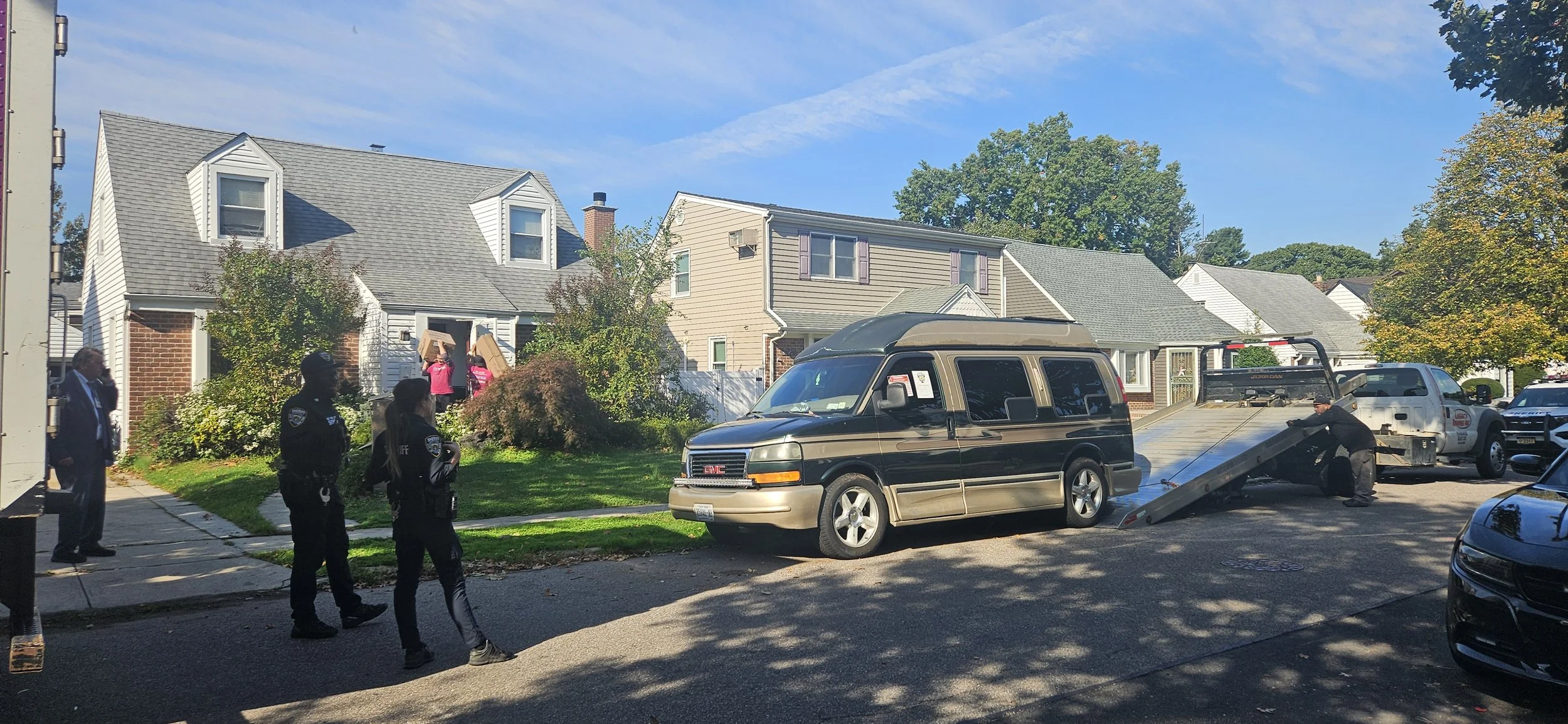
Movers clear out a Bayside home of alleged squatters’ possessions. Eagle photo by Noah Powelson
“You simply cannot move into a home without permission and claim you have a right to stay – even if the property is vacant and the owner is deceased,” Katz said in a statement in September. “The defendants have been removed from the property, and the home has been secured to prevent their return. They will now face justice in our court system.”
The house officially became the property of the public administrator as of Tuesday morning. It will take some time to fully clear out Glass and Taylor’s belongings, which will be held in storage containers for the next few months, and get the estate ready to be put back on the market. A broker has already been tasked with marketing the house and getting it ready for sale.
Harry, a local resident who lives across the street from the unoccupied home and declined to give his last name, said seeing the police and movers begin clearing out the house gave him a sense of closure.
“We’re delighted, we’re happy,” he said. “We felt that it should have been done a year ago, but regardless, now, we’re just happy that it's all taken care of.”
But the house isn’t out of the woods just yet. It isn’t uncommon for other would-be squatters to attempt to break into the home during the transition period, Sweeney said, adding that he hoped the house would be sold within the next month or two.
“We'll close as quickly as we can,” Sweeney said.
The Queens public administrator bears the sole responsibility of managing the estates of Queens residents who die without a will or named next of kin. The office works directly under the Queens Surrogate’s Court judge.
Every county in New York City has a public administrator. The office can manage the estate of a deceased person, attempt to find living relatives and arrange for the estate’s assets to be sold if none are located. It can also take over if the executor of a will or the previous administrator of an estate becomes ill, dies or is convicted of a felony.
How the public administrator handles estates varies by case, but the office employs a large team of accountants, auctioneers and lawyers to fully understand the scope of the assets they have to distribute and determine how to handle them.
According to Sweeney, the public administrator turns over millions of dollars to the city through fees collected during the sale of estates. Sweeney also said a large proportion of the funds generated is returned to family members of the deceased or others entitled to the money.
Sweeney said it used to be much more common for the public administrator’s office to be notified of cases like Klibschon’s shortly after a death, but lax enforcement of notification requirements means the office often finds out about an estate’s situation far too late.
“A funeral director is supposed to notify us. A hospital is supposed to notify us,” Sweeney said. “But they don't do it anymore.”