Teens locked in solitary confinement for months in state facilities, new lawsuit claims
/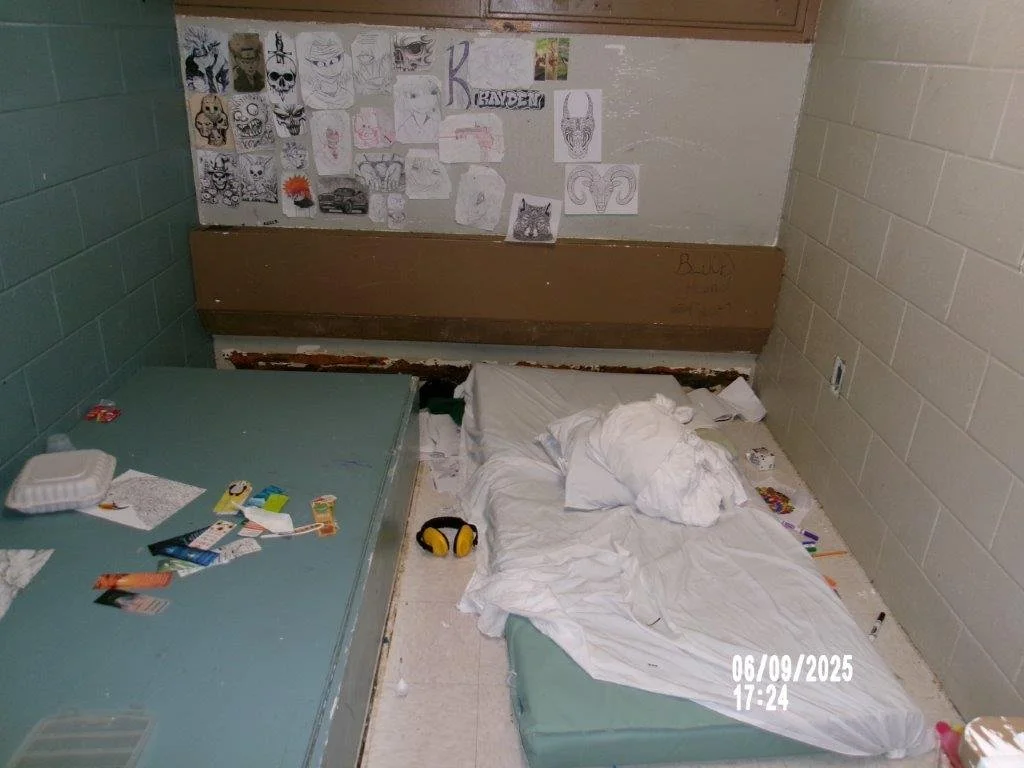
A cell at Industry Residential Center in Rochester that attorneys said youth are confined in for sometimes 24 hours a day. Photo provided by the Legal Aid Society
By Noah Powelson
New York teens held inside the state’s adolescent detention centers are routinely kept locked in cramped quarters without reliable access to water or bathroom facilities, a new class action lawsuit claims.
The Legal Aid Society and Jenner and Block LLP law firm filed a class action civil rights lawsuit in the United States District Court for the Southern District of New York on Thursday, alleging that the New York State Office of Children and Family Services maintains unlawful and inhumane solitary confinement practices for youths in their care. The lawsuit says that OCFS violated the teens’ Eighth and Fourteenth Amendment rights, as well as the rights afforded to them through the Americans with Disabilities Act.
The lawsuit names five secure placement facilities operated by OCFS — located in Columbia, Orange, Cayuga, Monroe, and Tompkins counties — where youth are confined in tiny cells for up to 24 hours at a time. Litigators who filed the class action lawsuit said the youth are subjected to solitary confinement as punishment for alleged rule breaking and misbehavior.
During these times of isolations, which the lawsuit said can last for months, teens are allegedly locked in cells with no toilets or sinks and are “forced to use garbage pails, water bottles, food containers, or buckets to relieve themselves.” The lawsuit also claimed the youth have no access to education or programming during isolation, resulting in detrimental effects to their development and mental health.
“Young people housed in secure placement facilities operated by OCFS have a right to safety, dignity, and age-appropriate treatment,” Dawne Mitchell, chief attorney of the Juvenile Rights Practice at The Legal Aid Society, said in a statement. “OCFS must immediately put an end to these barbaric unlawful and inhumane practices and ensure these young New Yorkers are provided appropriate care, including basic hygiene, education and rehabilitative services.”
The lawsuit names four youths currently held in OCFS custody as plaintiffs in the case, the oldest being 20 years old and the youngest being 16.
One of the plaintiffs, identified as Marcus F. in the filing, is an 18-year-old who was allegedly repeatedly locked in solitary confinement at two different secure placement facilities. Marcus F. was allegedly locked in his cell alone for up to 23 hours a day without any contact with peers, and only occasionally let out to use the bathroom.
Another plaintiff, a 16-year-old named Garret M., is currently in OCFS custody at Industry Residential Center, according to the suit. He was allegedly locked in his cell for 22 to 24 hours a day his first month at the facility, and at times was subject to multiple consecutive 24-hour isolation periods. He was also allegedly denied access to the bathroom during these times.
All named plaintiffs were allegedly denied access to education while in confinement.
The conditions the youth faced were apparently discovered by attorneys after the Public Employees Federation, the union representing many OCFS employees, sent a letter to lawmakers detailing the conditions in the facilities.
“Extended isolation can severely disrupt a young person’s emotional and developmental growth, increasing trauma, anxiety, and long-term harm,” Rochester Assemblyman Demond Meeks said in a statement. “This practice is deeply inconsistent with our commitment to restorative justice and rehabilitation. We must continue working toward a system that lifts young people, addresses root causes such as adverse childhood experiences, and give them the tools they need to succeed when they return to their communities.”
An OCFS spokesperson said they were aware of the lawsuit and reviewing the allegations.
“We are aware of the lawsuit filed by the Legal Aid Society, which challenges certain juvenile justice protocols. The complaint will be thoroughly examined and we will respond through the appropriate legal process,” the spokesperson said. “CFS does not endorse or condone the use of isolation for punishment. We have clear protocols that are designed to ensure the safety of youth, and staff, while incorporating trauma-informed and mental health–responsive practices. We will continue to work diligently to ensure the safety and well-being of all those under care of our facilities.”
Solitary confinement, a practice which was banned with certain exceptions in the state’s 2021 Humane Alternatives to Long-Term Solitary Confinement Act, has reportedly seen continued use in New York correctional facilities.
Under the HALT Act, solitary confinement is prohibited from being used against an incarcerated person for more than 15 consecutive days or for 20 total days over a 60-day period.
There is an exception to this rule that allows for a suspension of HALT due to an emergency across the state’s prisons, which was employed by Department of Corrections and Community Supervision Commissioner Daniel Martuscello during the correctional officers’ wildcat strike last year.
Since the end of the wildcat strike, legal advocates have issued several lawsuits against DOCCS for failing to resume HALT Act requirements and report on its implementation. A preliminary injunction was issued in April 2025 ordering DOCCS to roll back the emergency suspension of the HALT Act, which the agency said they have complied with. But Legal Aid Society attorneys said their clients continue to face solitary confinement for up to 22 hours a day, and have called on the courts to hold DOCCS in contempt.
The care of youth and children inside detention facilities also came under scrutiny this past year.
At a joint oversight meeting held by the City Council Committees on Children and Youth and Education in Nov. 2025, leaders of the city’s two juvenile detention centers said that youth routinely have to sleep in classrooms because of capacity issues, and supervised youth do occasionally miss class.
Nancy Ginsburg, deputy commissioner for the Division of Youth and Family Justice at the Administration for Children’s Services, said the lack of beds have required some teens sleep in repurposed classrooms while at one of the juvenile detention facilities.
“We have more young people than we have bedroom capacity in these facilities,” Ginsburg said at the time.