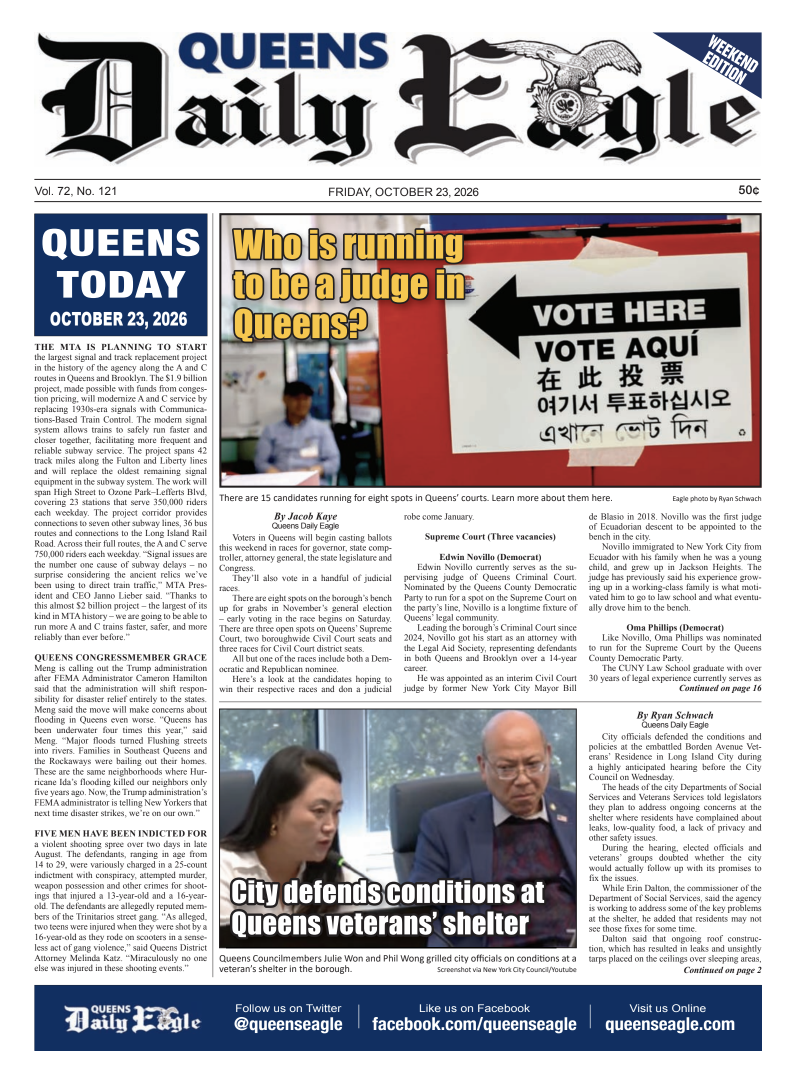
Year-long gang war ends with arrest of twelve men
/
Queens District Attorney Melinda Katz stood with NYPD Commissioner Jessica Tisch and Mayor Eric Adams to announce the takedown of the Floss Money Ballers on Thursday. Eagle photo by Noah Powelson
By Noah Powelson
A dozen men responsible for the majority of shootings in Southeast Queens during a gang war this past year were arrested and indicted this last week, putting an end to a year-long investigation by law enforcement.
Just a few weeks before the anniversary of the death of an 18-year-old that ignited a series of shootings, Queens District Attorney Melinda Katz announced that all known members of the Floss Money Ballers had been arrested and were arraigned on Aug. 28. FMB members were linked to shootings that happened between April 2024 and May 2025, prosecutors allege, most stemming from an escalating feud with a rival gang, the Blitz Gang 4.
The men, who range in age as young as 18 to as old as 26, were slapped with a 33-count indictment that included conspiracy, attempted murder and other charges. Most of their crimes took place in the neighborhoods of Springfield Gardens, Laurelton, Queens Village and the Baisley Park Houses.
They each face up to 25 years in prison if convicted.
The FMB came from remnants of the Money World gang that was dismantled back in March of 2023, according to the DA’s office.
“As alleged, these 12 suspected members of the Floss Money Ballers gang were responsible for the vast majority of shooting incidents in Southeast Queens over the past year,” Queens District Attorney Melinda Katz said in a statement. “It is no coincidence that directly following this takedown – a culmination of a year-long investigation by my office and the NYPD – these same neighborhoods reported zero shootings over Labor Day weekend.”
According to the District attorney’s office, the escalation in gang violence between the FMB and BG4 began on Sept. 27, 2024 with the death of 18-year-old Akim Cisse.
Cisse, an alleged member of the FMB, was reportedly in a parked car in a McDonald’s parking lot on South Conduit Avenue when a member of the rival BG4 opened fire on the vehicle, killing Cisse. The BG4 shooter, Rayvon Phillip, was arrested not long after and was sentenced to 21 years in prison last July.
But following Cisse’s murder, the DA said the victim’s fellow FMB members waged a war throughout Southeast Queens, launching targeted shooting and attacks on perceived gang rivals.
On Sept. 28, 2024, at 1:15 a.m., just hours after Cisse’s death, five FMB members drove to a house on 119 Avenue in South Jamaica and opened fire three separate times. The shooting was allegedly in retaliation for Cisse’s death, and the DA said they were targeting members of a perceived rival gang.
One of the defendants, Jackson Cross, 21, was allegedly chased by police in the afternoon following the Sept. 28 shooting. Cross escaped, but dropped his backpack in the process. Police said the bag was filled with ammunition and a 9mm Glock with an extended magazine.
Another shooting was reported on Jan. 12, 2025, when officers responded to a call from 142nd Avenue in Springfield Gardens, where defendants Kevson Hankey, Kevin Petit-Dieu, and Tahnell Williams, who are all 20-years-old, had allegedly shot at a man they lured into a weed deal.
No arrests were made at the time, but the DA said a search warrant of Hankey’s home uncovered a .40-caliber loaded Glock pistol that was a match for the shell casings recovered in January.
The final shooting incident before the gang members were arrested occurred on May 10, 2025, on Mother’s Day. Prosecutors said a “caravan of FMB members” were organized to drive to the Baisley Park Houses, a NYCHA development in South Jamaica, and shoot any gang opponents on sight.
One of the FMB members spotted an alleged rival gang leader on Guy Brewer Boulevard, who was greeting his grandmother from her car at the time. Defendant Larry Spencer, 20, got out of the car and fired on the alleged gang leader multiple times, hitting his back and leg, before driving away. The man survived his wounds.
The DA said most guns seized from the defendants were likely illegally brought in through the Iron Pipeline, the route used by gun traffickers to smuggle guns from states with less restrictive gun control laws. One gun seized was a ghost gun.
The DA also said that no non-gang affiliated Queens residents were injured in any of the shootings.
Mayor Eric Adams stood with Katz and Police Commissioner Jessica Tisch during the gang takedown’s announcement on Thursday, and said that gang violence like that allegedly perpetuated by the defendants hurts communities of color the most.
“These locations are personal to me; my family still has a home in Southeast Queens. These shootings have a total disregard for the hard-working people here,” Adams said. “When you talk about Springfield Gardens, you talk about Laurelton, you talk about Cambra Heights, you’re talking about the bedrock of the Black and brown working-class people.”
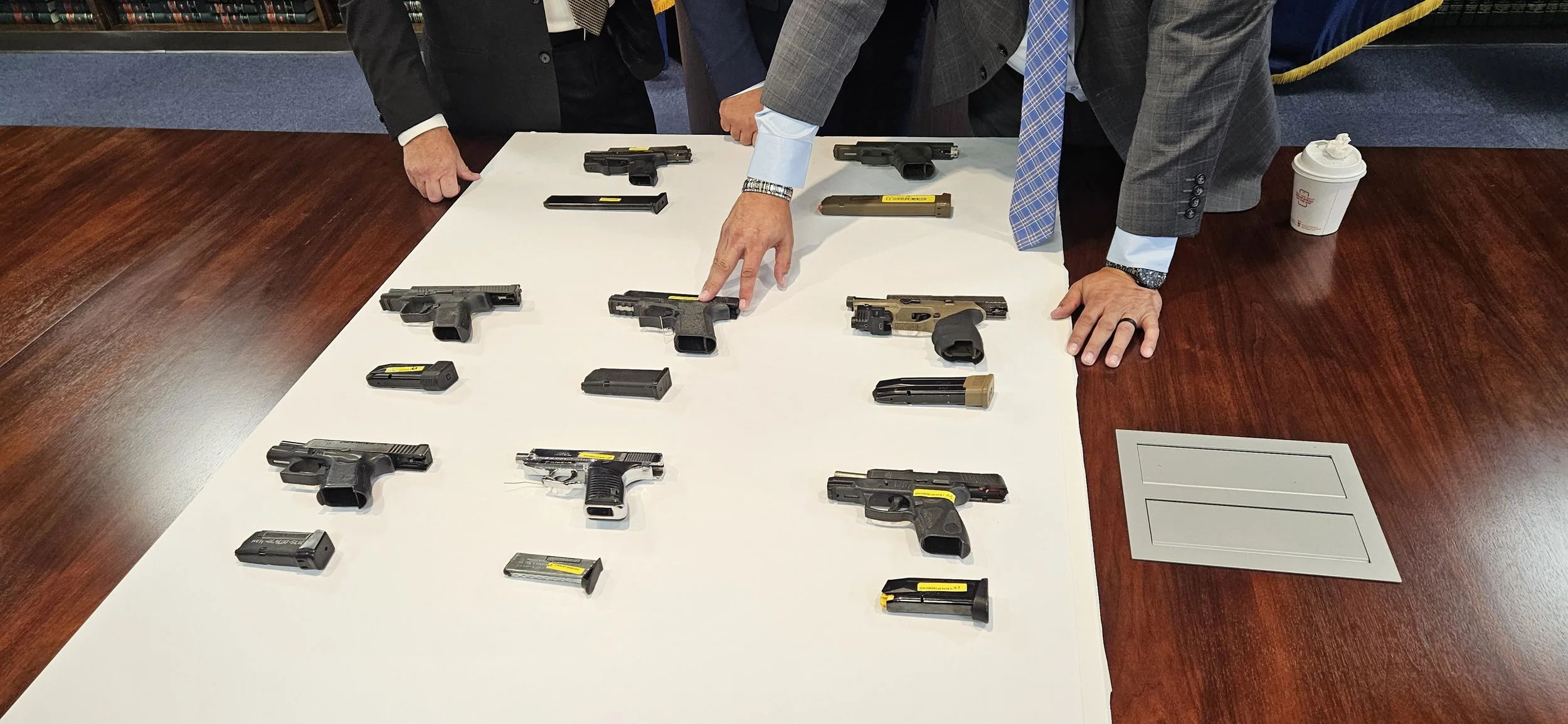
Prosecutors say twelve men were responsible for a majority of the shootings in Southeast Queens this past year, using guns obtained from the Iron Pipeline. Eagle photo by Noah Powelson
Tisch also highlighted NYPD’s efforts against gang activity last year, announcing earlier this week that 2025 had the lowest number of shooting victims and incidents in the first eight months compared to any other time in history. Tisch also said the NYPD executed 55 gang takedowns, arresting 396 gang members in 2025.
The commissioner also took the opportunity to say how the gang takedown last week exemplifies why the controversial Criminal Group Database, otherwise known as the Gang Database, is a crucial tool for police enforcement.
The Gang Database is accessible to authorized NYPD members and holds a collection of information, including criminal group names, associated incidents, geographic data and the names, addresses and associations of those allegedly in the groups.
A City Council bill co-sponsored by Queens Councilmembers Tiffany Cabán and Nantasha Williams aims to abolish the database, a move Tisch called grossly irresponsible.
“Of the twelve case subjects, every single one of them is entered into the NYPD’s Criminal Group Database. And with this takedown, we’ve taken off the street nearly all of the known members of Floss Money,” Tisch said. “This case shows why the database matters and it proves, again, why calls from the City Council to abolish it are so dangerous and so reckless.”
But the City Council isn’t the only group calling for the Gang Database to be taken down.
Last April, the Legal Aid Society filed a class-action complaint against the city alleging that the NYPD registers citizens onto the gang database using arbitrary metrics that racially profiles and harasses people of color who have committed low-level offenses, or who have no criminal history at all.
"The NYPD’s gang database unfairly targets New Yorkers of color, often relying on vague and arbitrary criteria such as clothing, social media activity, or associations,” Rigodis Appling, Staff Attorney with the Special Litigation Unit & Community Justice Unit at LAS, told the Eagle in a statement. “Rather than enhancing public safety, it subjects young people to heightened surveillance and lifelong consequences without due process. It’s time for the City to move away from this harmful practice."
Katz and Tisch said they do not use the Gang Database to make arrests, build probable cause or use it as evidence.