Queens buses are slow and often late, report says
/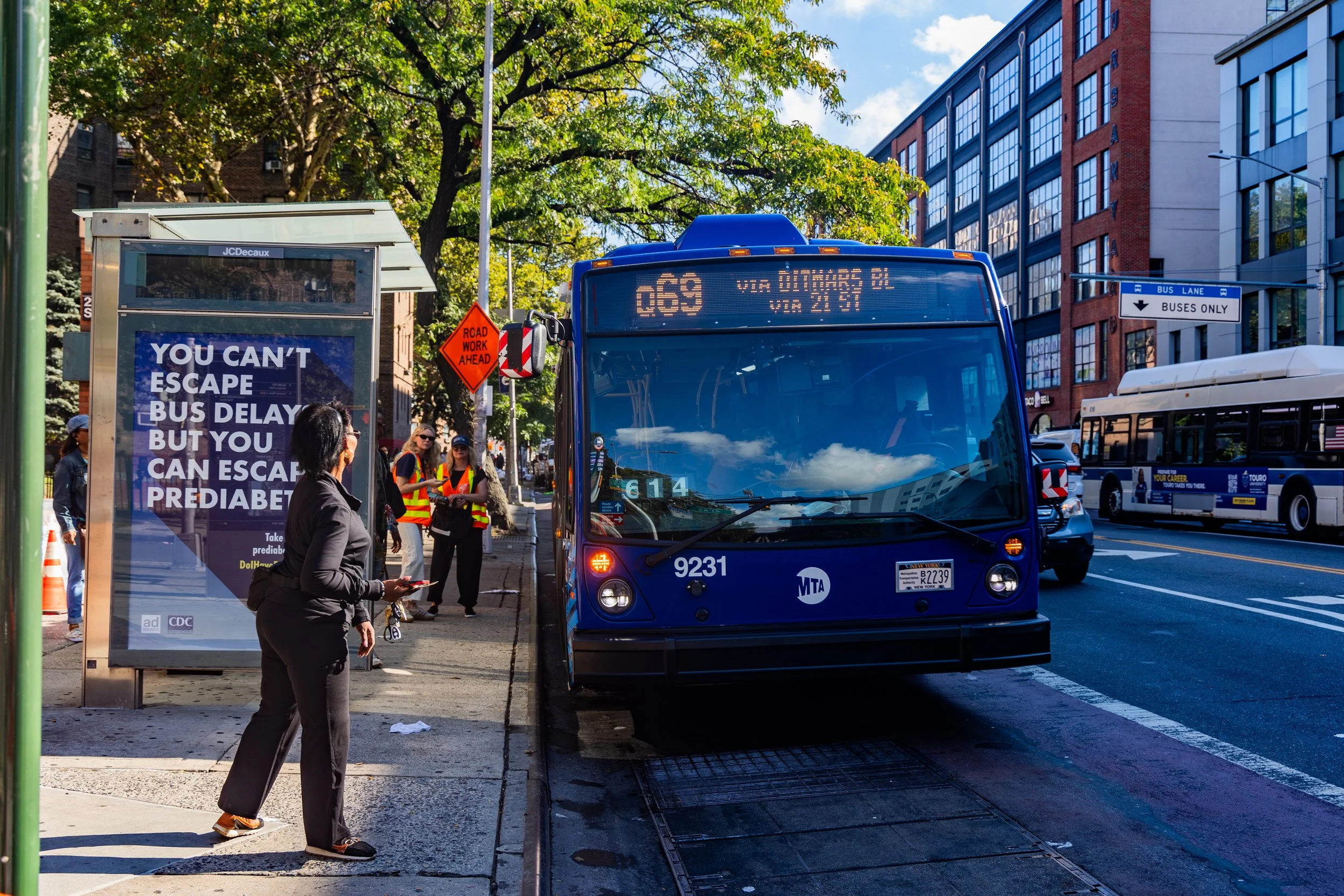
A new report from Comptroller Brad Lander’s office shows that Queens buses are struggling with speed and on-time rates as the MTA rolls out a new bus map for the borough. Eagle photo by Ryan Schwach
By Ryan Schwach
It may only be the first full week of the school year, but Queens’ buses have already fallen behind on their report card.
Queens buses are slower, and less on time than the city average, a new report from the comptroller’s office says.
When graded on speed, on-time rate and overall bus reliability, more than 90 percent of Queens’ local bus routes scored lower than a B-grade, and 17 were given F-grades, as Queens buses struggle alongside the rest of the city’s.
“New York City is home to the largest bus network in all of North America, yet pedestrians can walk faster than some buses,” said Comptroller Brad Lander. “New Yorkers deserve a system that actually gets people where they need to go.
“The impact of the city and MTA’s failures is unmistakable and felt daily for thousands,” he added.
Lander’s report analyzed all of the city’s 332 local and express routes, and found that 56 percent of them scored “below average” – or less than a D-grade.
For Queens’ 79 local bus routes, only five buses were rated with either an A- or a B-grade.
None of the borough’s express routes to Manhattan achieved higher than a C.
Compared to the numbers for the rest of the city, Queens local buses were a tad bit slower than the city’s average, registering an average of 8.78 miles per hour compared to 9.3 miles per hour citywide. However, Queens’ speed outpaced every borough besides the less populated and traffic-plagued Staten Island.
Queens’ buses bunch together, which leads to less reliable service, at a rate higher than every other borough except Brooklyn, and more than the citywide average.
The World’s Borough’s buses were on time 70.2 percent of the time, about on par with the city’s 70.3 percent, but lower than the on-time rate of every borough except Brooklyn.
Those reliability issues are widespread through the Queens’ bus system, according to the comptroller’s metrics.
Only one bus received a top mark, the Q35, which spends little time in Queens, only traversing about 2.8 miles along the Rockaways before jumping into Brooklyn, where it completes the majority of its route.
Only four of Queens’ 79 buses received B-grades – the Q50 and Q44-SBS, which make similar trips from Flushing to the Bronx, the Q46, which runs down Union Turnpike, and the Jamaica-Hollis Q2. The Q2 also runs on time about 89 percent of the time, the best in the borough.
Queen’s two least on-time buses were the Q8, which runs from Jamaica Center to Spring Creek in Brooklyn, and the Q24, which runs from Downtown Jamaica to Bed-Stuy. Both buses are on time about half of the time. The Q24 also bunches up at around the highest rate in the borough.
While arguing for more dedicated bus lanes and funding as potential solutions, the report does little to specify exactly what the MTA and the city can do to better service.
“The MTA agrees with Comptroller Lander that faster buses are essential for riders, which is why we are undertaking all-borough bus network redesigns to speed up service with improved routing and stop spacing, expanding automatic camera enforcement, and significantly improving speeds in Manhattan through congestion relief,” NYC Transit Acting Senior Vice President for Buses Frank Farrell sad in response to the report. “The fact remains that dedicated bus lanes are needed to make a material impact on bus speed citywide.”
The comptroller's report comes hot on the heels of the implementation of the Queens Bus Network Redesign, which reworked nearly the entirety of the borough’s bus map.
The MTA redrew Queens’ routes, introduced new, faster rush routes and also eliminated stops in an attempt to increase speed and frequency.
Both of Queens’ two slowest routes, the Q8 and Q24, had stops eliminated on their route in the hopes they will get faster.
However, the MTA’s rollout of the bus redesign has had its growing pains, with riders not knowing how to get where they need to go amid the route and stop changes.
The elimination of stops was a major issue even before the redesign was approved, with locals lambasting those proposals during the public comment period, arguing it would inconvenience riders, especially seniors.
In just the first two months of the redesign’s initial implementation, local pushback has already led to the reinstating of two bus stops that the redesign scrapped.