State begins design of Queens-Brooklyn light rail
/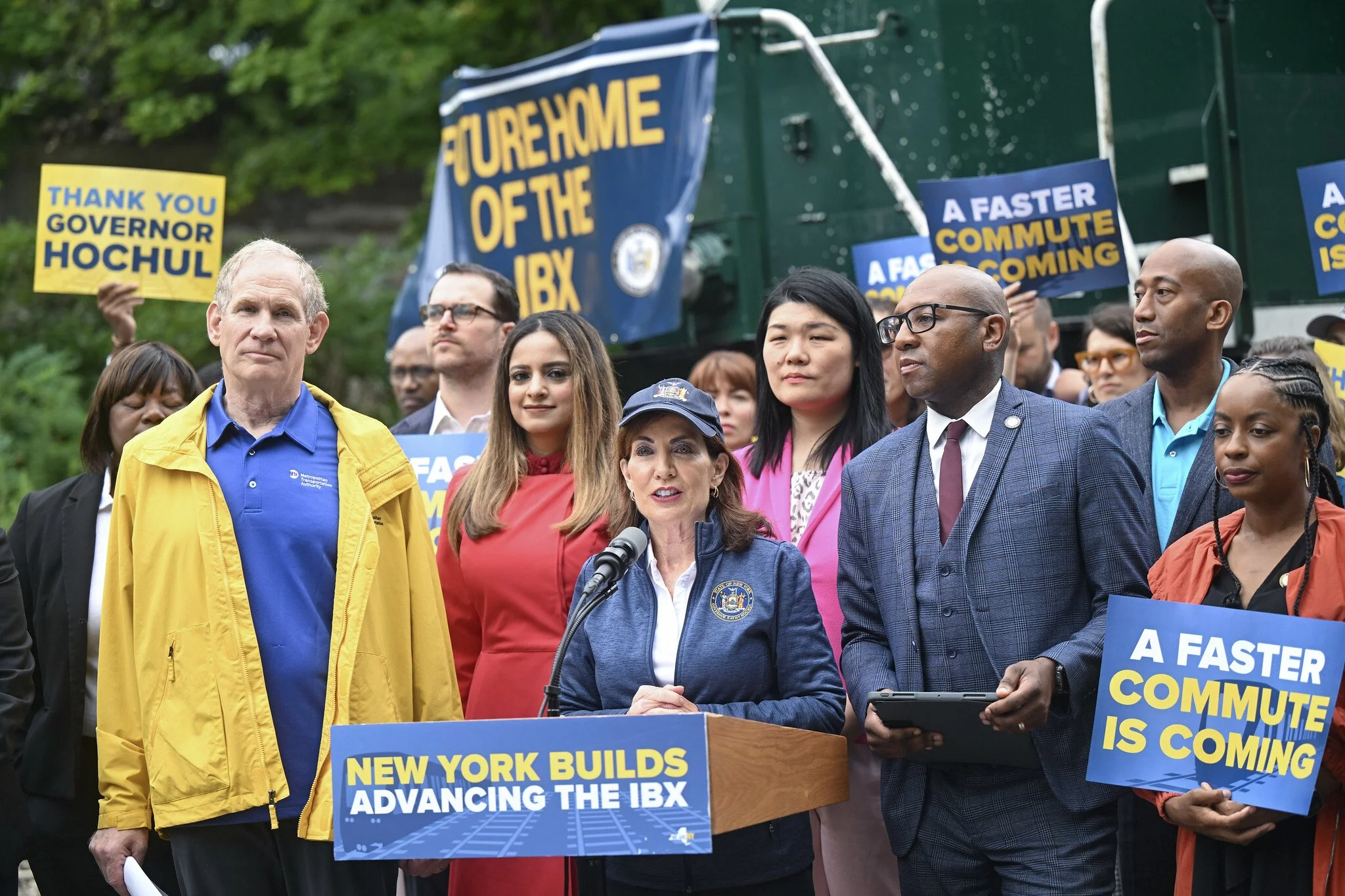
Governor Kathy Hochul was joined by state and local officials, including MTA Chair Janno Lieber, Queens Assemblymember Jenifer Rajkumar, Brooklyn City Councilmember Susan Zhuang, Queens Borough President Donovan Richards, Queens Assemblymember Clyde Vanel and Queens City Councilmember Selvena Brooks-Powers, to announce the next phase of the IBX on Friday. Photo by Susan Watts/Office of Governor Kathy Hochul
By Jacob Kaye
Three years after Governor Kathy Hochul kickstarted the state’s effort to build a 14-mile light rail connecting Queens and Brooklyn, the Interborough Express was officially moved from the planning to the design and engineering phase.
Governor Kathy Hochul announced the next stage of the $5.5 billion project on Friday, several days after the Metropolitan Transit Authority’s board approved a $165.9 million contract for two engineering and design firms to guide the project along.
While the IBX won’t be pulling into stations in Queens and Brooklyn anytime in the immediate future, the state has already committed to funding half of the ambitious project. The MTA set aside $2.75 billion for the IBX in its 2025-2029 capital plan, which features few other expansion projects like the rail line.
The IBX, which would be built on an existing freight line, is Hochul’s signature transit proposal – she announced her plan to pursue it during her first major speech as governor in 2022.
On Friday, she claimed her administration was defying what New Yorkers have come to expect of colossal projects like the IBX, which she said often gets “put on a shelf, gets dusty over the years and feeds the cynicism that government can’t get things done.”
“That era is over,” Hochul said.
The IBX would run from Jackson Heights to Red Hook, hitting 19 stops along the route that snakes through a number of neighborhoods currently lacking reliable public transportation options.
The line would likely serve nearly 1 million riders, connecting with 17 subway lines and stopping in neighborhoods like Jackson Heights, Elmhurst, Maspeth, Middle Village and Ridgewood in Queens, and Bushwick, Brownsville, Flatbush and Borough Park in Brooklyn.
From end to end, the trip is expected to take 32 minutes for riders who may currently have to first travel in Manhattan to get between the two connected boroughs.
“This is about bringing people together,” Hochul said on Friday. “It's all about lifting up people's quality of life.”
With the planning phase of the project now complete, the design and engineering of the light rail will soon begin. The design of the IBX will be the final phase before construction can begin.
Firms Jacobs Civil Consultants and Henningson, Durham & Richardson Architecture and Engineering will lead the next phase of the project, having been awarded a contract by the MTA’s board last week.
While the project will be built along an existing rail line, it won’t come without its design and engineering complications.
One hurdle may center around All Faiths Cemetery in Middle Village – although, the MTA appears to already have a solution.
The MTA has two options when it comes to the IBX’s passage through the cemetery – retrofit an existing tunnel underneath the cemetery or send the IBX onto the street.
Both options came with their own set of complications.
Fixing the tunnel so that it can accommodate light rail travel would be expensive. But sending the IBX onto the street, where it would have to abide by the 25 miles per hour speed limit and compete with traffic, would likely add another 10 minutes to the trip end-to-end.
In October, the MTA announced it planned to pursue the tunnel option but said that it had yet to decide whether or not it would build a new tunnel entirely or update the existing one.
The MTA will also have to redesign over 40 bridges, update all of the track along the way and make improvements to elevators and other station infrastructure. The design phase will also focus on communications and signal design, vehicle design and the design of storage yards.
Beginning the design and engineering of the IBX marks a major step forward for the project, officials said Friday.
The project is the only major expansion project the MTA intends to pursue over the next half decade.
MTA Chair Janno Lieber said that while the IBX is an exciting pursuit, “it’s not just a shiny object like some expansion proposals.”
“There are almost a million people living in the neighborhoods along the route, plus another 260,000 who work nearby, and it makes no sense that they have to cross the river to Manhattan,” he said.
“We're going to take an existing, underutilized infrastructure asset and turn it into so much more,” Lieber added.
While the MTA currently does not have a timeline for the project or all the funding it will need, officials on Friday couldn’t contain their optimism about the IBX.
“We're one step closer to putting shovels in the ground,” said Queens Borough President Donovan Richards. “All aboard.”