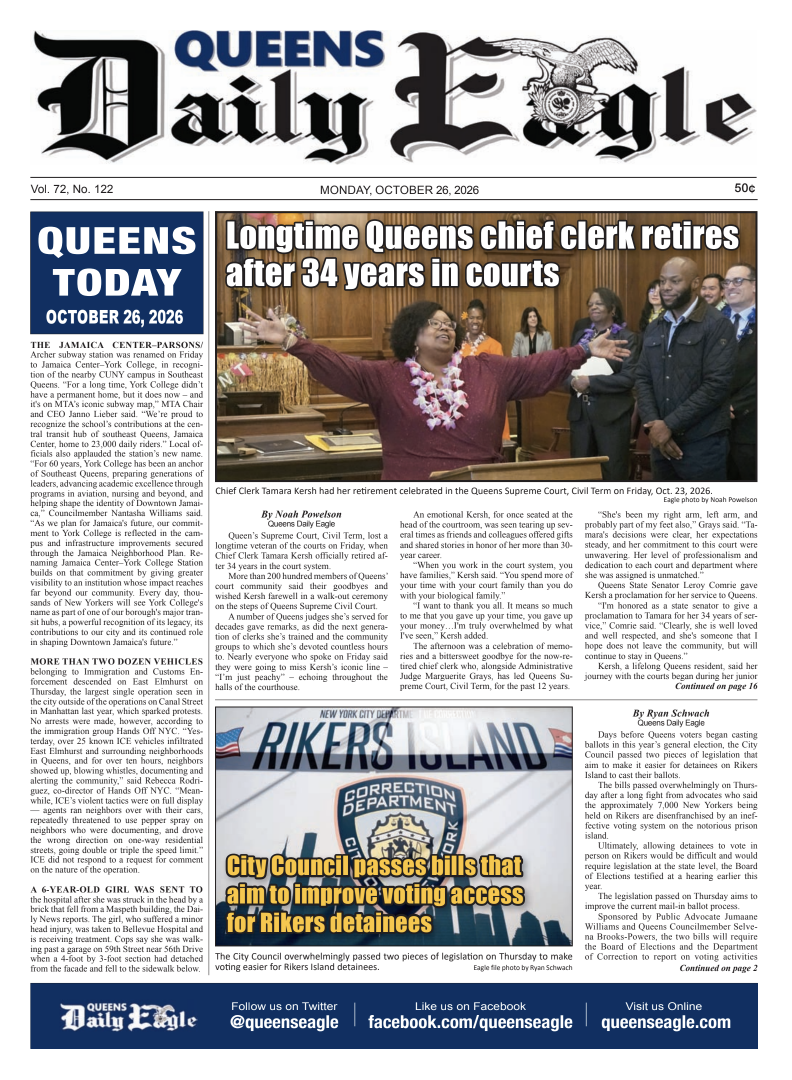
Former Flushing Airport to be converted into 3,000 new homes
/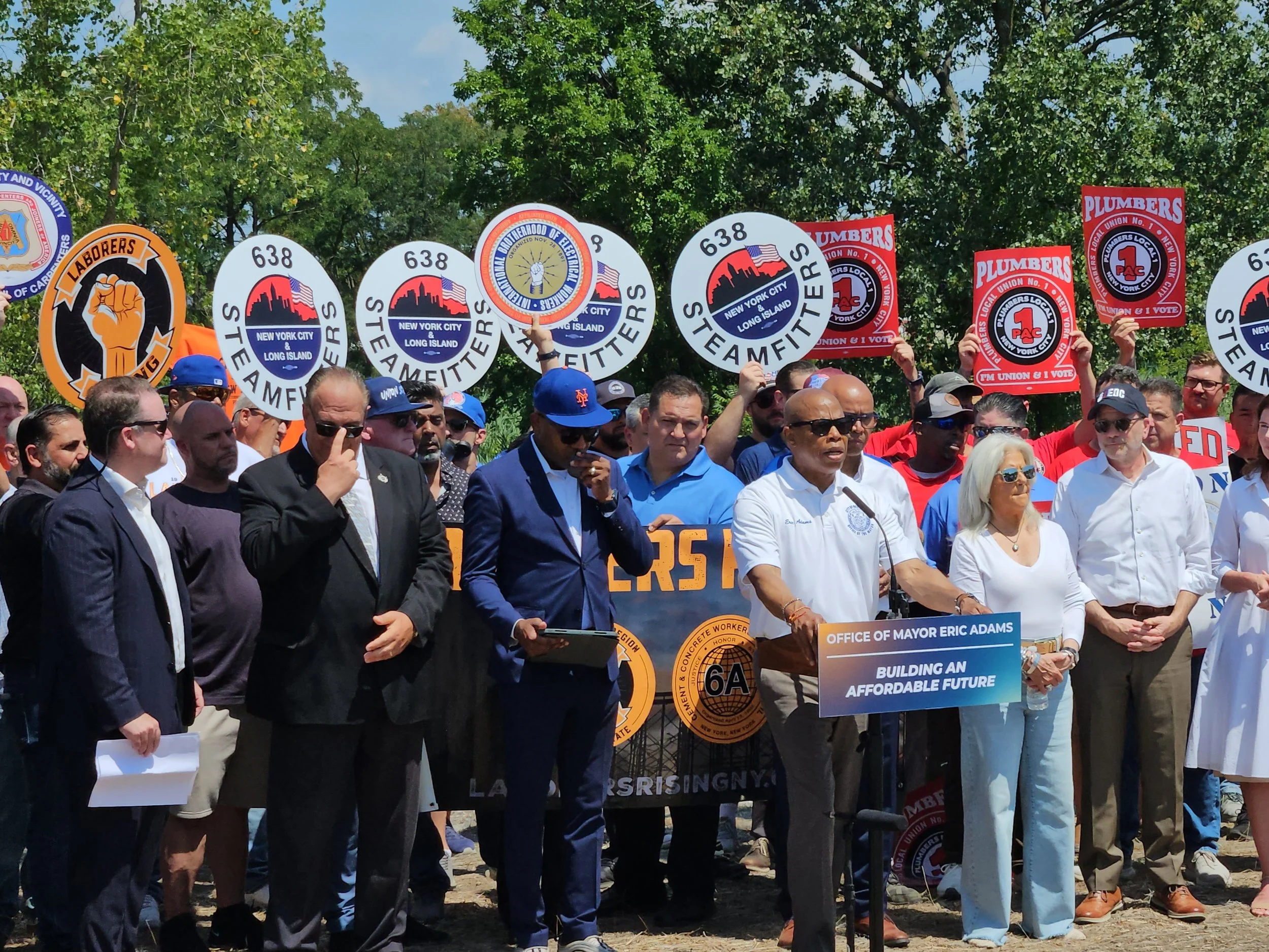
Mayor Eric Adams announced a new College Point housing project alongside union workers, Cirrus Managing Partner Joseph McDonnell, President of the Building and Construction Trades Council of Greater New York Gary LaBarbera, Queens Borough President Donovan Richards and Queens City Councilmember Vicky Paladino. Eagle photo by Noah Powelson
By Noah Powelson
A new major development proposal from the city plans to reclaim 80 acres of closed off wetland in College Point to create thousands of units of Queens housing and park land.
Mayor Eric Adams announced on Monday that the the site of the former Flushing Airport – which currently sits empty and fenced off from public access – will be the future site of 3,000 new apartment units.
The new housing development came as a result of the City of Yes plan that reformed housing zoning regulations throughout the city, as well as the mayor’s Executive Order 43, which required a review of any unused land for potential housing developments.
Flushing Airport was once the center of air travel in the city before it was closed down in 1984. Closed off and reverted to wetlands, the 80 acres of land has seen several attempts by the city to develop parks or commercial districts, but the city was regularly met with significant resistance from community members, leaving the land untouched.
In November 2024, the New York City Economic Development Corporation released a request for proposals for the fenced off former airport space, which was won by NYC-based firms Cirrus Workforce Housing and LCOR Incorporated. The mayor’s office said they expect the development to generate $3.2 billion in economic activity over the next 30 years, while creating 1,300 temporary construction jobs and 530 permanent careers.
Joseph McDonnell, managing partner at Cirrus said the development plan will involve building 3,000 units of housing on roughly 20 acres of land along 20th Avenue. The remaining 60 acres of land in the development will go towards public space that will incorporate the existing wetland habitat, which acts as a natural barrier for flooding.
The project is funded through a private-public partnership between Cirrus and the Building and Construction Trades Council of Greater New York, which represents over 100,000 trade workers at 15 unions. As part of funding for the housing development, 11 unions will contribute pension funds toward the creation of workforce housing in the development plan.
“Thanks to this generational program, this project and others like it will continue to reinforce labor's historic role in boosting the middle class, generating family-sustaining careers, and providing our communities with economic stimulus,” President of BCTC Gary LaBarbera said. “Hardworking New Yorkers, like our tradesmen and tradeswomen, deserve to live comfortably and raise their families in the city they serve.”
Surrounded by union members and their leaders enduring the overwhelming summer heat, Adams stood in the future site of the development alongside Queens City Councilmember Vickie Paladino and Queens Borough President Donovan Richards.
“At the dawn of modern aviation a century ago, Flushing Airport made history as New York City's first-ever airfield and eventually the busiest airport in the five boroughs. But today, we're beginning the process of repurposing that incredible piece of Queens' history into a critical aspect of Queens' future," Richards said. "After years of conversations between my office, the Mayor's Office and NYCEDC, I couldn't be more excited to help announce this innovative plan to build badly needed affordable housing and create good-paying jobs on this historic-turned-vacant site.”
The proposed development will be built in an area that’s seen significant investment in recent years.
NYCEDC recently completed a 0.7 mile extension of 132nd Street, which crosses the road the proposed housing development will be built on.
Construction on the housing units is expected to begin in 2028 following the completion of the Uniform Land Use Review Procedure, the city approval process for rezoning changes, and an environmental review.