
City defends City of Yes in court
/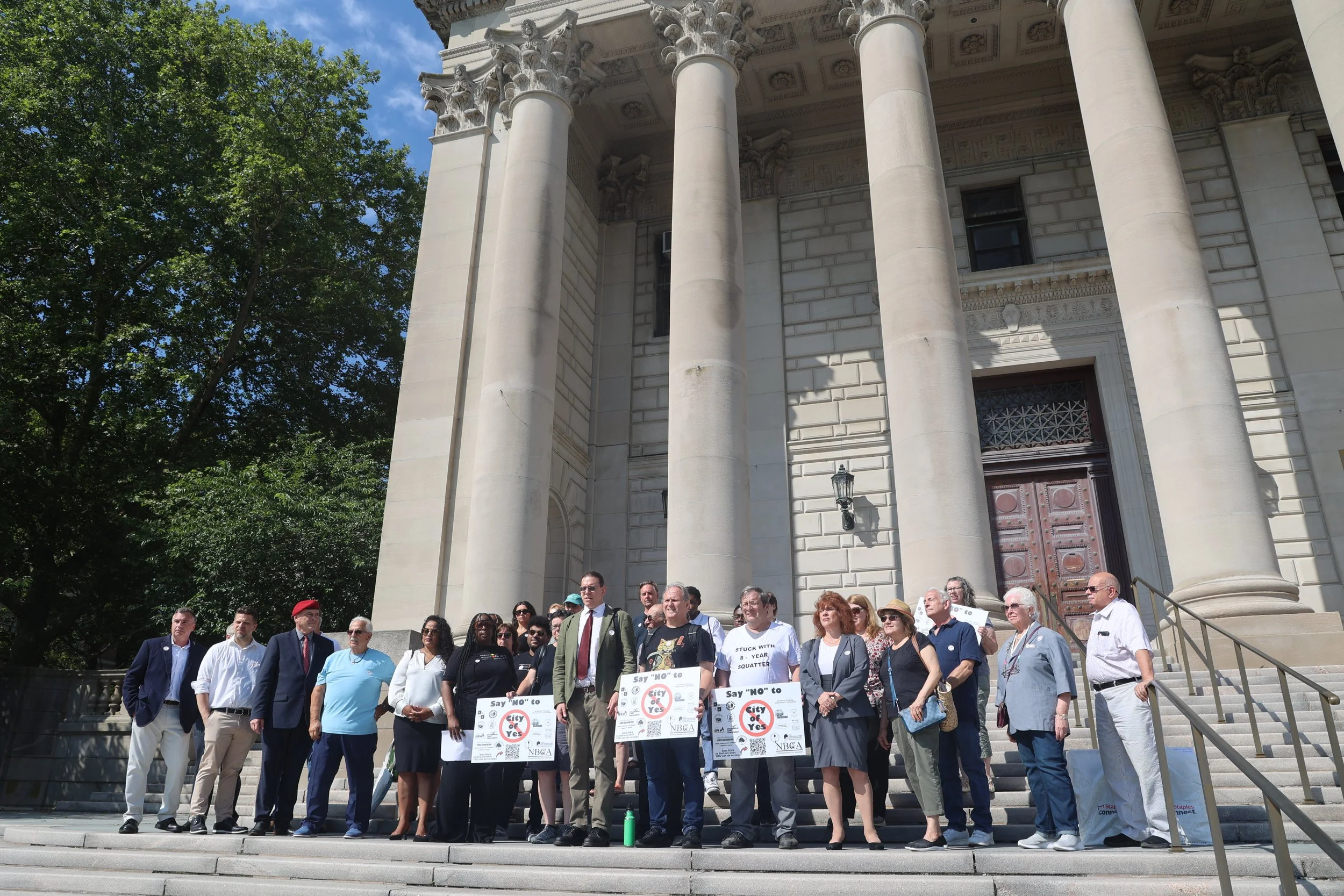
Opening arguments in the case over the City of Yes for Housing Opportunity were made in Staten Island on Wednesday. Eagle photo by Ryan Schwach
By Ryan Schwach
The city made its first defense of its sweeping but controversial plan to address New York City’s housing crisis known as the City of Yes for Housing Opportunity in a Staten Island courtroom on Wednesday.
Attorneys for the city made its opening defense against the major zoning change against attorneys representing several civic groups and elected officials, including several from Queens, who brought the lawsuit in March.
The groups behind the suit claim that the plan to rezone large swaths of the city in an effort to encourage housing development would prove to be an apocalyptic scenario for the city’s suburban-esque communities. Queens Councilmembers Joann Ariola, Bob Holden and Vickie Paladino are plaintiffs in the suit, as is Queens GOP Chair Anthony Nunziato and several civic groups under the Queens Civic Congress.
The crux of the argument from the groups who brought the case is that the city, by way of the Department of City Planning, City Hall and the City Council, defied environmental law when it did not adequately review the potential environmental impact of the City of Yes.
The city in turn argued that it fulfilled those legal requirements when it outlined the citywide rezoning plan. In the city’s environmental impact study for the City of Yes, the city listed out several “potential adverse effects” to aspects of city life such as open space, school seats, transportation and shadows created by buildings.
Jack Lester, the attorney for the civic groups, argued that when the city did its necessary environmental review, it was required to list ways to mitigate those issues should they arise, but didn’t adequately do so.
“There is no mitigation,” Lester, a prominent lawyer who also represented New Jersey in its case against congestion pricing, said in court. “They fail to offer mitigation in any effect…there has to be some explanation as to why.”
Lester further argued that the alleged lack of mitigation strategies “defies common sense.”
The city’s corporation counsel, who is defending the city and Mayor Eric Adams in the case, argued that the city did its due diligence when making the plan.
“Just because they disagree does not make our review irrational,” said Assistant Corporation Counsel Tess Dernbach.
Dernbach said that while the city didn’t list out potential mitigation measures for City of Yes, it didn’t have to. Dernbach argued that it “didn’t make sense,” for the city to lay out those measures because the broad, citywide nature of the rezoning plan makes it so the city doesn’t actually know specifically what the actual housing created under the plan will look like.
The environmental impact statement available via the DCP, articulated as much.
“Due to the non-site-specific nature of the Proposed Action, there are no known or identified development sites, and therefore there is no mechanism for the City to require mitigation at individual development sites as future development under the Proposed Action would occur as-of-right,” the review reads.
Dernbach also stressed that when the City Council modified the City of Yes into the “City for All” plan they passed in December, the legislative body provided mitigation by securing $5 billion for potential infrastructure projects it secured from the state.
Lester took issue with the City Council’s role in the argument, saying that the body was not the governing agency on the project, so their efforts to provide mitigation are null and void.
Dernbach disagreed, and said that the argument from Lester was “new” and not included in briefs filed prior to the hearing and should be disregarded by the court.
Much of Lester’s argument also centered around the three-pronged City of Yes plan Mayor Eric Adams has pushed throughout his administration.
Besides Housing Opportunity, the mayor also pushed the City of Yes for Carbon Neutrality, which changes rezoning to meet climate goals, and the City of Yes for Economic Opportunity changes rezoning to encourage increased economic activity in the five boroughs.
Lester argued that the three programs were unnecessarily segmented by the city, and that the lawsuit, should it prevail, would strike down the entire platform.
Dernbach called the three City of Yes plans "completely separate,” and said that they should not be grouped together.
She said that they only share a name for marketing reasons and because they are all connected to zoning.
Part of the “segmentation” argument concerns battery storage sites, known as battery farms, which opponents say are dangerous to local communities. They claimed that the City of Yes opened the door for more of the facilities to be placed in residential communities.
Locals on Staten Island as well as Jamaica have protested against the placement of the sites in their communities.
The petitioners pointed to a planned site on Linden Boulevard in Queens as an example.
Dernbach rejected that, and said that it was “scare tactics,” and that the battery storage site would have been placed there regardless of City of Yes and that the sites are heavily regulated by the FDNY.
She added that bringing up the battery storage sites was just a “transparent attempt” to bring up issues with the City of Yes for Carbon Neutrality, which the city maintains is not part of the lawsuit.
Richmond County Judge Lizette Colon said she would examine all of the documents provided to her by both sides and would issue her ruling in “due course.”
Outside the courthouse, Lester and several Staten Island and Queens elected officials echoed their concerns over the City of Yes.
“Staten Island and other parts of the city will suffer because the city didn't do enough, not only did it not review but also ignored a lot of our concerns,” said Republican Staten Island Borough President Vito Fossella. “This is only the third time in New York City's history that there's been rezoning and most of it has been to respect and ensure that the environment is protected, that there's more open space, there's more air, there's more circulation, more yard space, and yet the city of yes goes in the complete opposite direction.”
Fossella was the only borough president to outright reject the plan during its approval process.
Queens city planner Paul Graziano, one of the loudest opponents of COY and a main proponent of the lawsuit called the city’s argument “circular,” and “very self serving.”
“You can't say, ‘We can't do anything, it's not going to have any effect on anything, it's going to be spread out all over, but by the way, we don't know where anything is going to be,’” he said.