BP greenlights Jamaica rezoning plan with call for more investment
/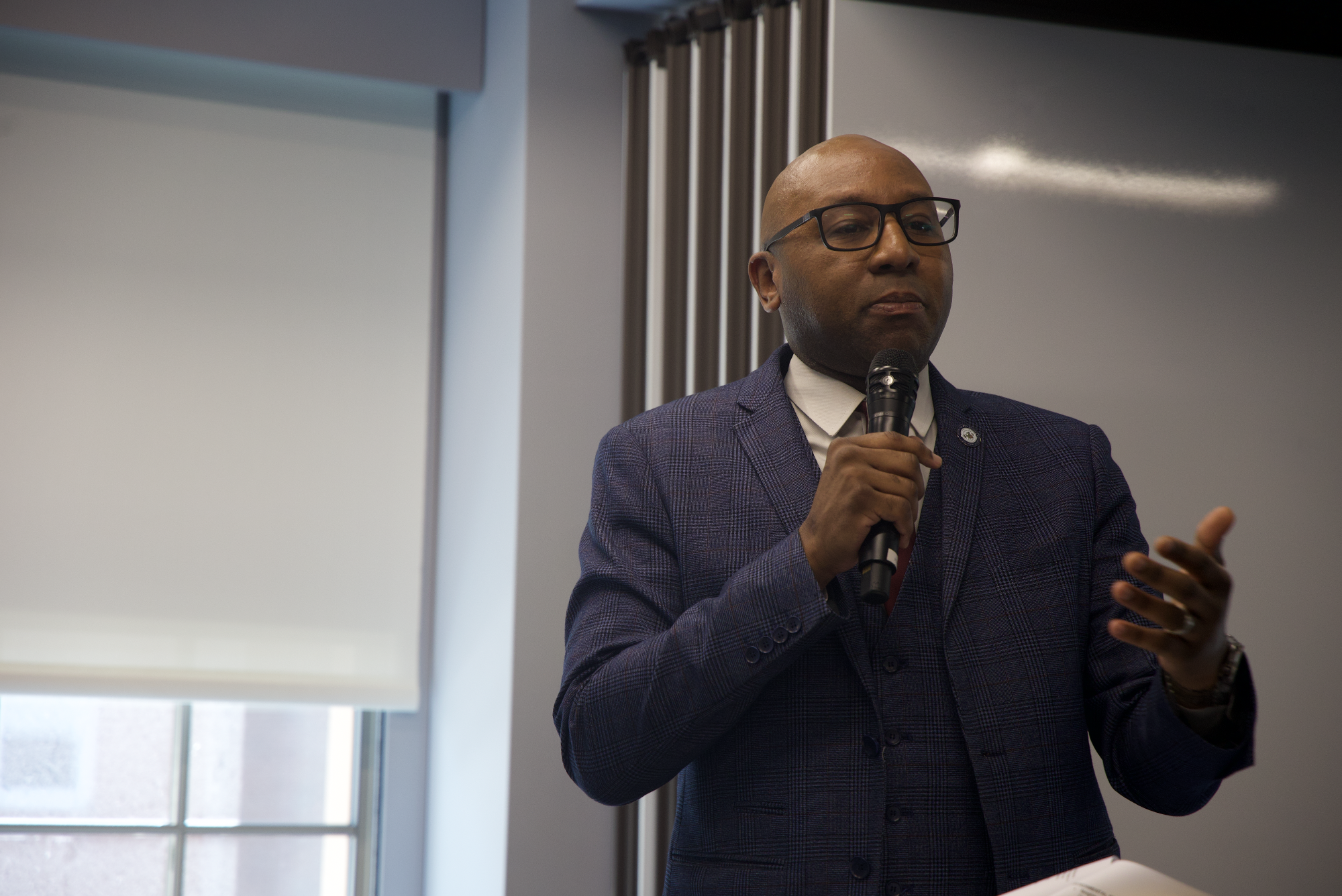
Queens Borough President Donovan Richards issued his approval of the ambitious Jamaica rezoning plan on Monday, and included several suggestions for further investment.Eagle photo by Ryan Schwach
By Ryan Schwach
Queens Borough President Donovan Richards approved the city’s plan to redevelop a major section of Downtown Jamaica on Monday, bucking the recommendations made by two local community boards.
Richards said the plan to rezone the neighborhood was a big step toward addressing longstanding inequalities in Jamaica, but said he wants the city to go further on infrastructure improvements, school seats and green space.
“We deserve better,” he said, speaking from the Greater Nexus, a shared workspace a block from Jamaica Center. “Jamaica deserved better a long time ago, and I'm very proud today that we're going to sign this recommendation with conditions, but I'm very proud of the work that everyone has got us here.”
The BP has been a supporter of the effort to rezone a large swath of Jamaica, where he spent a large part of his childhood.
The plan aims to encourage the private construction of around 12,000 new homes over a 230-block area, 4,000 of which would be income restricted.
The plan features a Mandatory Inclusionary Housing provision that officials say would make Jamaica the largest MIH zone in the city, if approved.
The plan also features regulations that officials claim will lead to streetscape improvements, open space and mixed-use areas.
But Richards wants to see the effort go futher.
On Monday, he sent the Department of City Planning – who is spearheading the rezoning – three and a half pages worth of recommendations on how to build on the already-ambitious rezoning plan.
“There is no such thing as a perfect plan, however, and there are a number of additional needed investments and changes this community must see happen in coordination with the Neighborhood Plan,” Richards wrote in his recommendations.
The BP called for at least $690 million in funds for the neighborhood’s existing schools, parks and street scape.
He also called for sanitary and stormwater sewer infrastructure improvements, renovations for the Gotham Health Center in Jamaica and $25 million for the existing community center in Roy Wilkins Park.
The plan already includes $2.64 billion stormwater management investments and $300 million for sewer upgrades.
He also said the city should add new schools, a new Queens Public Library branch, a new police precinct and a new fire house to accommodate the residents moving into the 12,319 units of housing projected for the plan.
All of these investments, he said, would go hand-in-hand with the rezoning and address a longtime lack of funding for the majority Black neighborhood.
“Southeast Queens is a Black, middle-class neighborhood where, on average, Blacks actually earn more than white people, where Blacks actually have more home ownership on average than white people, where Blacks paid some of the highest property taxes in the city, disproportionately on our backs,” he said. “But we don't see that investment on the pavement, on Jamaica Avenue or in our communities. So today is really about that investment coming back.”
DCP applauded the BP’s support on Monday.
“To help ensure that Jamaica remains a vibrant home for New York families, we must create a more equitable playing field,” said DCP spokesperson Joe Marvilli. “That’s what the Jamaica Neighborhood Plan will do – bring affordable homes, job opportunities, and infrastructure investments to this important corner of Queens. We deeply appreciate Borough President Richards’ support and look forward to reviewing his recommendations as we work to create a better, brighter future for this community.”
What is the Jamaica Neighborhood Plan?
The Jamaiza rezoning effort was first launched last year with the intention of reimagining the neighborhood, which is among the most dense in the city, and has already seen a large amount of growth in recent years.
From 2010 to 2020, the neighborhood's population grew by over 13 percent, which is nearly double the rate of growth citywide.
Rendering via DCP
But the housing in the area and in the borough as a whole hasn’t kept pace. Queens’ vacancy rate is currently around 0.88 percent, while the citywide vacancy rate is 1.4 percent. In Jamaica, nearly 60 percent of residents are rent burdened.
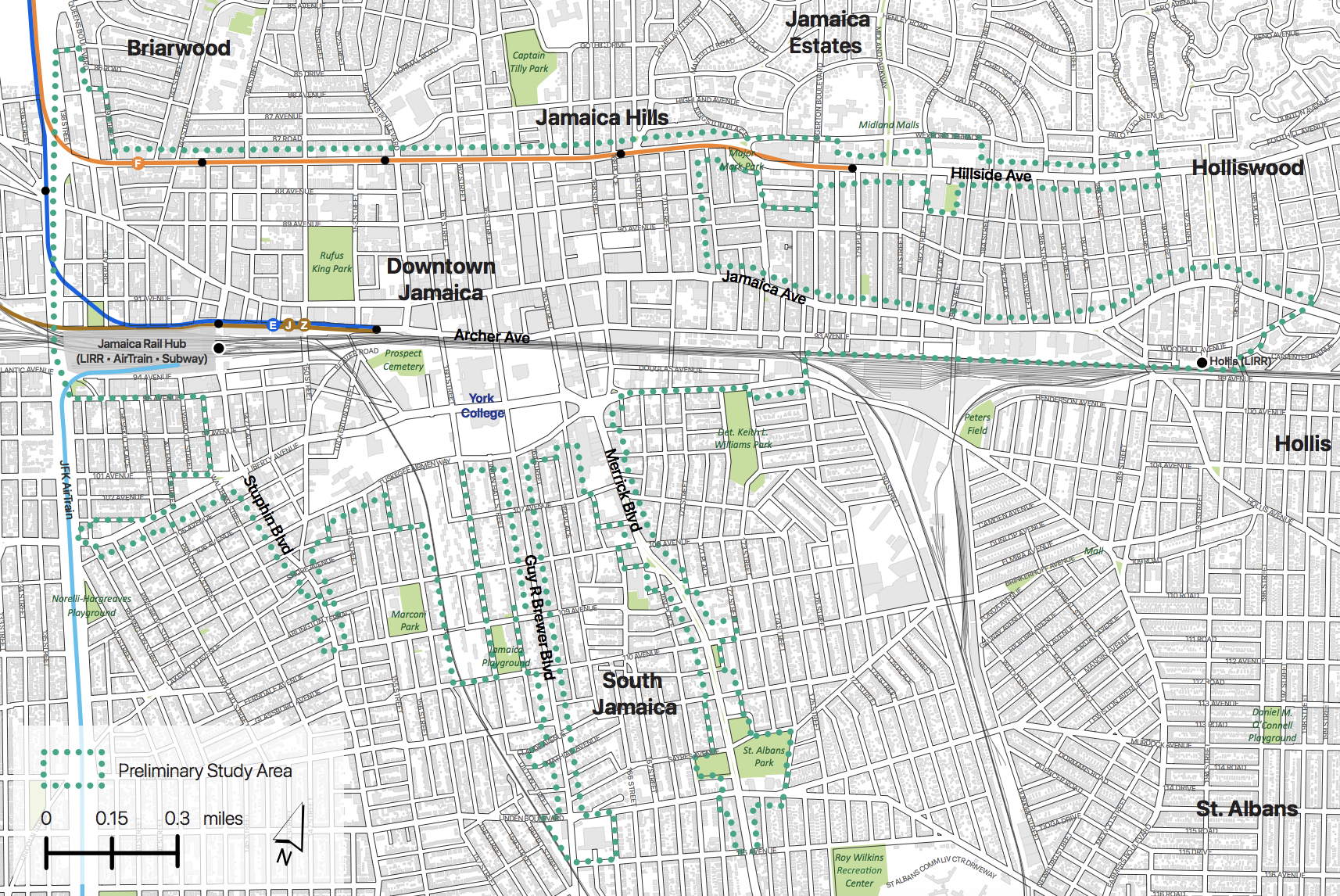
The 230-block project area is centered in the busy Downtown Jamaica area, characterized by the transportation and business hubs around Jamaica Center. The area also includes other major corridors, like Hillside Avenue, Liberty Avenue, Sutphin Boulevard and Merrick Boulevard.
The area is bounded by Hillside Avenue to the north, the Van Wyck Expressway Service Road to the west, 109th Avenue, 115th Avenue, and 116th Avenue to the south; and 191st Street and Farmers Boulevard to the east.
The majority of the project area is located in Queens Community Board 12, with
a portion along Hillside Avenue and Queens Boulevard located in Community Board 8. Both community boards voted against the plan, citing worries about increased density, a lack of parking and a lack of protection for existing homeowners.
“I believe we need to go back to the original map and look at it again,” CB12 Chair Reverend Charlene Thorbs said at the BP’s hearing on the plan in June. “The original zoning was to protect the homeowners. We don't feel protected. As the chair, looking at what's going on, the homeowners are not being protected.”
“When you're looking at putting up 11-story, 18-story buildings up against the backdrop of homeowners, that's a problem,” she added.
Richards said while he appreciates the CB’s input on the project, he wants to see changes to the neighborhood.
“Whether it's a community board, whether it's an elected official, I don't care who you are, I'm not coming here to be status quo,” he said.
DCP’s overall goal with the plan is not just to build housing, but to increase quality of life and access to businesses, culture and the neighborhood’s bevy of transportation options.
“We're trying to spur economic activity and housing creation in a more complete way,” DCP Commissioner Dan Garodknick said in March. “This plan would vastly expand housing opportunities in the neighborhood and help address current and future demand for housing. We also are creating flexibility for commercial and residential space, and we're creating more flexibility for industrial space.”
The plan will now head to the City Planning Commission, which is unlikely to vote down a DCP-designed plan, before it heads to the City Council.
Both the local councilmembers, Natasha Williams and Speaker Adrienne Adams, have expressed support for the plan.
"Speaker Adams appreciates Queens Borough President Richards' recommendations on the Jamaica Neighborhood Plan,” a council spokersperson said. “Once the proposed rezoning plan reaches the Council, it will go through our land use process and we look forward to reviewing it."
Williams said the plan is a “major opportunity” for the area.
“As the plan moves forward, I’m pushing for real commitments on affordability, homeownership opportunities, infrastructure, school seats, small business protections, and long-term accountability,” she said.
This story has been updated to reflect a statements from Speaker Adrienne Adams and Councilmember Nantasha Williams.