Gov backs away from sentence commutations while pardoning six New Yorkers
/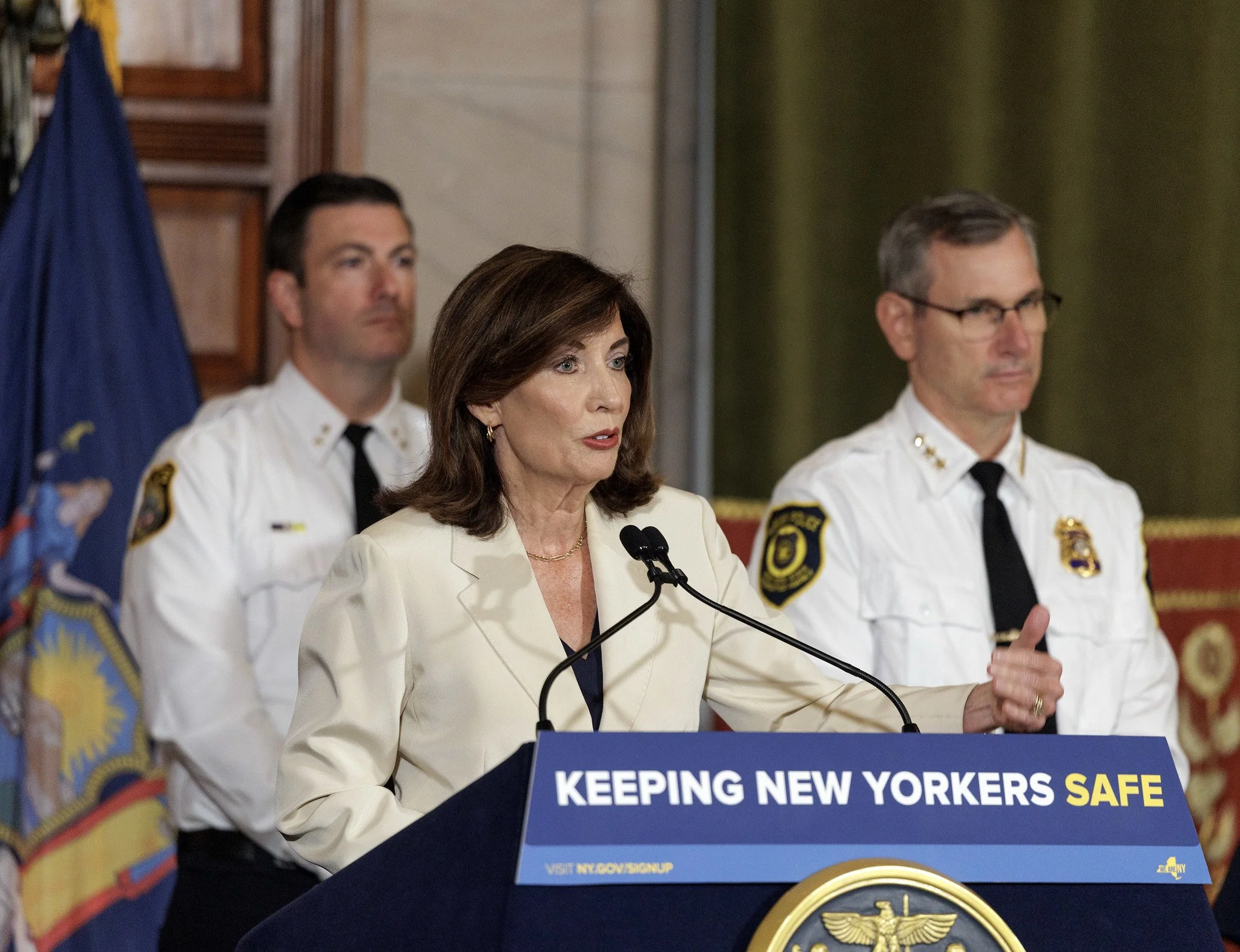
Governor Kathy Hochul pardoned six New Yorkers last week but did not grant a sentence commutation to the more than 1,300 people who have applied for one. File photo by Mike Groll/Office of Governor Kathy Hochul
By Jacob Kaye
Governor Kathy Hochul declined to commute the sentence of any of the more than 1,000 people in New York’s prisons who applied for clemency when she granted half a dozen pardons on Friday, angering advocates who say the governor has all but abandoned her promise to reform the state’s clemency process.
Continuing a trend that began in 2024, the governor did not grant clemency to any of the 1,040 people who have asked to have their prison sentences commuted on Friday. She instead granted pardons to six New Yorkers who “continue to be negatively impacted by their criminal conviction(s) despite having successfully served their sentence(s) many years ago,” according to a press release announcing the pardons.
Among those granted a pardon was Sae Joon Park, a Purple Heart recipient who was convicted of drug possession in Queens in 2007 and a bail jumping charge in 2009. In 2025, federal officials ordered Park to leave the country and return to Korea, where he was born, or face deportation. He decided to self-deport, according to reporting by the New York Times. It’s unclear if Hochul’s pardon will allow Park to return to the U.S.
“Today, I am granting clemency to six individuals who have displayed positive changes in their lives and will dedicate themselves to bettering their communities — they earned their second chance through rehabilitation and can now establish their futures once again,” Hochul said in a statement.
But while Hochul has embraced pardons – one of two forms the governor’s clemency powers can take – she’s effectively abandoned the second form of clemency: sentence commutations.
Between August 2024 and August 2026, Hochul commuted the sentences of two incarcerated New Yorkers, a quarter of the number of sentence commutations she granted from 2022 through the midway point of 2024.
The lack of sentence commutations has angered advocates, who argue that while pardons are meaningful to those who receive them, commutations are more urgently needed. A large number of incarcerated New Yorkers applying for a commutation have spent decades behind bars after being issued massive sentences in the ‘80s and ‘90s, when mandatory minimum sentencing and a tough-on-crime mentality led to a spike in the state’s prison population.
“While we welcome the six pardons granted today and celebrate for those who received them and their families, we are profoundly disappointed that Governor Hochul has yet again failed to grant a single commutation to any of the many worthy individuals languishing in state prisons,” Stanley Bellamy, a Queens man who was granted clemency by Hochul in 2022 and who now works as an organizer with the Release Aging People in Prison Campaign, said in a statement.
“As a recipient of clemency from Governor Hochul myself, and a person who long ago took full responsibility for a violent crime and committed myself to ending cycles of violence in our communities, I am living proof that people can and do change – and will use the opportunities afforded us to serve others,” he added.
The major drop-off in the number of sentence commutations granted by Hochul comes as the Democratic governor is running for reelection against Republican Bruce Blakeman, who has regularly accused Hochul of being soft on crime.
In December, Blakeman, the Nassau County executive, criticized Hochul’s support for legislation that required a formerly incarcerated New Yorker to be appointed to the Commission on Correction, the state’s prison watchdog agency, claiming the governor was putting “the interests of criminals ahead of law-abiding New Yorkers.”
Steve Zeidman, a professor at the CUNY School of Law and the director of its Criminal Defense Clinic, said that he believes Hochul’s apparent reluctance to commute sentences is the result of a “cowardly political calculation.”
“I see it as making a political calculation – if I use my clemency power in any meaningful way, I will subject myself to criticism that I am not willing to withstand or to rebut,” Zeidman said. “To me, that's the only way to look at it.”
The professor, whose clinic has around 100 clemency applications pending with the governor’s office, said Hochul should approach clemency in the same way President Donald Trump has, by granting pardons and sentence commutations in large numbers.
“She should say, ‘Yeah, Blakeman, come after me but this is why I did it, because it’s the right thing to do…And no, I’m not afraid, I’m not a coward, I’m not like you,’” he said. “But rather than go that route, she puts her head in the sand and issues a couple of pardons on a Friday afternoon.”
Bellamy compared Hochul’s apparent reluctance to use her full clemency powers to Trump, who has been criticized for pardoning and commuting the sentences of a number of his political allies.
“While President Trump is using clemency as a cash cow and a grab bag for political favors, Governor Hochul must demonstrate that this critical tool can be used properly to correct injustices and reunite families,” he said.
A spokesperson for the governor defended the latest round of clemencies and touted some of the reforms Hochul has made to the process, including the creation of a clemency advisory panel, more robust communications with clemency applicants, and the granting of clemency on a rolling basis – clemencies were typically granted only around Christmas in the years before Hochul took office.
“The safety of all New Yorkers – including the staff and incarcerated individuals in our prisons – is a top priority for Governor Hochul,” the spokesperson said. “This administration remains committed to a fair and thorough clemency process, and working to reduce recidivism and enhance reentry services for previously incarcerated individuals.”
There are around 1,560 pending clemency applications, according to the governor’s office. Among them are 1,040 sentence commutation applications and 524 pardon applications. Around 260 of those applications were submitted in 2026.