‘Going under’: Weekend storm swamps Queens streets, renewing questions about flooding fixes
/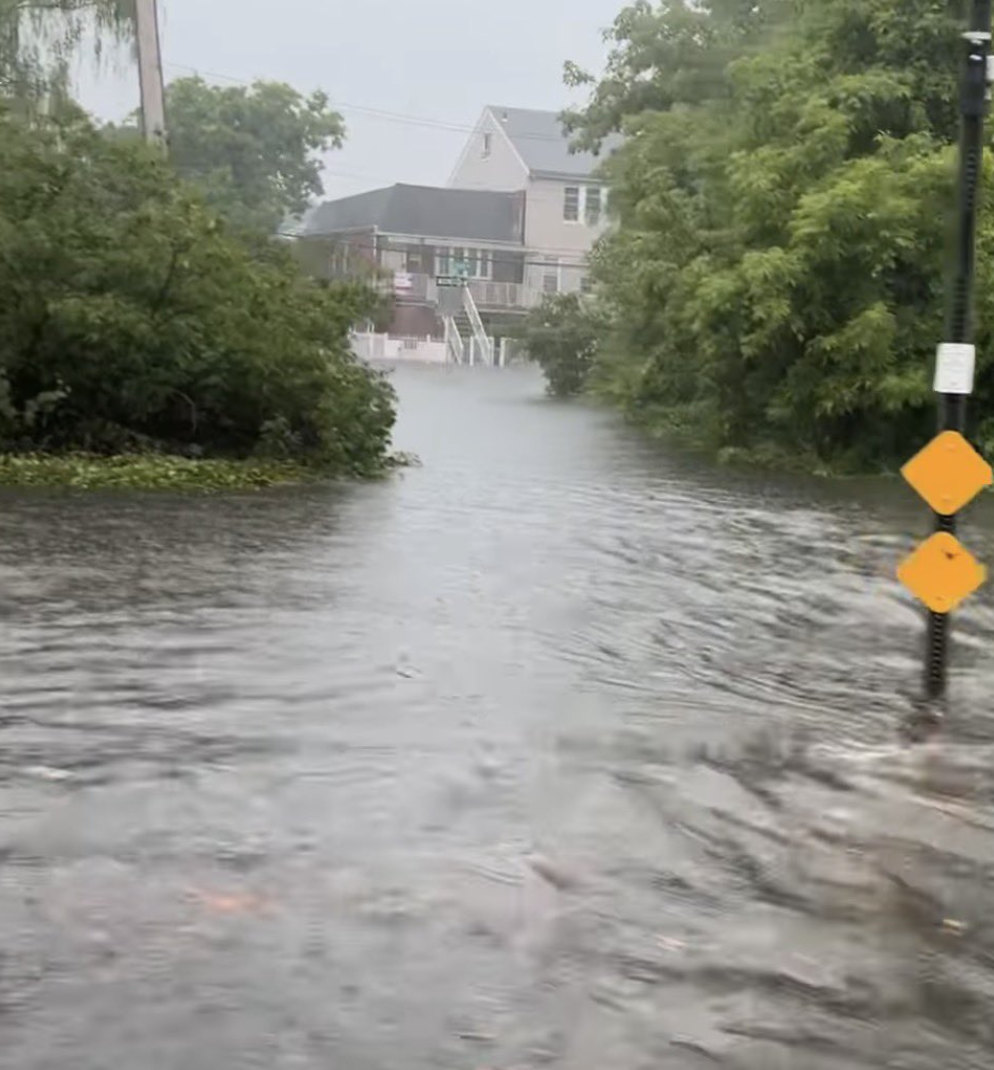
Flooding inundated parts of Queens over the weekend amid severe storms. Screenshot via Congressmember Grace Meng/X
By Ryan Schwach
Torrential downpours and consistent rainfall bore down on Queens over the weekend, flooding streets and blocking major highways even after the city has spent over a billion dollars in recent years on flood-mitigation efforts.
Residential streets in Flushing and East Elmhurst were underwater only a few hours into Saturday's storms. Drivers needed to be rescued from a deluged Long Island Expressway. FDNY firetrucks pushed through several feet of water. Stairs leading to Jackson Heights’ subway station turned into a waterfall, videos showed.
Flooding has long been an issue in Queens, where century-old sewer infrastructure has failed to keep up with harsher, more frequent storms.
Billions of dollars have been put into infrastructure fixes and other flood mitigation projects, but still, severe flooding persists.
In 2024, the city began a large-scale, $51.8 million infrastructure project in Rosedale that is expected to help improve the neighborhood’s regular flooding, and $128 million was allocated to build more sewer infrastructure in Whitestone 2025. This year, the Mamdani administration put aside $108 million for catch basin overhauls citywide.
But many Queens locals have continued to deal with persistent, dangerous flooding that often causes significant damage to their homes or belongings.
Without the finances or the political will to pursue the big infrastructure fixes that experts claim are necessary, flooding will continue to be a concern, sources said.
“It feels as though the borough is going under,” said Dinu Ahmed, an Elmhurst resident who has been vocal about consistent flooding in her community. “To me, it is a crisis moment where we're seeing what happens if we don't make concrete changes to our infrastructure now. It's only going to get worse.”
Ahmed spoke to the Eagle while taking a break from cleaning out her home from the weekend’s flooding, the fourth time her home has flooded in five years. She had just learned that the city was under a flood warning for Tuesday, as well.
“It just sort of feels like we're always on the precipice of another crisis,” she said. “It just feels very unsustainable. As I look around the neighborhood, I'm seeing homes going up for sale, or people saying they cannot continue to live like this, and that's really sad.”
Ahmed said the city is now on its second study to determine what can be done to help end the flooding on her small block in western Elmhurst, a community that also just lost $50 million in federal money for flooding after the funds were cut by the Trump administration.
But it’s not just East Elmhurst and Ahmed’s block where flooding persists.
Community board members from around Queens said addressing flooding and updating the borough’s outdated sewage infrastructure was atop their list of pressing needs when testifying about the city’s budget priorities in February.
“As far as flooding is concerned and sewer infrastructure, Community Board 12 continues to experience the severe impacts of climate change, including persistent flooding and a rising water table,” said CB12’s District Manager Katherina Thompson.
Felicia Johnson, the district manager of the flood-prone, low-lying coastal Community Board 14 on the Rockaway peninsula, highlighted the need for more bulkhead construction on the bay side of the peninsula, which has historically been overlooked.
“All the neighborhoods directly adjacent to the bay and ocean need updated and upgraded storm protective measures,” she said.
Over the weekend, floods inundated Flushing’s streets near Kissena Park, Queens’ highways and other spots across the borough.
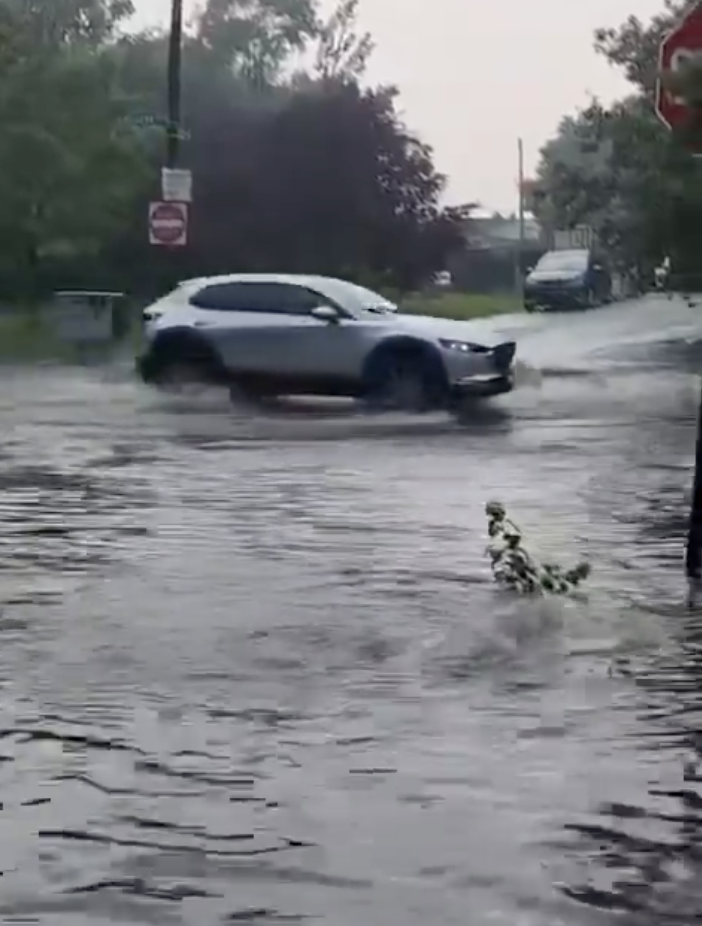
A car goes through a flooded Flushing street over the weekend. Screenshot via Congressmember Grace Meng/X
Queens officials including Congressman Grace Meng, Councilmember Phil Wong and Assemblymember Nily Rozic posted videos of people sitting on top of trucks half-submerged by flood water.
“This seems to happen with every heavy rain,” Rozic said on social media. “Until the city fixes its outdated infrastructure, clogged drains, and insufficient sewers, the least they can do is warn drivers and keep roadways clear.”
City Councilmember Jim Gennaro said the flooding was bad in his Eastern Queens district this weekend, as it often is.
As the longtime chair of the City Council’s Committee on Environmental Protection and Waterfronts, a five-person committee where he is the only Queens member, Gennaro has pushed for legislation related to floodzone maps and catch basin maintenance – smaller fixes to address the wider issues.
“This is not a problem that lends itself to short-term significant reductions in impact from storms,” he said.
Gennaro said the city’s inability to pursue the bigger infrastructure fixes was due to a lack of funding. He blamed a 40-year-old provision in the city’s budget framework that sees millions of dollars from city residents’ water payments go directly to the citywide general fund. The money could instead be used to fund infrastructure projects, he said.
“[The Department of Environmental Protection] is literally being robbed of money that it needs to get us out of this flooding crisis,” he said. “The agency is money starved by virtue of the fact that a significant chunk of what people pay in water and sewer bills, which they think is going to water and sewer, is going elsewhere.”
He said the Mamdani administration should eliminate the provision, which stems back to the city’s debt issues in the 1980s but was briefly ended by the de Blasio administration and then put back into effect by Mayor Eric Adams.
“To more quickly get out of the flooding situation, we need more money,” he said. “Everything costs money.”
Queens Borough President Donovan Richards has long-referred to Queens’ flooding issues as a game of “Whack-A-Mole.”
After the city appeared to make some progress addressing flooding in its coastal communities, its inland communities are now struggling with pooling water.
“Flushing wasn't a place where I woke up in the morning and wondered if they were going to be flooded,” he said. “Rockaway doesn't even keep me up as much anymore.”
Richards said there are currently around 100 flood-mitigation infrastructure projects underway in Queen.
“I am very encouraged with all of the work,” he said. “There's billions of dollars being invested across Queens.”
In addition to infrastructure fixes, Richards said that it is time to explore home buyouts in at-risk communities, like the areas around Kissena Park.
“I think if the city is willing and the state is willing to look at that solution, then that's an effort that I would be willing to explore with that community, because it's going to happen again,” he said. “How many times are you going to repair your basement and then another storm comes and then it happens again?”
But Richards admits that long-term fixes are hard to hear for residents like Ahmed, whose headaches are a lot more immediate.
“In a perfect world, all of these projects would have been done 40 or 50 years ago, but we're here, and most importantly, the money is in the bank,” he said. “But that doesn't do much if you're a homeowner who, unfortunately, his basement is flooded again.”
On Monday night, Ahmed said she was worried about what Tuesday will bring.
“It's only going to get worse,” she said. “I'm very worried. I'm worried about tomorrow. I feel like we just went through hours and hours of cleaning, and I'm like, ‘Are we going to have to start all over again tomorrow?’”