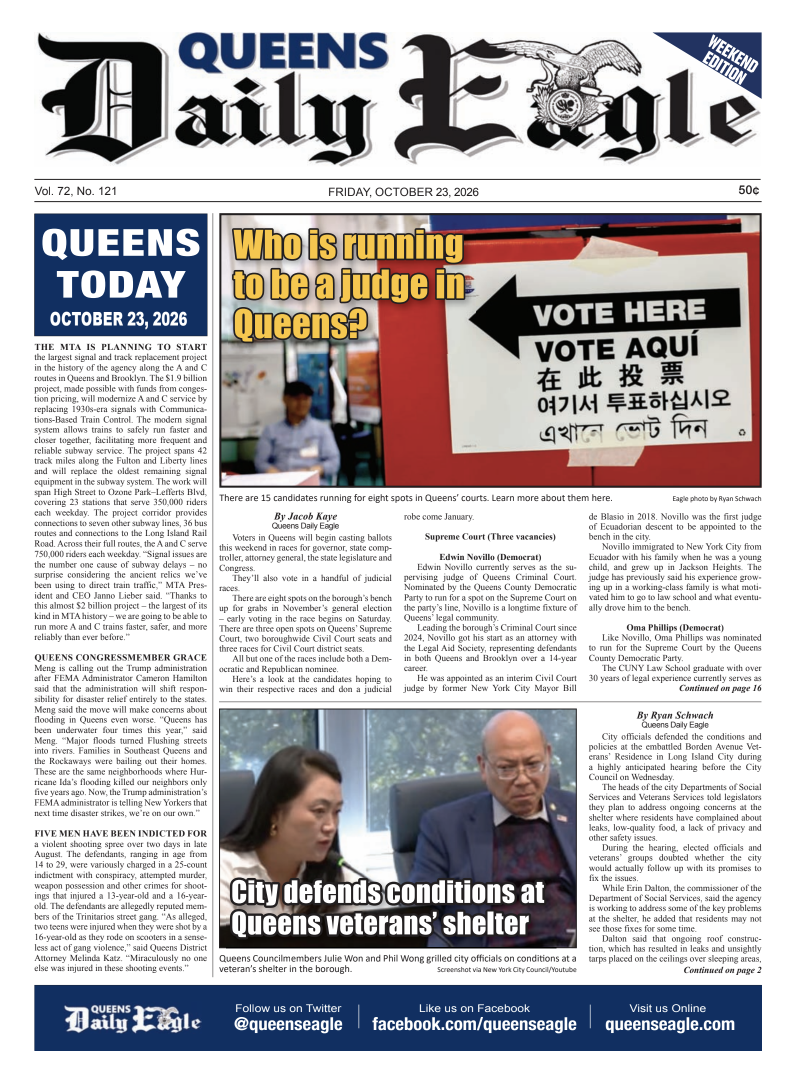
Case volume continues to challenge Queens Criminal Court, top judge says
/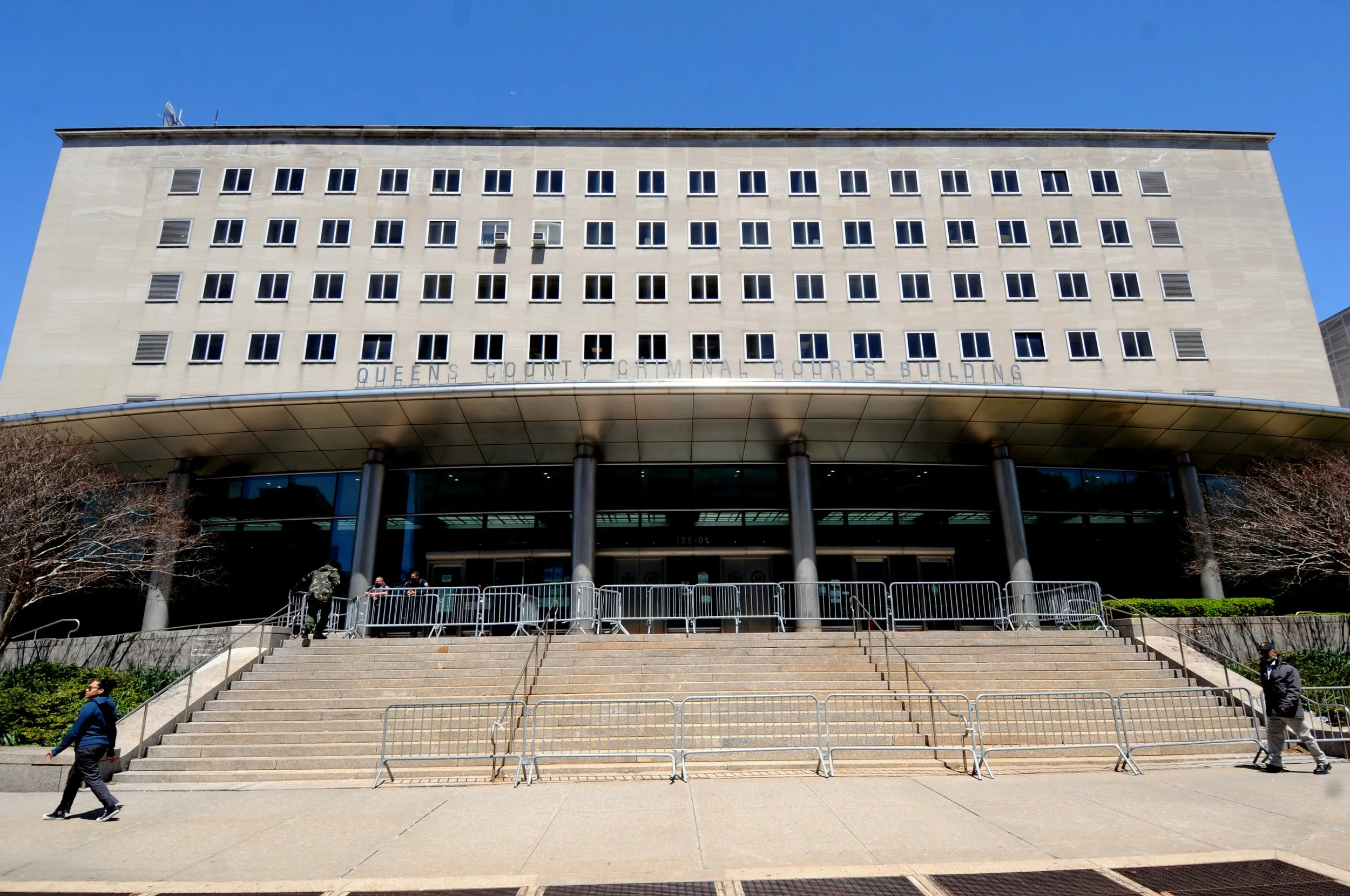
Supervising Judge of Queens Criminal Court Edwin Novillo said Queens Criminal Court has made significant strides improving arraignment processing. Photo by Walter Karling
By Noah Powelson
Despite a boost in funding and resources for the state’s court system, Queens Criminal Court’s Supervising Judge Edwin Novillo says that large case volumes continue to be the greatest challenge for the court, and that more resources for additional judges, trial parts and technology capabilities are needed to efficiently process cases.
Novillo described the court’s challenges during a recent interview with the Eagle, around a year and a half after he began leading the court.
The supervising judge said that while the court has made progress in its efforts to speed up cases, there’s still room to grow.
“I think one of the biggest challenges we have in Queens Criminal Court is the volume,” Novillo said. “This year, I've seen an uptick in arrests, and that volume requires more resources.”
According to data from the Office of Court Administration, there has been a roughly seven percent decrease in dispositions in Queens Criminal Court in the first six months of 2026 compared to the same time last year. Likewise, there are roughly 500 more pending cases than there were at the same time last year, a roughly five percent increase.
This increase in case backlog has come despite the fact that Queens Criminal Court has received additional resources in recent years that has helped make noticeable improvements in processing arraignments and cutting down the number of old cases sitting on the docket.
According to data provided by Novillo, the year before Novillo was appointed supervising judge in 2024, it took a defendant an average of 23 hours and 45 minutes before they were arraigned in court. By the end of 2025, when Novillo was in charge, that average time dropped to 21 hours and 58 minutes.
Overall, Queens Criminal Court total arrest to arraignment number – how often a defendant sees a judge within 24 hours of arrest – is 87 percent, roughly 7 percent higher than the rest of the city.
Likewise, Queens is resolving cases at a much quicker pace, faster than the rest of the city, according to Novillo.
In 2025, 45,583 cases were arraigned in Queens Criminal Court, and that same year, 45,609 cases were resolved – a difference of 26 cases.
“Twenty-six cases doesn't sound like a lot, but given the fact that we were the only county last year to resolve more cases than we arrainged, I took great pride in that,” Novillo said. “I think it showed how much work the attorneys were doing, how much work the judges were doing, and how much work was done collaboratively to help our community.”
Novillo made it a priority when he was first appointed supervising judge to get a second trial part opened up for Queens Criminal, as well as get an additional judge on the bench.
The move resulted in significantly more trials and evidentiary hearings taking place. The effort also began to have an effect on the court’s backlog of cases.
When Novillo first took over, Queens Criminal Court had a little more than 220 pending cases which were over a year old. By February 2026, that number had dropped down to 148 cases, about a 33 percent reduction. The number marks the fewest old cases the court has seen since 2019, the earliest year for which data is available.
“I'm not saying it's a great number, it's a number that we need to improve on,” Novillo said. “I think a great number would be zero cases over a year old, but it’s progress in the right direction”
But despite that progress and added resources, challenges still persist for Queens Criminal Court to get its caseload backlog down as arrest rates continue to grow.
According to data from the New York Criminal Justice Agency, there were 11,643 people in Queens who were arrested at least once for a misdemeanor offense in 2020. That number has grown steadily every year, and in 2025, 19,861 people had been arrested on a misdemeanor at least once.
Additionally, while Queens Criminal Court gained a new judge when Novillo took office, they also lost another after a judge retired at the beginning of 2026.
“It’s a challenge that we're adjusting to,” Novillo said.
There isn’t one simple solution, though Novillo said he is always advocating for more funding and resources. Novillo also said he opened up a new arraignment part, and started a new case conferencing system to identify the oldest cases in the county to find ways to resolve backlog more efficiently.
While every judge’s main priority is the efficient and fair processing of cases, for Novillo, he said the goal is very personal for him.
Growing up in Jackson Heights, Queens, Novillo said he had an early interaction with the criminal justice world when he was 13 after a friend of his was arrested. His friend received representation from the Legal Aid Society, and Novillo said it was the work those attorneys did that inspired him to go to law school and pursue criminal justice work.
Novillo himself worked for the Legal Aid Society for many years, and said he knows both as a former public defender and a Queens resident how important a fair, efficient and speedy courthouse is to protect the city’s communities.
“I've seen how criminal court works as a resident from the community,” Novillo said. “I've seen it as an attorney, and I've now seen it as a judge. I want to make sure that our community is served as best as possible by being in this position.”