Queens community boards continue to diversify
/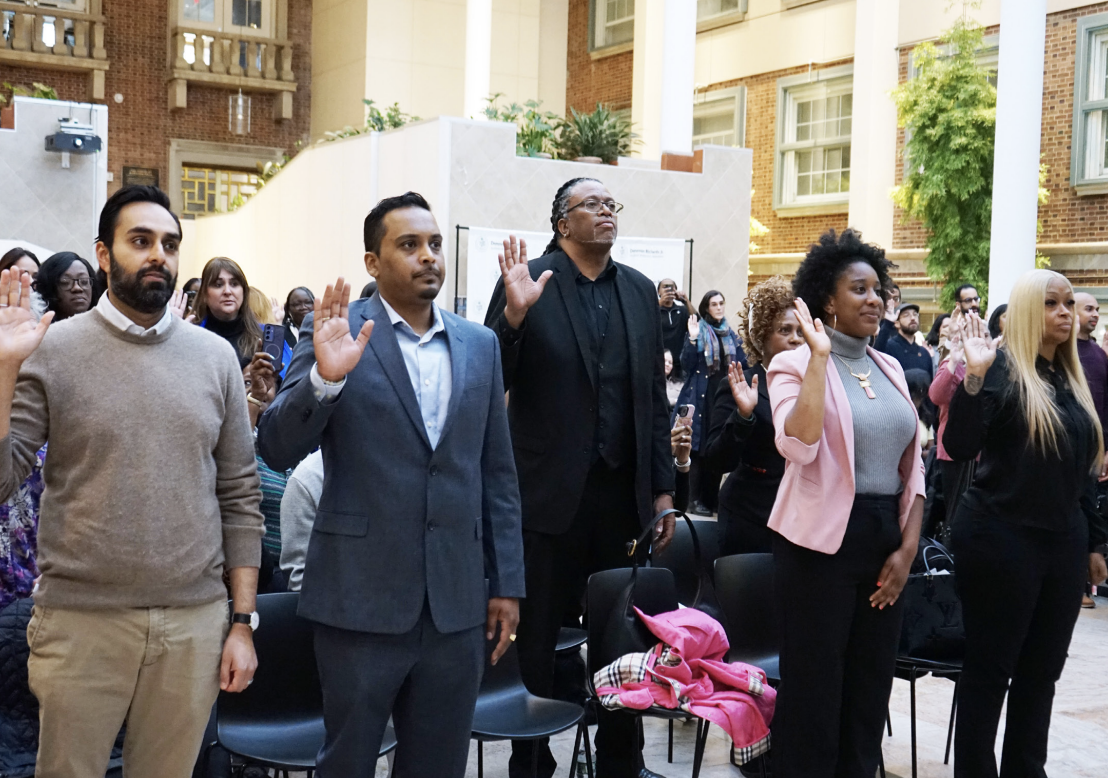
A new demographic report shows that Queens’ Community Boards are continuing to diversify but still lag behind boroughwide numbers. Photo via Queens Borough President’s Office
By Ryan Schwach
Queens’ 14 community boards are continuing to diversify with more people of color and young people joining the all-volunteer boards when compared to previous years, a new demographic report from the Queens borough president’s office shows.
Of the 115 new CB members who joined the boards this spring, 39 percent identify as Hispanic, up 10 percent from last year. And African American representation is up six percent from last year.
More than half of the new members are under 40 years old and 20 percent are younger than 30. Prior to Queens Borough President Donovan Richards’ tenure, less than a fourth of a percent of community board members were younger than 45 years old.
Richards, who appoints members to the boards, has made a point during his administration to make the first rung of city government in the World’s Borough reflect the diversity it is known for.
“For generations, our community boards did not look or feel like the neighborhoods they represented,” he said this week. “That’s why for the past six years, my office has worked relentlessly to remedy historic disparities on our community boards and uplift entire demographics that have been grossly underrepresented.
The BP’s office released the 25-page report on Thursday detailing the full breakdown of the borough’s community boards.
This year, the BP’s office received 962 total applications from Queens residents hoping to join their local boards. A little more than 360 total appointees were selected across all 14 boards. Of the 367 appointees, 115 were new to the boards.
A dozen of the new members were appointed to help fill the two boards with the highest number of vacancies – the Long Island City focused CB2, and CB14, which encompasses the Rockaways and Broad Channel.
Northern Queens’ CB7, which includes areas from Whitestone down to Willets Point, and CB13 in Southeast Queens each had the fewest vacancies with four.
The BP’s office said the diversification and increase in the number of younger members is a result of their effort to modernize the application process by putting it online, and of the institution of term limits citywide in 2018 to promote regular turn over.
However, the boards’ demographics don’t entirely align with the make up of the borough.
Around 37 percent of board members identify as white or European, a demographic that only makes up 23 percent of Queens.
Only around 20 percent of board members are Hispanic, while 28 percent of the borough is Hispanic.
Queens is known for its significant foreign-born population, with nearly half of the borough coming from somewhere else. But only around 17 percent of community board members are foreign born.
Board members also continue to skew older, despite the infusion of young members.
Between CB1 and CB2, which make up the increasingly progressive communities of Western Queens, only five members are younger than 30.
Only six of the 50 members of CB7 are younger than 40.
While he has celebrated diversifying the boards, Richards has long said there is still more work to be done.
“There is more work ahead, however, and I look forward to appointing yet another diverse class of community board members next spring,” he said.