New evidence fuels bid to toss convictions in 1975 Queens murder
/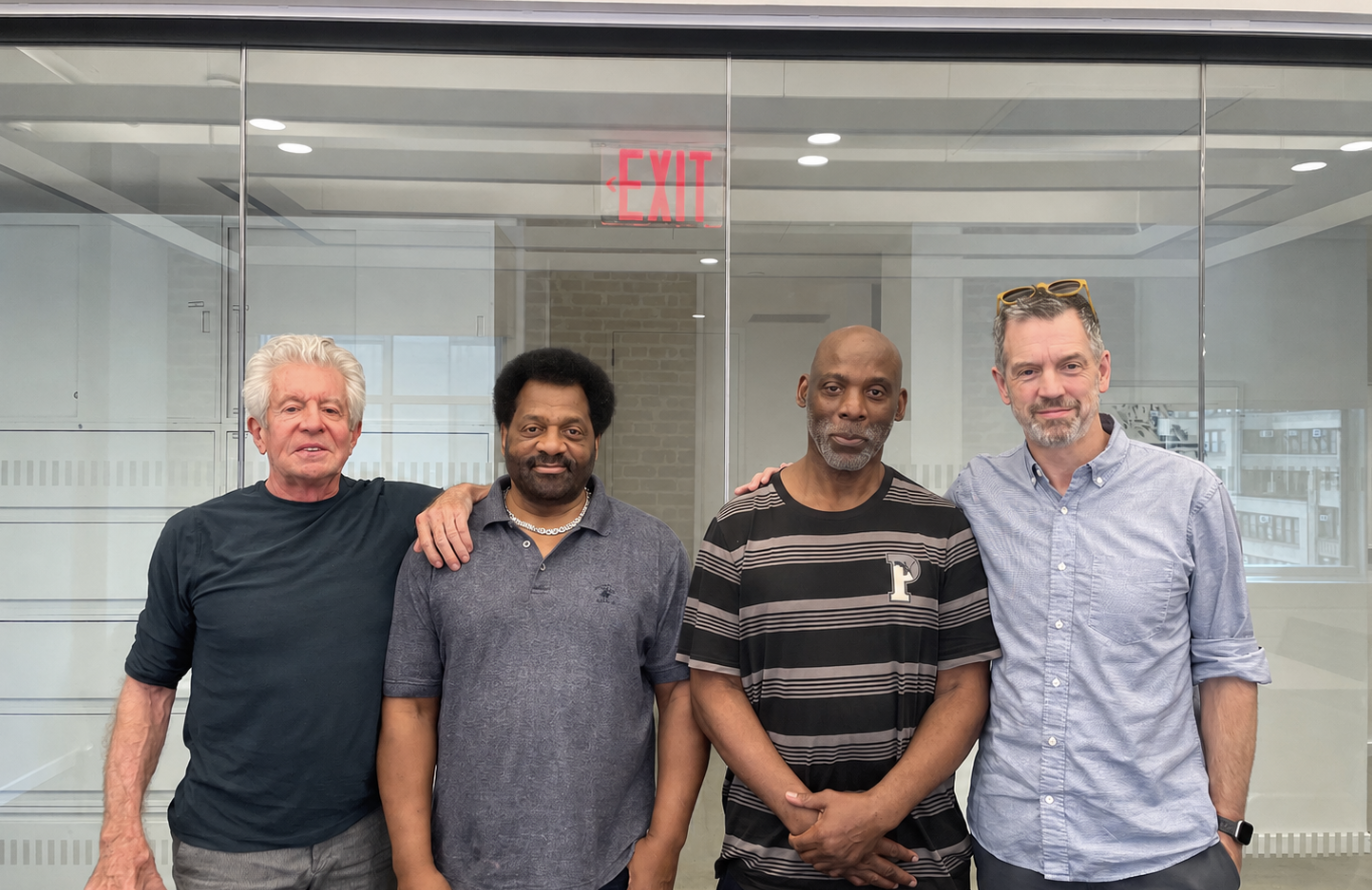
Richard Emery, Marcus Washington, Herbert Sims and Charles Linehan. Washington and Sims were convicted of a 1975 murder they claim they didn’t commit. Alongside attorneys Emery, Linehan, the men recently filed a motion in Queens Criminal Court to have their convictions vacated. Eagle photo by Jacob Kaye
By Jacob Kaye
Marcus Washington and Herbert Sims’ friendship has withstood more than most.
They met when they were 9 years old, growing up together in Far Rockaway. Washington lived in a three-story home with his parents and siblings. Sims lived nearby in a foster care group home.
The two were close.
But not long after the pair began going to high school together, Washington and Sims were placed in the middle of the 1975 murder of a 71-year-old woman, whose body was found strangled and sexually abused inside her burned Far Rockaway apartment.
Eventually, Washington and Sims, who both claimed they were innocent, were arrested and convicted of the killing. It put a strain on their relationship, in part because the state intentionally kept them in separate prisons.
Both men went on to spend the next three decades of their lives behind bars.
“It's been tough,” Washington recently told the Eagle. “We were kids when all of this happened. We grew up into manhood, we changed.”
It wasn’t until they were both released – Sims in 2006 and Washington in 2008 – that they reconnected.
But first, the air had to be cleared.
During the trial, witnesses, police officers and the judge implied that they believed that while Washington had committed the killing, Sims had only come along for the ride. The description of their relationship wasn’t entirely off base – Washington had been more of a leader, and Sims his companion. Prior to their conviction, Sims was given multiple chances to confirm the narrative by pointing the finger at his friend and likely escape without any serious consequences. But he never took the opportunity.
When they met up after being released, Washington addressed the fateful decision.
“I remember saying to Herbert, ‘Listen, I know you didn't do it, just like I didn't do it, and I hope that in your heart you don't hold any animosity towards me because you didn't take the opportunity to leave,’” Washington said.
Rather than hold a grudge, Sims chose to move on with one of his oldest friends, and together the two began embarking on a journey to prove their innocence, throwing them back into the 1975 murder that has defined their lives.
The effort came to a head last month when Washington and Sims filed a motion in Queens Criminal Court, arguing that a Queens judge should toss their conviction. The court filing claims that multiple witnesses were coerced by police to blame the killing on the two boys, and that evidence suggesting Washington and Sims’ innocence was kept from the defense during the trial. It also includes newly discovered evidence that appears to suggest that the real killer pinned the case on Washington and Sims as a way to get leniency on a separate murder for which he was facing significant prison time.
The filing and the investigation that led to it were conducted by Washington and Sims’ attorneys at Emery Celli Brinckerhoff Abady Ward & Maazel and Newirth Linehan.
Just as it was when they were young, Washington, who described himself as a “fighter,” has led the charge to prove their innocence as Sims has supportively followed.
“If it wasn't for him,” Sims said of the effort to clear their names, “I don't think this would have happened.”
‘My family knew this truth’
Mary Galligan was in her Queens apartment on Dec. 4, 1975 when someone murdered her, sexually abused her body with a table leg after she died, and then set her apartment on fire.
Early the next morning, a 16-year-old Washington walked up to the crime scene while on his way to school and asked Alvin Boykins, who lived in the neighborhood, what had happened. Boykins then told him the story, according to the motion.
Washington then made his way over to Irma Crook’s apartment. Sims was dating Crook’s daughter, Angela Strickland, and was living in the home, at the time.
Inside the apartment, Washington recounted what he had heard from Boykins, sharing details of the murder that investigators later said only the killer would know. In fact, that was true, but Washington wasn’t the killer, according to the motion.
Washington and Sims’ filing claims that Boykins’ brother-in-law, Derek Boston, was instead the person who murdered Galligan.
Four weeks after the murder, Boston told police that Washington, Sims and a third person, Charles Ellis, had been making their way around Far Rockway, bragging about carrying out the brutal killing.
Detectives turned their eyes toward Washington, Sims and Ellis, all three of whom claimed they were innocent. Without any physical evidence tying the three young men to the scene, the case was put on ice for several years.
It wasn’t until Boston was arrested in 1978 for murdering a woman a block away from where Galligan lived that the investigation into the 1975 murder began again. Like Galligan, the second murder victim was found strangled and sexually abused.
After being arrested, Boston tried to pin the murder on someone who had a solid alibi. Then, he allegedly told police again that Washington, Sims and Ellis had killed Galligan three years prior. Boston was eventually convicted and sentenced to five to 15 years in prison, a fraction of the sentence both Washington and Sims received.
In their recent filing, Washington and Sims claim that Boston was behind Galligan’s murder.
His brother, Terry Boston, said in an affidavit that Boston and Boykins had both admitted to their family while they were alive that they had killed the 71-year-old.
“My family knew this truth for the whole time Marcus was locked up,” Terry Boston’s affidavit reads.
The filing also includes an anonymous letter written to investigators at the time of the 1978 murder that claimed that Boston, who has since died, was known for committing “lots of crimes around here,” such as “stealing[,] beating people up[,] killing them,” and “setting people on fire.”
The letter was not turned over to Washington and Sims’ original defense attorneys, one of several evidence sharing breaches, known as Brady violations, the pair allege in the recent filing.
“The case was incredibly weak,” said Richard Emery, a founding partner of Emery, Celli, Brinckerhoff Abady Ward & Maazel.
But the Queens district attorney's office does not share that view.
Washington and Sims had their case reviewed by Queens District Attorney Melinda Katz’s Conviction Integrity Unit, which decided against moving to vacate their conviction, claiming they found evidence to discredit the pair’s claims of innocence. However, much of the new evidence included in the pair’s wrongful conviction motion was uncovered during the CIU’s investigation.
In a statement, the DA’s spokesperson, Brendan Brosh, said that the office maintains its belief that Washington and Sims committed Galligan’s murder.
“On December 4, 1975, Marcus Washington and Herbert Sims brutally murdered Mary Galligan, a 71-year-old woman, inside her Far Rockaway apartment, mutilating her body and setting her apartment on fire,” Brosh said. “They were convicted at a 1980 trial based on an eyewitness identification of Washington, the testimony of accomplice Charles Ellis, who described Washington and Sims’s participation in the crime, and two other witnesses who recounted admissions made by Washington.”
But included in the recent filing was an affidavit from Ellis, who said police threatened him with a 25 year to life sentence for Galligan’s murder if he didn’t say Washington and Sims killed the 71-year-old.
“I went along with what they wanted because they said I would be charged with the murder and they lied to me and said there were witnesses who placed me at the scene of the murder,” Ellis’ affidavit reads. “That’s when I agreed to go along with the story they told me happened.”
“It was not true,” he added.
Taken all together, Charles Linehan, who is also representing the two men and who formerly led the Brooklyn district attorney’s office’s conviction review unit, said Washington and Sims’ case is not unlike many of the wrongful conviction cases he has seen throughout his career.
“All of these cases, at least in my view, are kind of a referendum on the way that we investigated and prosecuted crime back in this era,” he said. “I hate to be cynical, but I don't think anybody really gave too much of a damn about getting it right at the time.”
But that might change, Washington, Sims and their attorneys claim, when a Queens judge begins to review their motion later this month.
The court appearance will be a long time coming for Washington, who has petitioned a number of attorneys, advocates and others to help him clear his name over the years.
“I've never given up the fight,” he said.
Correction: An earlier version of this story stated that Charles Ellis was threatened by police with a lengthy prison sentence in a separate case. This is incorrect. Police threatened him with a 25 year to life sentence in Galligan’s murder, according to the filing.