New York’s mandatory retirement age for judges stands after top court ruling
/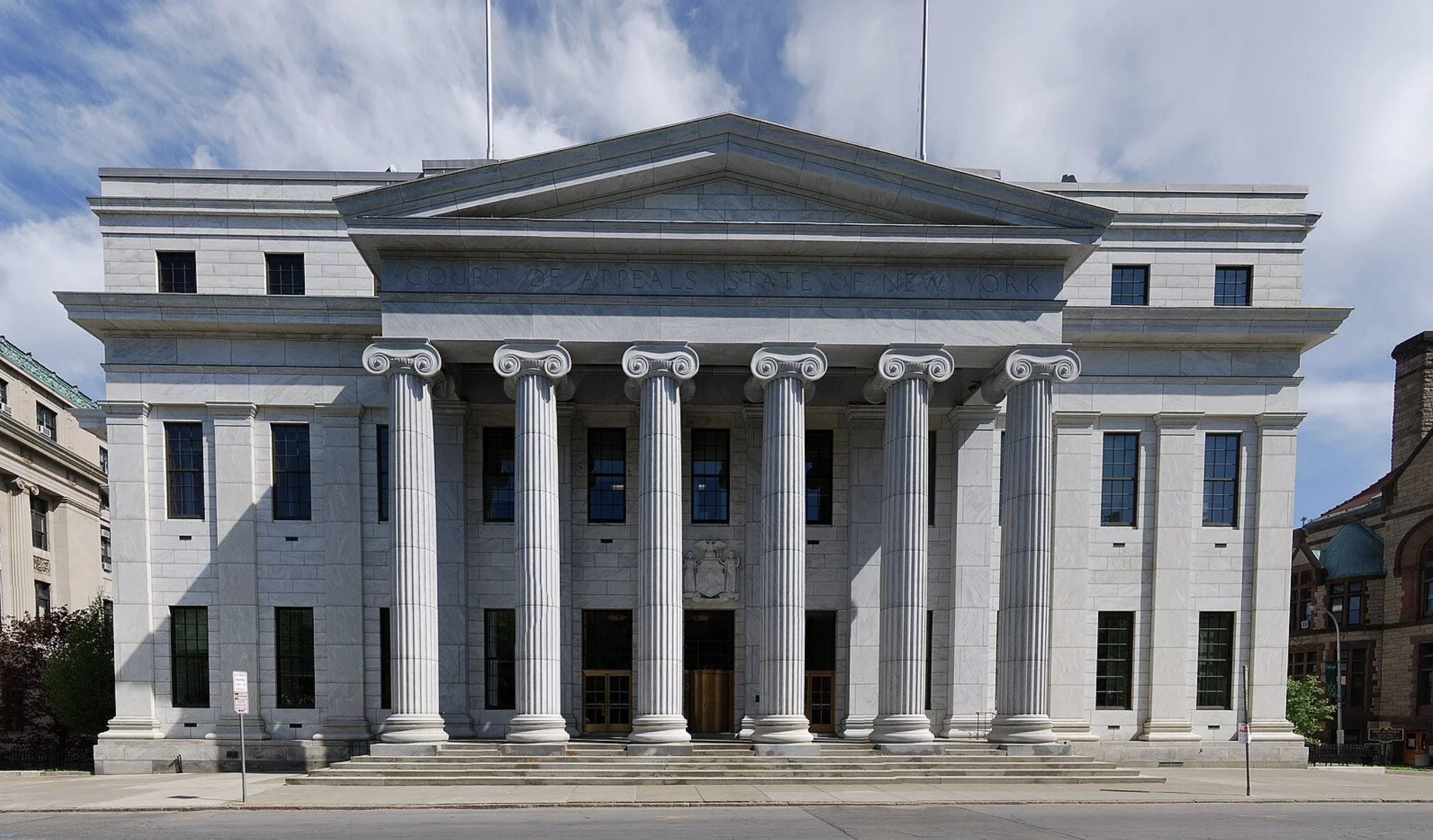
The New York Court of Appeals upheld the state’s mandatory retirement age rules for judges in a recent ruling. Photo by UpstateNYer via Wikimedia Commons
By Jacob Kaye
New York’s mandatory retirement age for judges will remain in place after the state’s top court rejected an argument from a trio of elderly justices who claimed that the retirement rules amounted to a form of discrimination.
The Court of Appeals upheld the requirement that judges retire at the age of 70 – or after being recertified to serve three times until they turn 76 – after three justices affected by the rule claimed that it fell under the category of age discrimination under New York’s recently enacted Equal Rights Amendment.
The state’s top judges rejected the argument in a unanimous ruling – Chief Judge Rowan Wilson and Associate Justice Madeline Singas recused themselves from the ruling.
Associate Justices Jenny Rivera, Michael Garcia, Anthony Cannataro and Caitlin Halligan, and Associate Justice Shirley Troutman, in a concurring opinion, said that Manhattan Supreme Court Justice Lyle Frank rightfully dismissed the lawsuit brought by Justices Robert J. Miller, 76, Richard J. Montelione, 70, and Orlando Marazzo, 75, in October 2025.
The suit was filed around a year after voters passed the ERA, which enshrined anti-discrimination protections to a multitude of categories, including age. Miller, Montelione and Marazzo claimed in their suit that the ERA applied to the mandatory retirement rule and that, as such, they should be allowed to serve regardless of their age.
The Court of Appeals judges said in their decision that they weren’t compelled by the justice’s argument that the ERA implicitly repealed the mandatory retirement age requirement, which has been a part of the state’s judiciary law for well over 200 years.
“Petitioners…maintain that because the ERA prohibits all age discrimination it thus must repeal the judicial retirement mandate,” the ruling read. “There is no evidence that the Legislature and the voters would have sought to accomplish such a dramatic change to the mandatory retirement provision merely by inference, and we see no indication that they intended to do so by adopting the ERA.”
“Given the longstanding constitutional age limitation on judicial service, the most natural and direct way to change course after two hundred years would be to amend outright [the state constitution],” the ruling continued. “Or, we would expect that if the ERA were intended to eliminate the age limitation, the ERA would unambiguously declare its repeal of [the mandatory retirement rule]. Instead, according to petitioners, we are to presume that the drafters and the voters obfuscated their intent to eliminate the specific, longstanding age limitation found in our state constitution by merely including ‘age’ within the ERA’s list of protected classifications.”
In her concurring opinion, Troutman said the majority did not go far enough in asserting the ERA’s standing as an enforceable law.
“The clear intent behind the ERA was to create new rights and to make the Civil Rights Clause self-executing against the government,” Troutman said in her decision. “The majority does the ERA a disservice by not pronouncing the enforceability of those rights and by concluding blithely that the ERA’s protection of age as a suspect classification does not conflict with a previously existing provision in our constitution mandating that certain judges and justices retire at age 70.”
The ruling puts an end to the Supreme Court justices' attempt to quash the mandatory retirement age, which has been a point of controversy for years.
In 2020, former Chief Judge Janet DiFiore decided not to recertify around 50 elderly justices looking to serve an additional two years on the bench. While the decision was later reversed, only a fraction of those judges who applied for recertification returned to the court. The move by the former chief judge prompted lawmakers to propose legislation that would have altered the criteria for recertification while keeping the mandatory retirement age in place. Though the bill was passed by lawmakers several times, it was vetoed by Governor Kathy Hochul each time.
Unlike the recertification issue, the lawsuit from Miller, Montelione and Marazzo sought to eliminate the mandatory retirement age altogether.
The rule has been on New York’s books since 1777.
In 1961, a provision was worked into the law allowing judges to serve until they turn 76 by applying for recertification at ages 70, 72 and 74.
An attempt was made in 2013 to raise the retirement age to 80, but the proposal was overwhelmingly rejected by voters.
The Court of Appeals cited that vote in its decision.
“The voters have reaffirmed that constitutional design — last amended in 1961 — that judges and justices shall not serve past the age of 70; in 2013, the voters rejected, by a wide margin, a proposed constitutional amendment to raise the retirement age for certain judges and justices to age 80,” the decision read. “Significantly, no ballot measure has ever sought to eliminate the age requirement.”