New York’s courts unveil new website
/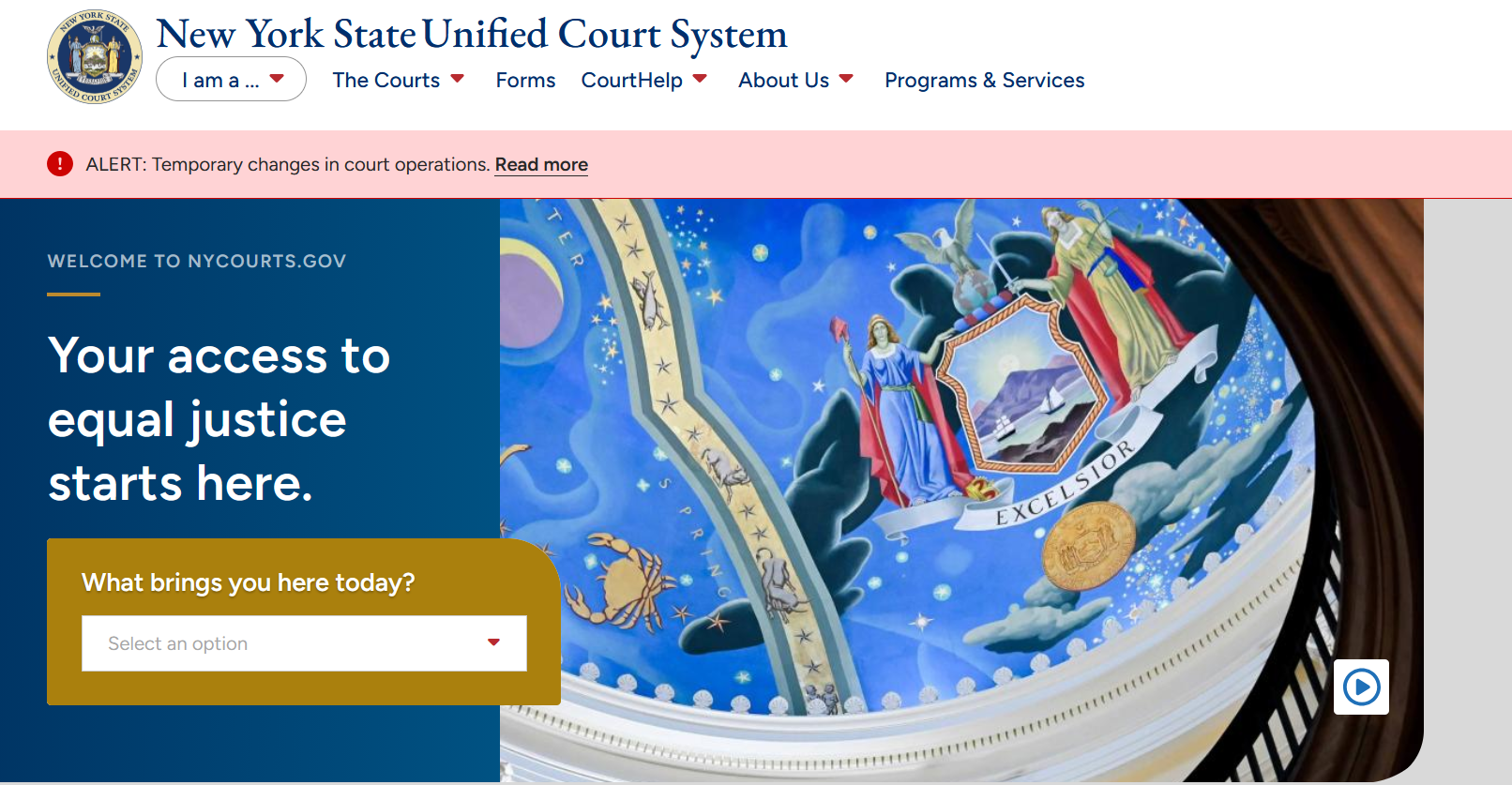
The home screen for the Unified Court System’s new website redesign.Screenshot via Unified Court System website
By Noah Powelson
After four years of research and development, the Unified Court System launched its new website that court leaders hope offer users a streamlined approach to accessing the courts.
Thousands of pages of UCS content were laboriously restructured and rolled out into the court system’s new website early Monday morning as part of UCS leadership’s ongoing effort to modernize the courts.
The new website includes a totally reimagined navigation structure, enhanced search functions, updated graphics and countless other updates.
The UCS website is used by thousands of people for a wide range of needs. Litigants often rely on the website to navigate their cases and find out their next steps, but it’s also regularly used by judges, attorneys, jurors, journalists and others.
One of the major new tools of the redesign is a guide for each type of court user on the front page of the website, which brings them to the most immediate and important information for their specific needs.
“This newly reimagined website represents a significant step forward in our mission to make the New York State Courts more accessible, transparent, and user-friendly,” Chief Administrative Judge Joseph Zayas said in a statement. “It is an easy-to-navigate resource for everyone — whether you are an attorney checking case schedules or accessing court rules, a litigant seeking information, a juror fulfilling your civic duty, or a student learning about the workings of our justice system.”
Phillip Yow, UCS’ website systems director, told the Eagle it took over four years of in-depth research, surveying, developing and review before the final redesign was ready for launch.
Yow said one of their biggest challenges and priorities was finding ways for court users to intuitively navigate their way through the courts’ thousands of webpages to find the information most pertinent to them. Users regularly said they had difficulty not just finding the pages they needed, but being able to find them again as they searched through mounds of disjointed webpages.
To address those problems, the new website includes a dropdown navigation tool leading users to the most common issue areas, and also incorporates many “breadcrumbs” that help users know what webpage they are on and how to navigate their way back.
"We want to make it easier to find what you’re looking for," Yow told the Eagle.
Yow also said refitting the website’s overall presentation was also a major focus, as previous feedback indicated the old website interface felt sterile and unwelcoming.
The new website, which includes various images of users and staff positively interacting within the courthouse, is meant to make users feel welcome and that the website is there to assist them. For many court users, where their day in court is likely one of the most difficult times in their lives, that presentation matters a lot.
"Users come here because they have to, not by choice," Yow said. "Even an image of a person in a courthouse smiling, a real photo not a stock image, can bring that anxiousness down one notch."
But work on improving the website still continues, and Yow said more updates can be expected in the coming weeks and months. The website’s court locator, for example, does not allow court users to find their relevant courthouses by entering their ZIP code. How said the issue would be resolved in the coming weeks.
Further down the line, Yow said they would also look into using artificial intelligence to improve on the website’s search functions.
"Today just marks deliverable one," Yow told the Eagle. "This is far from finished, and we will continue to add new features and enhance, hone, and polish current features."
To plan for future updates, the website also includes a user feedback portal that’s accessible on every page.
Court modernization has been top of mind for court leaders in recent years, dating back to COVID-19 pandemic, which exposed blind spots and inefficiencies in the state’s courthouses. To account for these issues, the Court Modernization Action Committee was formed in March of 2023 and has held regular stakeholder meetings to address the technology related problems.
Several major improvements have come since then, as have hundreds of millions of dollars in state investment to develop and implement new and updated technologies.
According to a report released by CMAC in 2025, 92 percent of the state’s 1,570 courtrooms have been upgraded with the latest audio systems, and one hundred courtrooms have also been updated to the latest hybrid standards in the last few years.
E-filing was also massively expanded during this time, and was critical to keep court operations afloat during the pandemic. The technology was previously limited, but a 2024 law gave the chief administrative judge extended authority to implement e-filing in all New York State trial courts and cases. Its use has skyrocketed across state courts since, and e-filing continues to remain in high demand even after the courts returned to in-person operations.
The website redesign on Monday was one of the largest modernization protects the courts have taken on in recent years.
“We are proud to unveil a platform that not only meets the needs of today but anticipates the demands of tomorrow,” First Deputy Chief Administrative Judge Norman St. George said in a statement. “This achievement reflects the dedication and expertise of countless individuals who worked tirelessly to bring this vision to life.”