New York’s top court decided cases more quickly last year, report says
/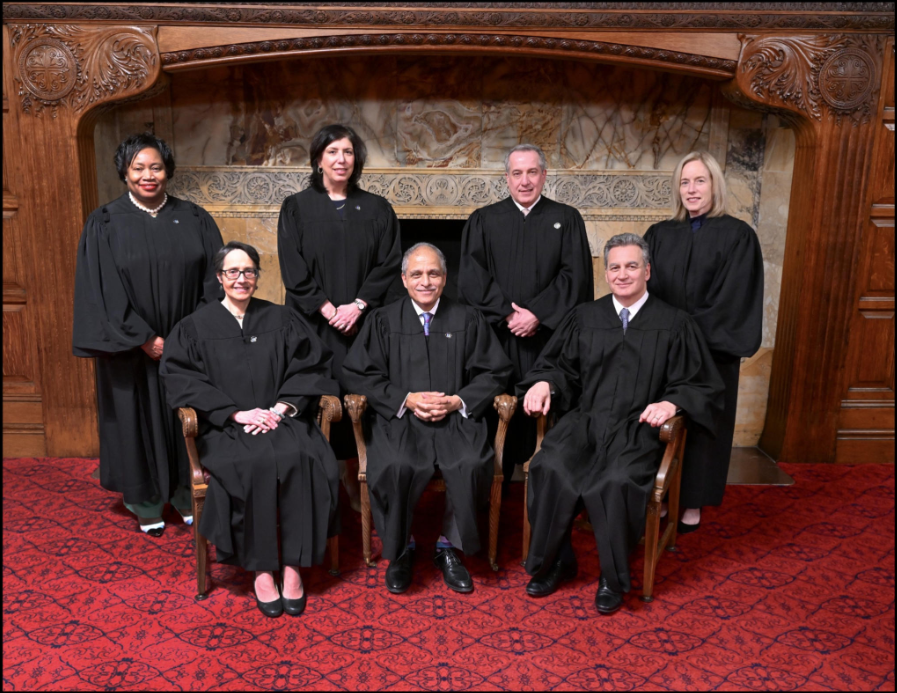
The New York Court of Appeals released its annual report in April, showing increases in court filings and the speed at which it processed cases compared to the previous year. Photo via Court of Appeals
By Noah Powelson
The state’s top court concluded cases at a faster rate in 2025, continuing a trend that has begun to emerge under Chief Judge Rowan Wilson, according to a new report.
The Court of Appeals recently released its 50th annual report, detailing the breadth of work the state’s highest court underwent for the past year.
While caseloads in the state’s top court remained roughly consistent with previous years in 2025, the clip at which the court decided cases increased.
In 2025, the court disposed of 2,232 matters, including 119 appeals, 817 motions, and 1,296 criminal leave applications. While the court disposed of a similar number of cases in 2024, when it decided on 2,082 matters, it saw a jump in the number of criminal leave applications, or requests for permission to appeal an appellate court ruling on a criminal case, it granted. In 2024, the court disposed of 1,139 criminal leave applications.
Despite the increase in work, the Court of Appeals made improvements to how fast it was able to process appeals and motions. For most matters, the court was able to bring cases to a conclusion a month or two faster than it had in 2024.
In 2025, it on average took approximately 12 months for the court to reach an oral argument after a notice of appeal or an order granting leave to appeal was filed, a two-month improvement compared to 2024 when it, on average, took 14 months.
The court also scheduled appeals for oral argument at a faster rate. The average period from readiness, where all papers were served and filed, to calendaring an appeal for oral argument was approximately 6 months, compared to 7 months in 2024.
Also in 2025, the average time from argument to disposition of a normal course appeal was 38 days. For all appeals, the average time from argument or submission to disposition was 36 days. These averages match the court’s rates for 2024.
“Despite the heavy workload, the Court has a stellar record of prompt disposition of appeals, and this year was no different,” Jenny Rivera, an associate justice of the Court of Appeals, said in the report. “We at the Court of Appeals strive to complete our judicial duties without fear or favor, obligated only to our oath of office to uphold the federal and New York Constitutions and the rule of law. We will continue to do so in the years ahead.”
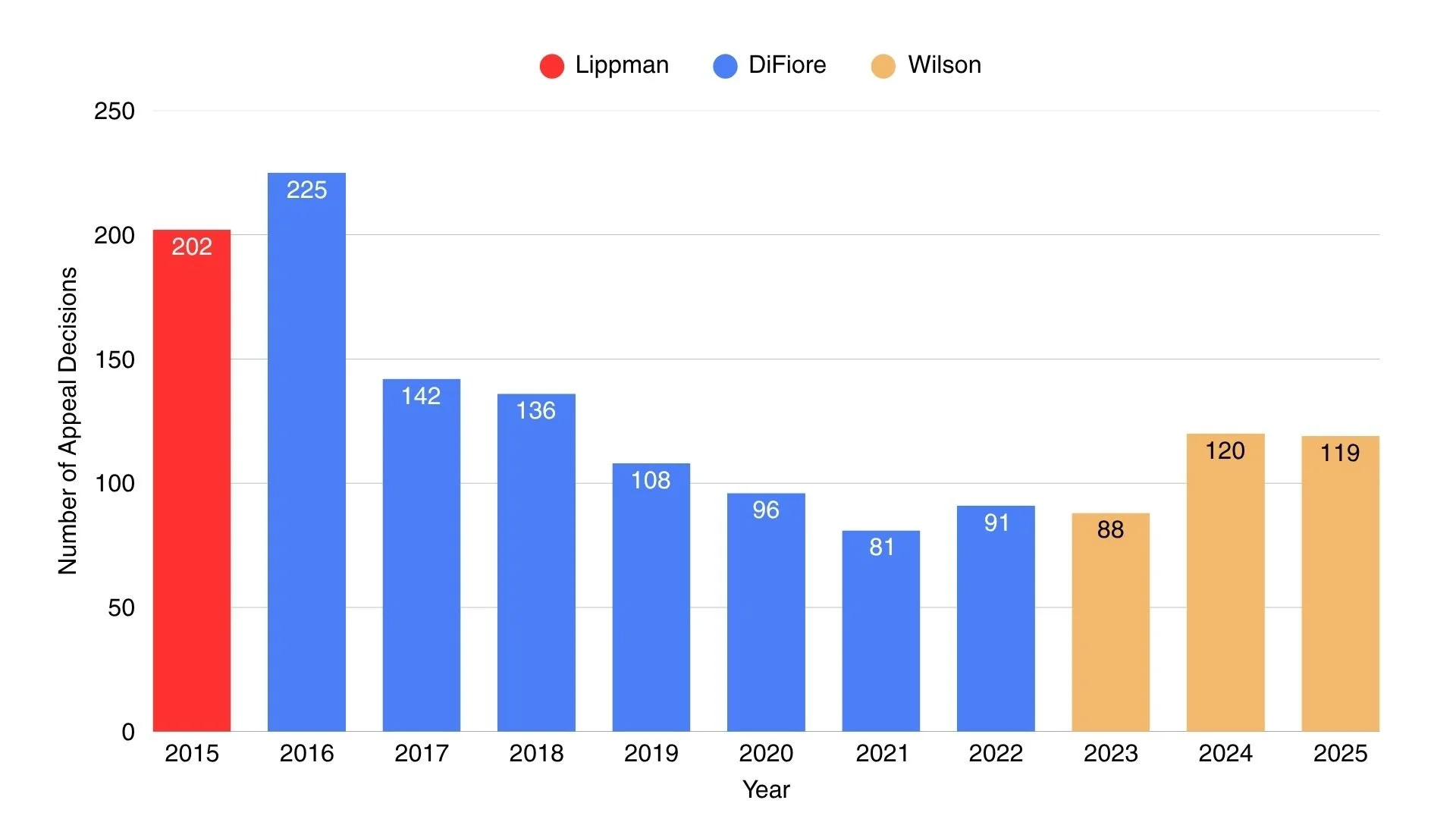
Data published by the Court of Appeals shows the number of appeals the court made decisions on dropped significantly while former Chief Judge Janet DiFiore ran the bench, but has slowly made gains under current Chief Judge Rowan Wilson. Data via Court of Appeals/Chart by Noah Powelson
An upward trend
While the improvement in processing decisions is significant, it reflects an ongoing upward trend of speedier decision and case processing since Chief Judge Rowan Wilson took over as the state’s top judge. The trend marks a departure from former Chief Judge Janet DiFiore’s term, where the overall number of appeals heard and decided dropped dramatically.
According to previous annual reports published by the Court of Appeals, when DiFiore first became chief judge in 2016, the court heard and decided on 225 appeals that year. The following year, in 2017, DiFiore’s court decided on 142 appeals.
By the end of her term in 2021, the Court of Appeals only decided on 81 appeals.
In the years since under Wilson, the Court of Appeals has been making more decisions at a faster rate, but still has fallen short of previous record highs.
In 2023, the year Wilson first became chief judge after the governor and Senate Democrats had a tumultuous battle over who should lead the state’s courts, the Court of Appeals made visible progress to bring up appeal decision numbers.
His first year at the head of the bench, Wilson’s court made 88 appeals decisions. The following year, in 2024, the court decided on 120 appeals. In 2025 that number remained roughly the same with 119 appeal decisions.
While the current Court of Appeals is making visible progress bringing cases to a conclusion, they are still far away from processing the same number of appeals as previous benches. Courts led by former Chief Judges Judith Kaye and Jonathan Lippman regularly decided on over 150 appeals every year. Some years, their courts decided over 259 cases.